
OpenAI Upgrades GPT-Rosalind With GPT-5.5 Agentic Capabilities for Life Sciences
Serge Bulaev
OpenAI has upgraded GPT-Rosalind for life sciences by adding GPT-5.5 agentic capabilities, which may help the model not only reason with text but also perform small coding tasks and use scientific tools. The new features include writing and running short scripts, searching databases, and improving accuracy in areas like medicinal chemistry and wet-lab troubleshooting. Early tests suggest the system might help with tasks such as finding new drug targets, planning experiments, and interpreting data, but labs still need to review all code and results for safety and accuracy. There is not yet independent data comparing GPT-Rosalind to similar tools, and experts suggest careful oversight and validation are still required. Overall, the updated GPT-Rosalind appears to work as a helpful assistant under human supervision.

The recent OpenAI upgrade to GPT-Rosalind with GPT-5.5 agentic capabilities significantly expands the model's functionality beyond text reasoning, enabling it to orchestrate scientific tools and execute code. This enhancement is crucial for a model specialized in life sciences - including molecules, proteins, and disease biology - as the new agentic layer can perform coding tasks that have historically bottlenecked discovery.
OpenAI presents the updated system as a collaborative partner for researchers, capable of suggesting experiments, writing Python scripts for analysis, interacting with cheminformatics APIs, and summarizing findings - all while under strict human supervision.
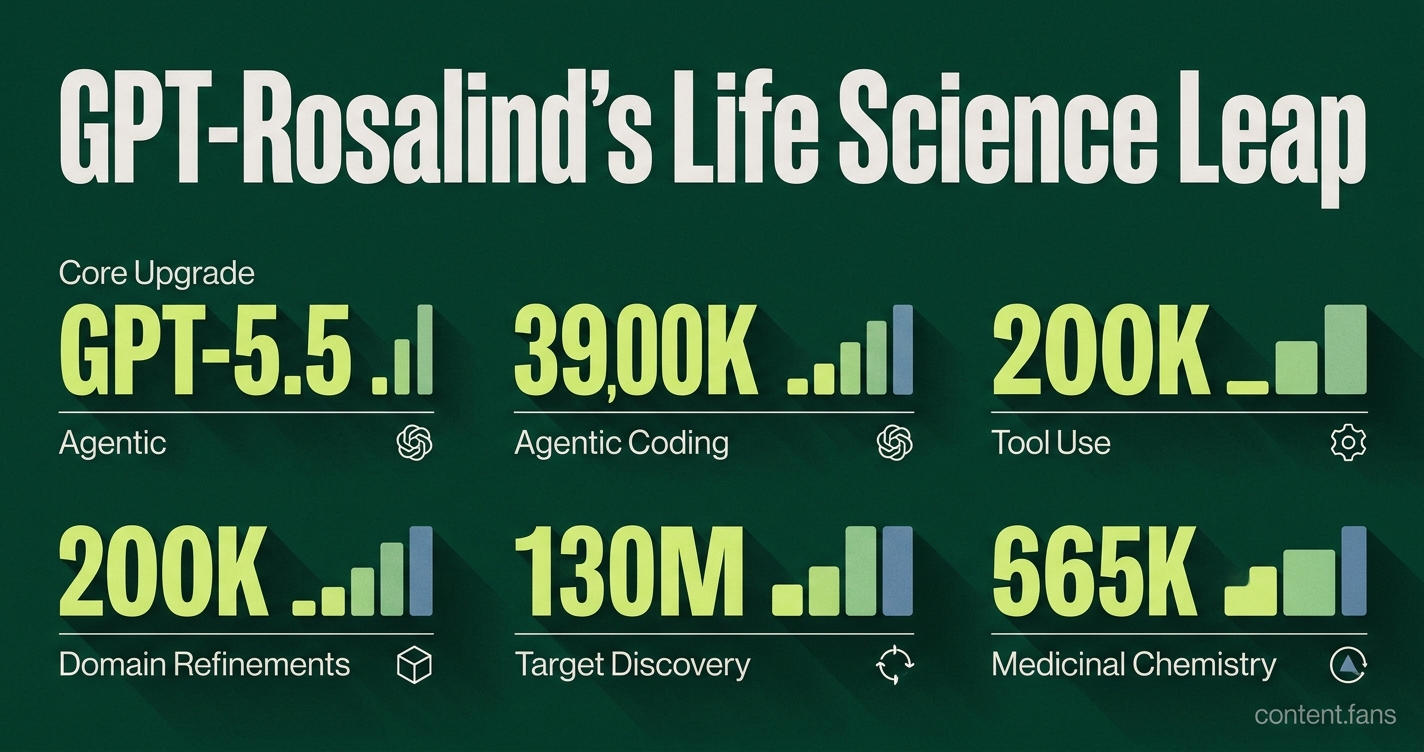
What GPT-5.5 adds to GPT-Rosalind
The upgrade equips GPT-Rosalind with agentic capabilities to autonomously write and execute code, use external tools like scientific databases, and perform structured searches. It also includes domain-specific refinements that improve reasoning accuracy in medicinal chemistry, quantitative biology, and experimental troubleshooting, all under user supervision.
OpenAI highlights three principal enhancements:
- Agentic coding: Autonomous generation, execution, and debugging of user-approved scripts.
- Tool use: Structured calls to databases and lab software for literature searches, protein modeling, and data retrieval.
- Domain refinements: Enhanced accuracy in medicinal chemistry, quantitative biology, and wet-lab troubleshooting.
According to OpenAI's release notes, the model demonstrates its strongest reasoning on multi-step prompts involving molecular or genomic entities. Industry reports also noted improved performance on quantitative biology benchmarks, although specific metrics were not provided.
Early lab applications
OpenAI provided a research preview to select pharmaceutical and biotech teams. According to Quartz, these groups utilized the system for evidence synthesis and hypothesis generation. TechTimes reported that other labs applied it to pathway analysis and genome interpretation.
Press accounts indicate four primary workflows are emerging from these pilot programs:
- Target discovery - Researchers task the model with identifying under-studied protein-disease connections and proposing validation assays.
- Medicinal chemistry - The agent generates code to rank compound analogues by predicted binding affinity using public docking libraries.
- Experimental planning - The system drafts detailed wet-lab protocols that align with available lab reagents and instrumentation.
- Data interpretation - It integrates raw omics data with relevant literature to produce structured result summaries.
Scientists involved in the preview emphasize that compliance reviews and assay-specific validation remain critical. While the agent can draft and run code, labs must still review every line before deployment for safety and accuracy.
Context in the wider agentic AI trend
The NTI AIxBio Horizon Scan notes that agentic coding tools such as OpenAI Codex and Claude Code have "increased the accessibility of computational biology workflows." Furthermore, industry reports suggest that agentic AI could impact a significant portion of pharma and medtech workflows, stressing that strong governance and auditability are essential prerequisites.
This trend is echoed by competitors. AWS marketing material, cited in industry blogs, promotes starter agents for target identification, biomarker discovery, and clinical protocol drafting. This suggests OpenAI's upgrade is part of a broader industry shift toward bounded agents operating in secure sandboxes, rather than fully autonomous systems.
Competitive landscape
As GPT-Rosalind gains tool-use capabilities, its competitors are also advancing. Anthropic's latest report describes production-grade agent frameworks, and various cloud vendors now offer domain-specific agents with integrated compliance checks. The industry is moving toward orchestration layers that connect models, APIs, and lab hardware, with market differentiation depending on validation data and enterprise-grade controls.
Currently, no independent benchmarks compare GPT-Rosalind against these alternatives, so assessments rely on vendor claims and limited preview feedback. Labs evaluating the upgrade must weigh potential efficiency gains against the necessary overhead of auditing code and integrating the tool into regulated environments.
At this stage, the agentic GPT-Rosalind is positioned as a powerful, supervised assistant. It can significantly reduce computational and documentation workloads, empowering scientists to focus on core experimental decisions and strategy.
What new capabilities did GPT-Rosalind receive in the recent update?
Agentic coding and tool-use functions from GPT-5.5 were fully integrated alongside sharper medicinal-chemistry and genomics reasoning. The model can now author, run, and debug its own code, query public and private biological databases, and orchestrate multiple third-party lab tools in a single workflow. OpenAI's announcement states these upgrades directly accelerate target discovery, pathway analysis, wet-lab troubleshooting, and quantitative-biology tasks.
How does the upgrade impact day-to-day drug-discovery work?
Researchers can hand the model a high-level goal - for example, "find novel DDR1 inhibitors with oral bioavailability" - and GPT-Rosalind will synthesize literature, generate and test in-silico molecules, design follow-up assays, and output an actionable experimental plan. Reuters notes this collapses weeks of manual literature review and preliminary design into hours of agent-driven iteration, freeing chemists to focus on bench validation.
Is GPT-Rosalind now fully autonomous in the lab?
No. Industry reports that praise its coding reliability also stress the broader industry pattern of "bounded agents under human supervision". The system can propose and execute code, but final protocol approval, safety review, and physical handling remain researcher responsibilities, ensuring compliance and safety.
Who is getting access and under what terms?
Eligibility has expanded to enterprise life-science teams worldwide, moving beyond the initial research-preview cohort. Access is still gated: organizations must meet OpenAI's Bio-Use compliance checklist and sign enhanced data-protection agreements. Early adopters already named in trade coverage include teams at Amgen, Moderna, and Novo Nordisk.
How does GPT-Rosalind compare with competing life-science AI platforms?
While general frontier models like Anthropic's Claude or Google's Gemini Med offer strong coding skills, GPT-Rosalind is narrow-tuned for molecules, proteins, genes, pathways, and disease biology. OpenAI benchmarks claim higher accuracy on multi-step reasoning tasks that blend wet-lab constraints with computational chemistry - a gap that general coding agents have not yet closed.