
OpenAI unveils GPT-Rosalind for life sciences research by 2026
Serge Bulaev
OpenAI has announced GPT-Rosalind, an AI model that may help organize scattered scientific data into clear research processes in life sciences. The model is expected to launch a preview for select users in April 2026, focusing on biochemistry, drug development, and genomics. Early access will likely be limited to trusted organizations, and the model aims to address issues like merging different data types, suggesting experiments, and tracking the source of recommendations. Experts suggest that real-world success will depend on how well the tool fits into strict data rules and how reliably it works with lab data, not just on its benchmark test scores. There are signs from other AI projects that such tools might speed up research, but some challenges with data quality and rules remain.

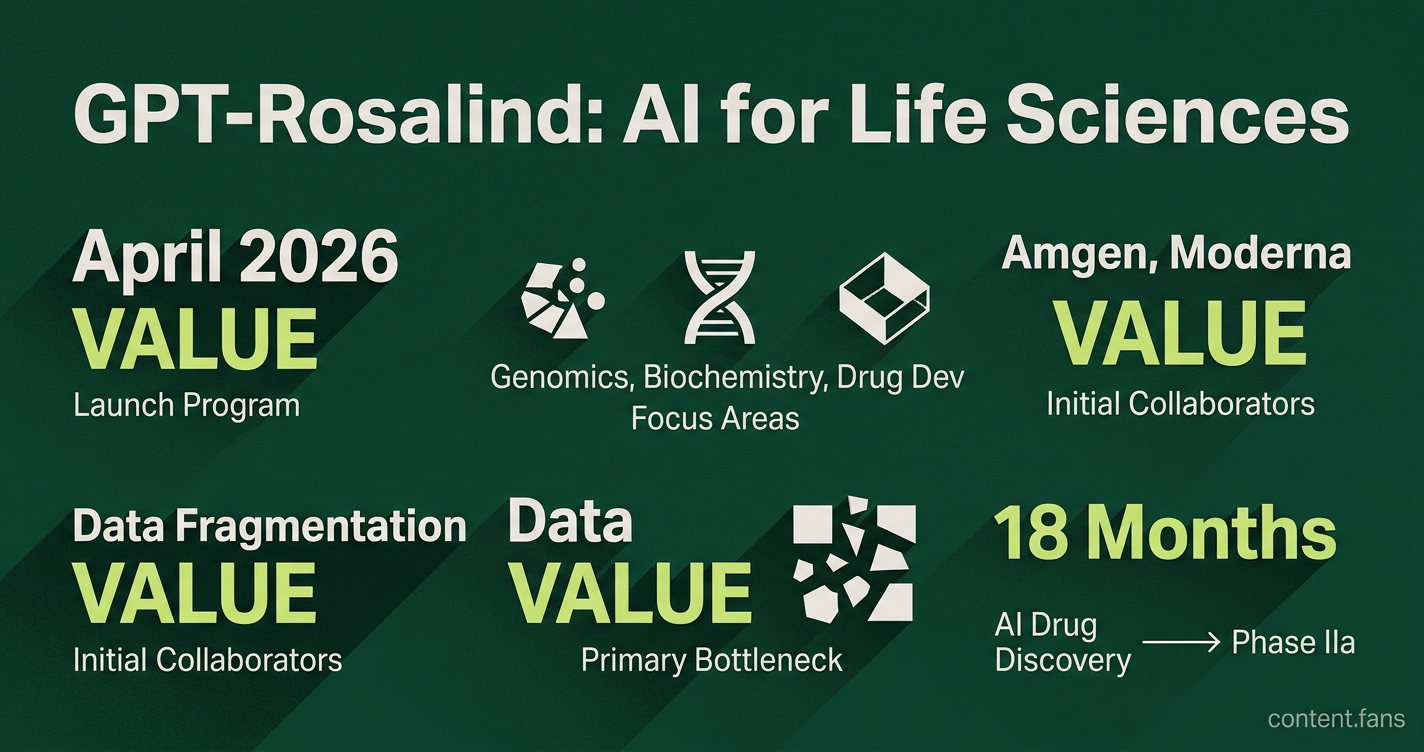
OpenAI's GPT-Rosalind for life sciences research promises to organize scattered scientific data into coherent workflows, tackling one of the industry's biggest hurdles. A research-preview program for qualified users opened in April 2026, focusing on genomics, biochemistry, and drug development, according to a Reuters report.
The model is positioned as an advanced orchestration layer designed to significantly reduce data preparation time, allowing scientists to focus more on analysis and experimentation.
What OpenAI Says the Model Will Do
GPT-Rosalind is a specialized AI from OpenAI designed to streamline life sciences research. It organizes complex scientific data, suggests experimental steps, and integrates with lab systems. The model aims to accelerate discovery in fields like genomics and drug development by automating data-heavy preparation and analysis tasks.
Access to the preview is restricted through a trusted-access framework, with initial collaborators including enterprise-grade organizations like Amgen and Moderna. This phased approach prioritizes controlled validation over immediate widespread public availability.
Why Data Fragmentation Dominates Lab Work
Data fragmentation remains the primary non-biological bottleneck in life sciences, according to industry experts. An Ontoforce trend brief highlights that without shared data semantics, research insights are difficult to connect and trust, prompting firms to invest in semantic layers that bridge structured and unstructured data. Similarly, the Pistoia Alliance emphasizes that multi-agent systems need live knowledge, ontologies/grounding, logging, rollback, and human oversight.
To address these issues, GPT-Rosalind is engineered to tackle several key pain points:
- Merging heterogeneous formats such as assay tables, lab notebooks, and clinical notes
- Surfacing relevant literature snippets alongside proprietary measurements
- Suggesting next-step experiments directly inside lab automation systems
- Tracking provenance so researchers can audit every recommendation
Insights from Adjacent AI Use Cases
Adjacent AI applications offer clues to GPT-Rosalind's potential impact. For example, Insilico Medicine used AI to advance a drug candidate from discovery to Phase IIa trials in under 18 months. While a Nature review notes such automation can significantly compress preclinical timelines, successful translation to marketed drugs remains uncommon.
The merger of Recursion and Exscientia signals strong market demand for integrated, end-to-end AI platforms. However, analysts caution that many AI pilots fail due to inadequate data governance and readiness. This suggests GPT-Rosalind's success will hinge not just on its AI capabilities, but on its seamless integration into regulated data pipelines.
Benchmarks vs. Real-World Reliability
While OpenAI reports strong performance on benchmarks like BixBench and LABBench2, external experts caution that these scores don't guarantee real-world reliability. Industry outlooks from Snowflake and Dataiku emphasize that building a solid data foundation and ensuring an auditable chain of thought for every AI decision are critical in regulated environments.
These external perspectives underscore the logic behind OpenAI's restricted preview. By testing in a controlled setting, the company can identify and address reproducibility and governance gaps before a wider launch. Therefore, the scientific community will be evaluating GPT-Rosalind on its ability to ground outputs in verifiable data and operate within strict regulatory frameworks, not just its language proficiency.
What exactly is GPT-Rosalind and when will it be available?
GPT-Rosalind is OpenAI's life sciences research model unveiled on April 16, 2026, for qualified customers in a research preview.
It is currently offered as a research preview inside ChatGPT, Codex and the OpenAI API, but access is restricted to qualified customers through OpenAI's trusted-access program.
If your organization is already on OpenAI's enterprise tier, you can request entry; otherwise you will be wait-listed.
Which real-world tasks is the model designed to accelerate?
OpenAI lists five priority areas: biochemistry, drug discovery, genomics, translational medicine and full scientific research workflows.
In practice, users can ask GPT-Rosalind to synthesize evidence from the latest papers, generate testable hypotheses, plan multi-step experiments and automatically pull data from more than 50 connected scientific tools and databases.
Early partners such as Amgen, Moderna and Thermo Fisher are wiring the model into their internal LIMS and ELN stacks to cut routine literature-to-experiment cycles from weeks to hours.
How good is it on domain benchmarks?
On BixBench - a public life-sciences reasoning suite - GPT-Rosalind posted the highest published score to date.
It also beat GPT-5.4 on 6 of 11 tasks in LABBench2, with the largest jump in CloningQA, a task that requires end-to-end design of DNA and enzyme reagents for molecular cloning.
These numbers matter because they are the first third-party evidence that a general LLM can outperform narrower, fine-tuned bio-models.
What are the biggest integration hurdles companies should expect?
The model only delivers value when it can see your proprietary data; that means solving three problems before Day 1:
1. Data harmonization - lab results, omics tables and clinical notes must share a common schema.
2. Governance - every query and generated protocol needs an auditable chain-of-thought to satisfy regulatory reviewers.
3. Human oversight - early adopters report the best outcomes when a scientist-in-the-loop signs off on every AI-planned experiment.
Does the launch signal that AI will replace biologists?
OpenAI itself presents GPT-Rosalind as a life sciences research preview model.
Current case studies show AI compresses pre-clinical timelines from years to months - for example, Insilico's AI-generated fibrosis drug moved from target to Phase IIa in 30 months - but experimental validation and clinical translation still require human expertise.
In short, GPT-Rosalind is framed as an acceleration layer, not a replacement for scientific judgment.