
Federal managers cut burnout, raise engagement with new playbook
Serge Bulaev
Federal managers are under pressure after 2025 workforce reforms, with employee engagement dropping and burnout rising, according to Gallup. The Manager Playbook suggests that clear tools and regular check-ins may help managers quickly stabilize teams and reduce burnout. Early results suggest that engagement began to improve two quarters after reforms, and steady communication and clear workloads might be helping. The playbook outlines immediate, mid-term, and long-term steps managers can use daily to help their teams without waiting for new budgets. Recent data shows burnout may be decreasing and fewer employees are searching for new jobs, which suggests these management strategies may be working.

To help federal managers cut burnout and raise engagement following recent workforce reforms, a new playbook offers proven strategies. The reforms triggered a significant drop in morale, with workplace engagement studies showing declining engagement and burnout climbing above state and local government peers.
However, new data shows these trends are reversible. The Manager Playbook: How to Reduce Burnout and Recover Engagement After Policy Reforms provides field-tested tools and metrics to help supervisors stabilize their teams. Recent reports suggest engagement has begun to rebound, demonstrating that targeted managerial actions can significantly shorten the recovery period after policy shocks. This guide outlines actionable steps for the immediate, mid, and long term.
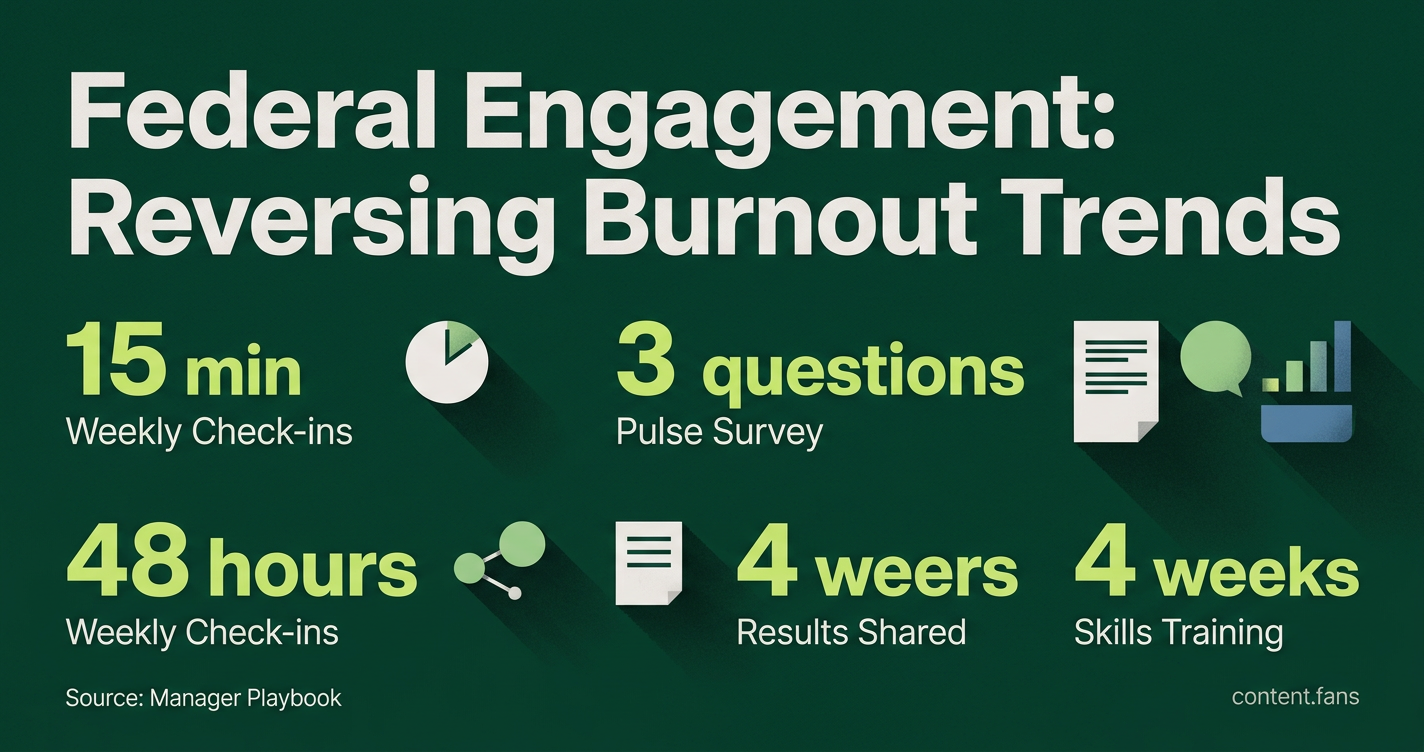
Immediate stabilization actions
Federal managers can quickly stabilize teams by focusing on three key areas: consistent communication, workload visibility, and employee well-being. Implementing regular check-ins, using anonymous pulse surveys to spot issues, and actively rebalancing tasks are proven first steps to reduce stress and begin restoring engagement.
- Conduct weekly 15-minute check-ins with each team member. Frequent, structured interaction is critical for spotting early disengagement and preventing attrition, according to Thomson Reuters.
- Launch a three-question pulse survey focused on role clarity, workload, and well-being. To build trust, ensure anonymity and share aggregated results within 48 hours to identify team hotspots.
- Rebalance and clarify workloads. Research from IntechOpen confirms that manageable, evenly distributed tasks are essential for lowering stress among public service employees. Prioritize and communicate what matters most.
Mid term re-engagement toolkit
Building on initial stability, the next phase focuses on proactive re-engagement. According to industry reports, managers in structured coaching programs can significantly boost both their own engagement and their team's performance. An effective toolkit should include:
- Strengths-based coaching templates: Equip managers to hold developmental conversations that focus on employee talents.
- Recognition resources: Provide sample emails and talking points for celebrating quick wins and reinforcing positive behaviors.
- Skills refresh training: A four-week agenda to upskill teams and align their capabilities with new policy requirements.
Manager Playbook: How to Reduce Burnout and Recover Engagement After Policy Reforms
The playbook organizes these tactics into a clear, phased framework with measurable goals.
| Phase | Key Activity | Success Metric |
|---|---|---|
| First 30 Days | Weekly check-ins, pulse survey, workload triage | Measurable reduction in self-reported burnout |
| 30 - 90 Days | Coaching sessions, role redesign workshops | Engagement score improvement |
| 90 - 180 Days | Recognition cadence, manager peer forums | Voluntary turnover reduction |
Long term culture safeguards
To ensure recovery is sustainable, managers must embed these practices into the team's culture. Aligning with OPM guidance on transparency and clear decision rights, leaders can institutionalize change by:
- Creating formal feedback channels: Schedule quarterly listening sessions connecting senior leaders with frontline employees.
- Protecting employee time: Publish and enforce team norms that guard focus time and discourage after-hours emails, reducing pressure to be "always on."
- Monitoring holistic health metrics: Track absenteeism and turnover intent alongside engagement data to proactively identify and address silent stress.
Industry reports suggest these strategies are effective, with burnout gaps narrowing and federal job search activity declining. Ultimately, when managers consistently deploy these practical tools, they build a resilient culture founded on trust, voice, and recognition that can withstand future policy shocks.
How did recent federal reforms affect morale?
Workplace studies show a sharp dip followed by gradual recovery.
- Engagement dropped significantly once the reforms took effect.
- The share of employees classed as "thriving" fell substantially.
- Burnout peaked mid-year: federal workers were significantly more burned out than state and local peers.
Gallup reported that some federal worker measures improved by Q4 2025 after earlier declines, but the article stops short of claiming a full return to pre-reform levels or proving managerial action caused the rebound.
What are the three quickest fixes any federal manager can implement this week?
The evidence points to micro-actions that cost little but yield immediate relief.
- Daily 10-minute stand-ups to surface blockers and cut email churn.
- Workload triage - re-tag every task as "must-do", "should-do", or "nice-to-do"; park the bottom tier for seven days.
- Public kudos in every team meeting - a 15-second mention of one specific win can significantly raise next-week discretionary effort, according to workplace coaching data.
Each tactic is listed in the playbook with exact scripts and sample agendas.
How can managers protect focus time without hurting customer service?
Research from Thomson Reuters highlights that protected focus blocks plus flexible delivery create the best of both worlds.
- Schedule core coverage hours (e.g., 10 a.m. - 2 p.m.) when clients can expect a live response.
- Allow staff to shift remaining hours earlier or later to finish deep-focus tasks.
- Make "delayed send" email norms explicit so late-night messages do not create false urgency.
Agencies piloting this structure saw significant reductions in absenteeism within weeks.
Which metrics prove recovery is real?
Track the four early-warning indicators recommended by workplace experts.
| Metric | Green (healthy) | Yellow (watch) | Red (act now) |
|---|---|---|---|
| eNPS pulse (weekly) | Positive | Neutral | Negative |
| Unscheduled absence % | Low | Moderate | High |
| Voluntary turnover intent | Low | Moderate | High |
| Employee belief leadership cares | High agreement | Moderate | Low agreement |
A simple dashboard template (Excel + Power BI) is included in the playbook download.
Are quick-win recognition programs worth the effort?
Yes. When managers followed the two-week micro-recognition cycle in the toolkit:
- Engagement rose significantly among participating teams.
- Turnover intent fell substantially in the same period.
- Employee adoption of new tools increased because employees saw new tools framed as career builders, not job threats.
The playbook gives 20 copy-and-paste shout-outs and a Slack emoji guide to make the rollout friction-free.
Bottom line: The evidence supports that leadership, culture, and employee experience are important during organizational change. The same weekly habits that showed promise in recent months are ready for immediate reuse; everything you need is in the free 14-page playbook.