
OpenAI Launches $4B Deployment Company, Acquires Tomoro to Scale Enterprise AI
Serge Bulaev
OpenAI has launched a new company called the OpenAI Deployment Company, backed by over $4 billion and supported by 19 private-equity and consulting partners. The move may be a response to competitors and aims to help big companies use AI at a larger scale by placing experienced engineers inside their organizations. OpenAI acquired Tomoro, bringing 150 more engineers and more connections to clients. This new approach focuses on hands-on support rather than self-serve tools and may suggest that OpenAI believes talent shortages are a main reason AI projects stall. There appears to be strong competition in this field, with Anthropic and Google also making moves to win enterprise customers.

OpenAI has launched its new $4B Deployment Company, a strategic initiative designed to embed seasoned AI engineers directly within large customer organizations. This move, backed by over $4 billion and multiple partners, aims to convert AI pilots into production-scale systems and counter early wins by rivals, as reported by Reuters. The company is betting billions that expert execution, rather than just model features, will determine the next phase of enterprise AI adoption.
Inside the $4B Blueprint: OpenAI Launches $4B 'Deployment Company' and Partner Network to Reclaim Enterprise Ground
The OpenAI Deployment Company is a new subsidiary created to help large enterprises move AI projects from pilot to production. Backed by over $4 billion, it provides hands-on support by embedding skilled AI engineers and deployment specialists directly into customer teams to overcome common adoption hurdles.
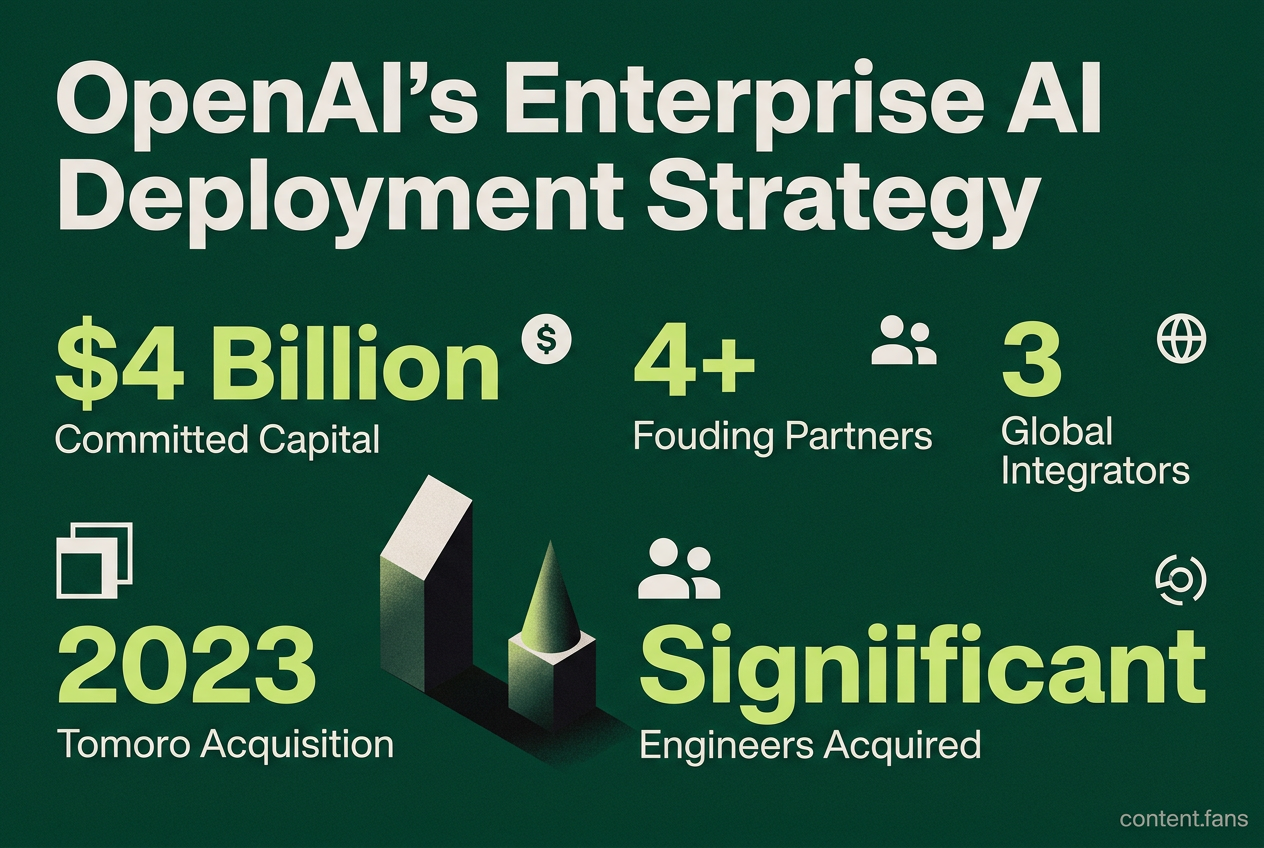
The venture's multi-layered capital stack is led by TPG, with Advent International, Bain Capital, and Brookfield Asset Management participating as co-lead founding partners, reports TechWyse. Key consulting firms including Bain & Company, Capgemini, and McKinsey & Company have joined as preferred integrators, providing direct access to thousands of enterprise clients.
Key figures highlight the initiative's significant scale:
- $4 billion in committed capital
- Multiple investment and consulting partners
- A significant number of experienced engineers via the Tomoro acquisition
- Thousands of portfolio companies reachable through sponsor networks
- Three global integrators already trained on OpenAI deployment playbooks
The simultaneous acquisition of Tomoro, an applied AI firm founded in 2023, adds a substantial team of experienced engineers to the company. Tomoro brings a global presence and established clients like Virgin Atlantic and Supercell. As noted by The Next Web, a shared history between Tomoro's founders and OpenAI's commercial team is expected to streamline cultural integration.
Embedded Engineers, Not Self-Serve Portals
The new unit shifts focus from self-serve portals to a hands-on service model, embedding "Forward Deployed Engineers" within customer organizations. These specialists will manage critical areas like data governance, prompt security, and multi-team coordination - common roadblocks that stall AI pilots. This strategy indicates OpenAI believes a persistent talent shortage, not technology, is the primary obstacle to widespread AI adoption, a concern echoed in industry surveys.
Competitive Pressure Tightens
The competitive landscape is heating up, with rival Anthropic announcing a similar enterprise venture with Blackstone shortly after OpenAI's news. With current market share estimates placing Anthropic, OpenAI, and Google in a tight race for dominance in foundation models, the focus is shifting. Competitors are also highlighting unique strengths, such as Google Gemini's compliance features on GCP and Microsoft's deep integration with Azure.
What Codex Brings to the Table
OpenAI's Codex model remains a core part of its enterprise strategy, with usage significantly higher among leading-edge firms according to industry reports. Recent updates to Codex have expanded its capabilities with scheduled automations, an in-app browser, and over 90 new plugins, broadening its application from code maintenance to sales forecasting and beyond. These enhancements aim to deliver measurable business outcomes, such as the faster decision-making cycles reported by users.
Ultimately, the market is evaluating AI providers on their ability to turn proofs of concept into reliable, scalable workflows. With its new Deployment Company, OpenAI is making a significant bet that combining embedded human expertise with powerful tooling and extensive partner networks is the key to winning the enterprise AI race.