
OpenAI unveils GPT-Rosalind for life sciences data challenges
Serge Bulaev
OpenAI has introduced GPT-Rosalind, a new language model designed to help with life sciences data, which may make it easier for researchers to organize complex biology information. The tool is available to certain enterprise users and aims to speed up work by reasoning across scientific papers and data in one place. Early reports suggest the model's main strength is helping scientists quickly review and test research ideas, rather than fully automating tasks. Experts note that GPT-Rosalind's success might depend on how well it fits into current data systems and rules, and there are ongoing questions about its effects on research quality and bias.

OpenAI is tackling complex life sciences data challenges with GPT-Rosalind, a new biology-focused language model designed to streamline research. According to an April 16 2026 announcement, the platform aims to unify scattered literature and experimental data into a single, coherent workflow. GPT-Rosalind helps researchers compress the time-consuming process of harmonizing genomics, proteomics, and clinical records by enabling analysis across multiple sources within one interface.
How GPT-Rosalind Accelerates Biological Research
GPT-Rosalind functions as a specialized AI copilot for biological research, integrating scientific literature, structured data, and external analysis tools. The model is fine-tuned to understand complex scientific vocabulary and perform multi-step tasks, enabling researchers to rapidly generate and validate hypotheses within a unified conversational interface.
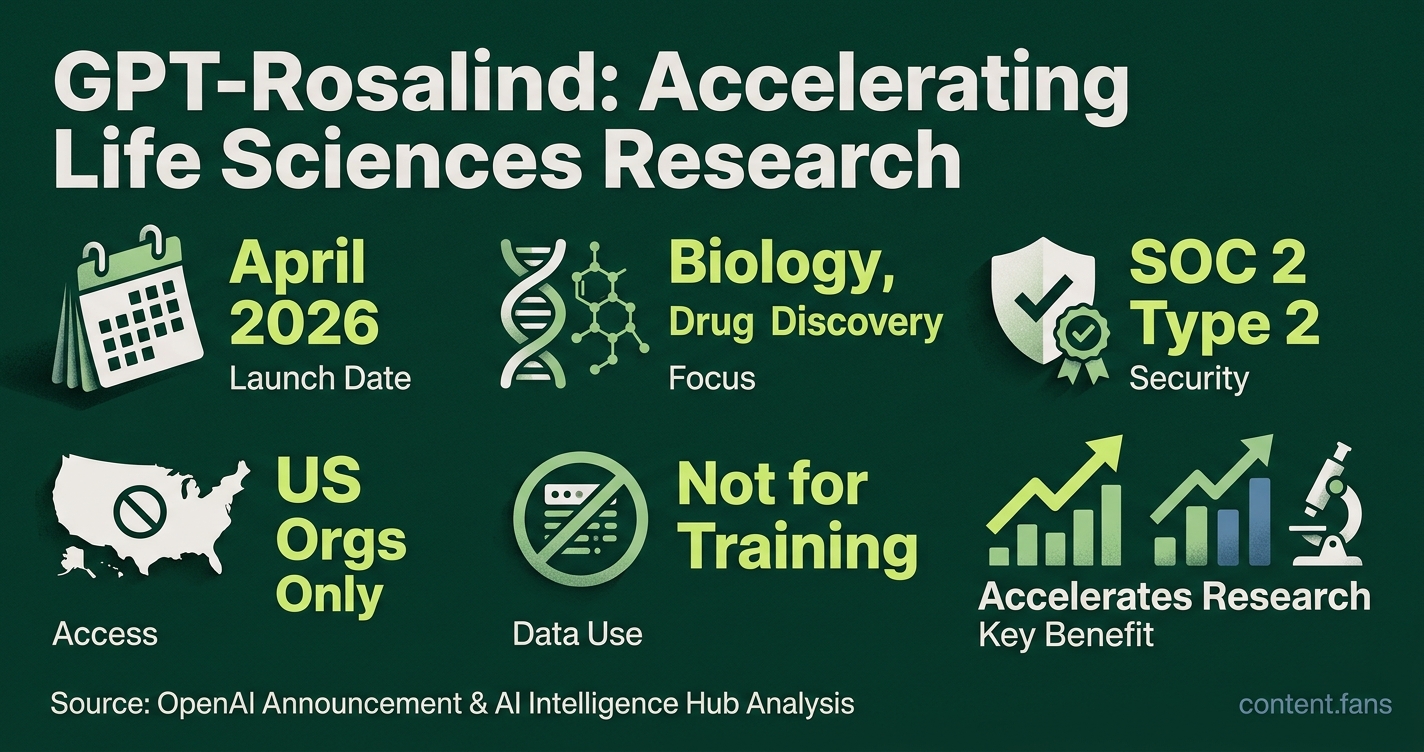
Named in honor of pioneering scientist Rosalind Franklin, the model is described by OpenAI as a "frontier AI model specifically designed for biology, drug discovery and translational medicine." Backed by enterprise-grade security controls like SOC 2 Type 2 alignment, the system emphasizes throughput over full automation. According to an AI Intelligence Hub analysis, its key strength is accelerating the research cycle. Labs can generate target candidates, receive ranked rationales, and test ideas against existing literature, shortening the path from initial scan to wet-lab design.
Key Capabilities in Research Preview
- Target discovery and validation
- Pathway analysis
- Genomics interpretation
- Hypothesis generation with confidence scoring
- Evidence synthesis across recent publications
Access and Compliance Framework
The model is available in a research preview via ChatGPT Enterprise, Codex, and the API. Currently, access is limited to U.S.-based organizations with established biological research operations that meet OpenAI's safety criteria; individual researchers are not yet eligible. To address proprietary data concerns, OpenAI confirms that customer data is not used for model training.
Role in the Broader Life Sciences Data Ecosystem
GPT-Rosalind enters a landscape focused on fusing multimodal data. It acts as an orchestration layer, leveraging existing tools rather than replacing them as a data warehouse. This approach complements platforms described in a 2026 Nature paper that integrate transcriptomics and clinical data for patient stratification. Early enterprise partners, including Amgen, Moderna, and Thermo Fisher Scientific, are exploring use cases like rapid literature triage and iterative pathway mapping. Ultimately, its success will depend on seamless integration with existing regulated data pipelines and governance frameworks.
Key questions surrounding the platform's adoption involve reproducibility and potential bias. As the previously mentioned Nature article highlights, clinical translation demands validated longitudinal data, and GxP systems require strict change control. Therefore, GPT-Rosalind's long-term impact will likely be measured by its ability to integrate into existing quality and audit processes without introducing technical debt or compliance risk.
What exactly is GPT-Rosalind and when did it become available?
GPT-Rosalind is a biology-specialized model that OpenAI announced in April 2026.
It is tuned for stronger biological reasoning and reliable multi-step tool use, letting researchers chain literature review, pathway mapping, and candidate ranking inside one conversation.
Access is currently limited to eligible U.S. organizations with Enterprise agreements; individual academic accounts are not yet supported.
How does the platform solve the "data fragmentation" problem?
Instead of moving files between databases, PDFs, and ELNs, scientists can ask GPT-Rosalind to pull, align, and reason across papers, structured omics, and internal notes in a single prompt.
Early adopters report significant reductions in manual harmonization time while keeping full audit logs required for GLP or HIPAA settings.
Which laboratory workflows show the fastest return on investment?
Target identification and validation currently deliver the clearest wins: teams plug the model in before expensive wet-lab steps to rank targets, surface contradictory evidence, and design follow-up CRISPR or high-throughput screens.
Users at Amgen, Moderna, and Thermo Fisher have folded the tool into pre-lab literature triage, with many teams reporting substantial reductions in senior scientist hours per project while keeping human sign-off for final decisions.
Does OpenAI train on my proprietary data?
No. Enterprise contracts include SOC 2 Type 2 and HIPAA-aligned controls, and OpenAI explicitly states it does not train on customer prompts or uploaded datasets.
Role-based access and Business Associate Agreements are available for organizations that need 21 CFR Part 11 or GxP documentation.
What limits should teams expect during the research preview?
- Coverage gaps: chemistry-first projects or animal-health indications have fewer embedded tools than oncology or immunology.
- Throughput caps: each enterprise tenant receives rate-limited tokens; large parallel screens may need batching.
- Validation burden: although confidence scores are provided, domain-specific wet-lab confirmation is still required before moving to IND-enabling studies.