
OpenAI launches $4B 'Deployment Company' to embed AI in enterprise
Serge Bulaev
OpenAI has started a new company, called the Deployment Company, with more than $4 billion in funding to help bring AI tools like Codex and ChatGPT Enterprise into everyday business use. The plan involves putting engineers directly inside client companies to help connect AI to their data and workflows. Experts suggest this move may shift focus from just selling AI access to helping clients see real business outcomes. There are no official results yet, but partners predict this could make AI adoption faster and easier. OpenAI has not shared revenue goals, but the investment and partnerships suggest they hope to help businesses use AI without waiting for clients to solve problems on their own.

In a landmark move to embed AI in enterprise functions, OpenAI launches its 'Deployment Company,' an initiative designed to transition artificial intelligence from pilot programs to core business operations. The new unit aims to accelerate enterprise AI adoption, according to an official OpenAI announcement.
This new company will embed engineers directly into client teams, pushing advanced models like Codex and ChatGPT Enterprise into live production environments. This strategy signals a significant market shift from simply selling API access to delivering tangible, measurable business outcomes with AI.
How DeployCo is structured
OpenAI's Deployment Company is a new entity created to integrate advanced AI directly into business workflows. By embedding its engineers within client companies, OpenAI aims to overcome common adoption hurdles and help enterprises achieve measurable results from their AI investments faster and more effectively.
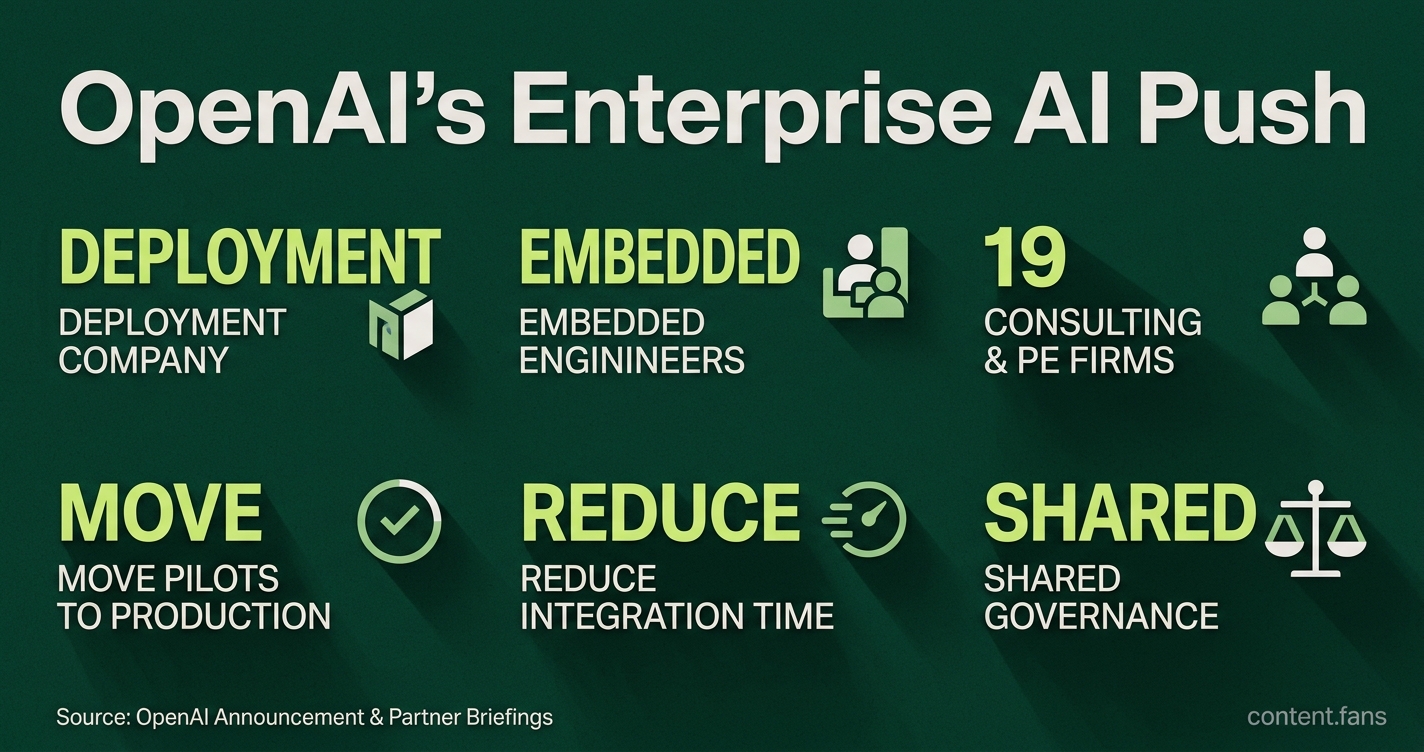
Structured as a stand-alone entity with its own budget, the Deployment Company will place "engineering teams directly inside customer environments," as noted by ERP Today analysis. These specialists, called Forward Deployed Engineers (FDEs), will manage the complex integration, governance, and monitoring tasks that frequently delay enterprise AI initiatives.
To support this effort, a founding group of 19 partners from consulting and private equity will provide implementation support. Launch partner Capgemini confirmed the goal is to help clients "embed frontier AI into core operations, workflows, and business processes," according to a Capgemini release.
Why the investment matters
The significant investment signifies a strategic pivot from pure research to hands-on service delivery. Analysts interpret this substantial funding as a direct challenge to competitors holding major enterprise contracts, suggesting the new frontier for competitive advantage is deployment speed, not just model innovation.
Partner briefings outline ambitious initial objectives for the Deployment Company, including:
- Move a significant number of pilot projects into production within the first year
- Reduce integration time for Codex use cases substantially
- Establish shared governance templates for regulated sectors
Early signals from partners
Partners like Capgemini anticipate faster AI adoption cycles, as embedded teams can directly align AI solutions with existing corporate risk controls. According to ERP Today, other partners expect to see higher renewal rates for products like ChatGPT Enterprise as clients begin realizing tangible workflow improvements.
While official customer results have not been released, related industry trends are promising. Bain Capital Ventures notes that mature enterprises often shift AI budgets into departmental spending, a sign of stronger ROI accountability. This financial integration will be a critical success factor for the Deployment Company's revenue goals.
Competitive context
The Deployment Company enters a highly competitive enterprise AI market. Industry reports highlight growing worker access to AI, intensifying pressure on vendors to provide scalable and secure deployments. OpenAI's strategy of embedding engineers mirrors the successful onsite-architect model used by major cloud providers to accelerate customer adoption.
What to watch next
OpenAI has not yet disclosed revenue projections for its new venture. However, the combination of significant capital, a robust partner ecosystem, and dedicated in-house engineering support signals a clear strategy: to transform its technological leadership into repeatable enterprise value by proactively solving customer integration challenges.