
OpenAI unveils GPT-5.6 Sol with restricted government access
Serge Bulaev
OpenAI launched GPT-5.6 Sol on June 26, 2026, but only about twenty U.S. government-approved partners can use it at first. Most other users, including small businesses and academics, cannot access the model until a later public release, which OpenAI says may happen in the coming weeks. This restriction is described as temporary while security reviews take place, and it may affect how developers plan their projects. Some reports suggest that Sol could be much stronger and more efficient than previous models, but early users cannot confirm these gains yet. OpenAI states it does not want restricted launches to be the usual way forward and plans to release Sol more widely after the review period.

The launch of GPT-5.6 Sol by OpenAI comes with restricted government access, a move prompted by a U.S. directive. Following its June 26, 2026 debut, OpenAI granted preview access to approximately twenty government-approved partners after officials requested a pause on a wider public release, according to a TechCrunch report.
This limited preview means that developers, academics, and most small businesses cannot access Sol via the API or ChatGPT during the initial launch phase. The restriction is poised to impact development roadmaps for projects relying on the model's promised frontier reasoning capabilities.
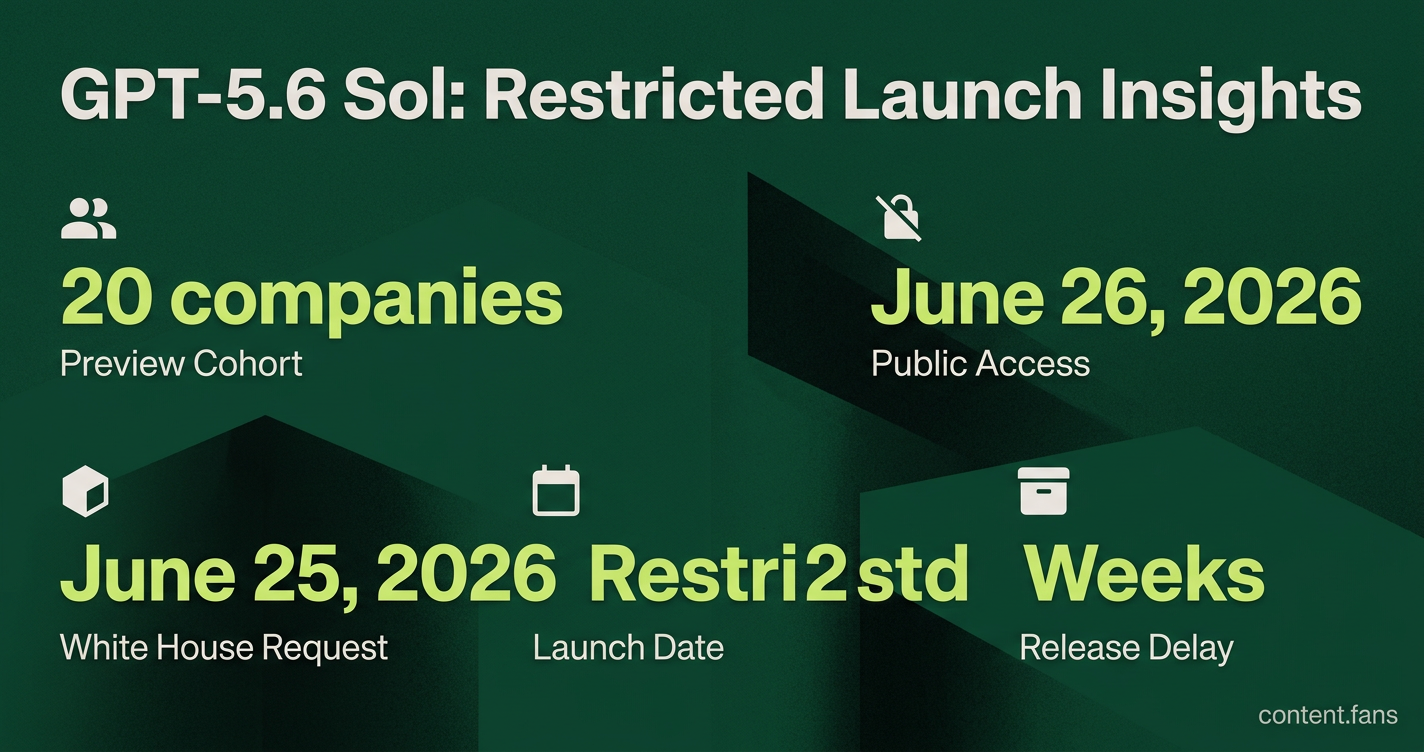
What the Restriction Looks Like
OpenAI has temporarily limited GPT-5.6 Sol's availability to approximately twenty government-approved partners. This short-term measure, part of a security review, blocks access for the general public, developers, and researchers until a wider release in the coming weeks.
In an official statement, OpenAI called the restriction a "short-term step" for security reviews. An Apidog analysis estimates the preview is limited to approximately twenty privately named firms. All other users must await a public release, which OpenAI suggests could happen "in the coming weeks."
Key details of the initial release include:
- Preview Cohort: Approximately 20 companies.
- Model Tiers: Sol, Terra, and Luna.
- Input Cost (Sol): Pricing details have not been officially disclosed.
The Regulatory Backdrop
The White House requested a voluntary slow-roll of GPT-5.6 release but explicitly rejected mandatory licensing or government approval. On June 25, 2026, the White House (Trump administration) requested the limitation, and the limited preview launched June 26, 2026. Sources told TechCrunch that OpenAI voluntarily participated, allowing government agencies to evaluate GPT-5.6 Sol before its public rollout.
In contrast, other frontier model restrictions have been applied to various AI models this year, though specific details about compulsory restrictions remain limited in public documentation.
Implications for Developers and Small Teams
For developers and researchers outside the exclusive preview group, the delay could stretch for weeks, potentially costing them significant productivity on projects that require advanced coding or cybersecurity functions. Industry commentators note that this introduces a new challenge: teams must now verify a model's regional accessibility before even considering its capabilities.
Although early reports suggest that Sol offers improvements for complex agentic tasks and enhanced token efficiency compared to previous models, developers cannot independently verify these claims. This information vacuum may drive some teams to adopt alternative models available in less restrictive regions.
What Happens Next
OpenAI has stated that this restricted launch process should not become the norm for future models. The company intends to release the Sol, Terra, and Luna models to the public through its API and the ChatGPT interface once the government's security review is complete, although no firm date has been provided.
What exactly is GPT-5.6 Sol and why is it considered a frontier model?
GPT-5.6 Sol is OpenAI's strongest model to date, engineered for frontier reasoning, long-horizon agentic work, and multi-step problem solving. In objective benchmarks it sets new records:
- 91.9 % on Terminal-Bench 2.1 (coding & command-line workflows)
- 68.4 % on human-pathogen tasks within SecureBio evaluations
- Three times the token-efficiency of competing cyber models while matching their exploit-discovery scores.
The combination of leading-edge scores and advanced context capabilities is what triggers its "frontier" classification.
How many companies currently have access, and who decided the limit?
Access is capped at approximately 20 pre-approved partners, individually vetted by the U.S. government. The selection followed a directive framed around national security risk management rather than a merit-based commercial lottery, leaving everyone else to wait for a wider release.
What practical hurdles do small businesses and independent developers face today?
- Operational freeze: Any workflow that was designed around the upcoming API must be re-architected for older models or paused entirely.
- Innovation lag: Even a three-week delay can push a startup past critical funding milestones, because venture timelines are now competing with government review cycles.
- Cost inflation: Inference costs may rise when teams are forced to stack weaker models to replicate Sol-level output.
- Geopolitical risk: Firms report already exploring non-U.S. inference providers to sidestep future restrictions.
When will broader public access be restored?
OpenAI calls the current policy a "short-term step" and has publicly committed to rolling the model out to ChatGPT and the general API "in the coming weeks." That language is deliberately vague; historically, such "weeks" have stretched into longer timeframes when extra red-team findings surface.
How can affected teams future-proof their products?
- Architect for swap-ability: Put an abstraction layer in front of model calls so you can hot-swap endpoints without code changes.
- Regional redundancy: Secure accounts with at least one provider outside U.S. jurisdiction as a fail-over.
- Budget buffer: Reserve extra compute budget for the next two quarters in case you remain on older, less efficient models.
- Follow the docket: Track updates via official OpenAI news pages (openai.com/news), the official CISA website (cisa.gov), or the White House AI Executive Order page (whitehouse.gov/ai) to time your migration the day restrictions lift.