
OpenAI unveils GPT-5.5-Cyber, launches 'Patch the Planet' security plan
Serge Bulaev
OpenAI has introduced GPT-5.5-Cyber, a specialized AI model for cybersecurity tasks, and started an open-source security project called Patch the Planet. GPT-5.5-Cyber may help vetted defenders find and fix problems faster, and early tests suggest it performs better than the regular GPT-5.5 in certain areas. More than 30 open-source projects are using these tools, and thousands of fixes have been logged, but ongoing success might depend on funding and community support. The model is currently only available to select users and appears to follow strict safety rules. Analysts say AI could speed up both finding and fixing security issues, but risks may remain if not carefully managed.

OpenAI is revolutionizing cybersecurity with GPT-5.5-Cyber, a specialized AI model, and its collaborative "Patch the Planet" initiative. This dual launch delivers powerful, domain-specific AI tooling for vetted defenders and a new framework for accelerating vulnerability fixes across critical open-source projects.
GPT-5.5-Cyber is a fine-tuned version of the base GPT-5.5 model, engineered specifically for security tasks. Early benchmarks show a significant performance lift, with GPT-5.5-Cyber scoring 85.6% on the CyberGym testbed; the score of the standard GPT-5.5 on CyberGym is not confirmed in the provided sources. GPT-5.5-Cyber scored 39.5% on ExploitGym; the standard GPT-5.5 score on ExploitGym is not confirmed in the provided sources, though this indicates superior exploit-path reasoning capabilities. While permissive for authorized red-teaming, the model operates under strict safety guidelines to prevent malicious use.
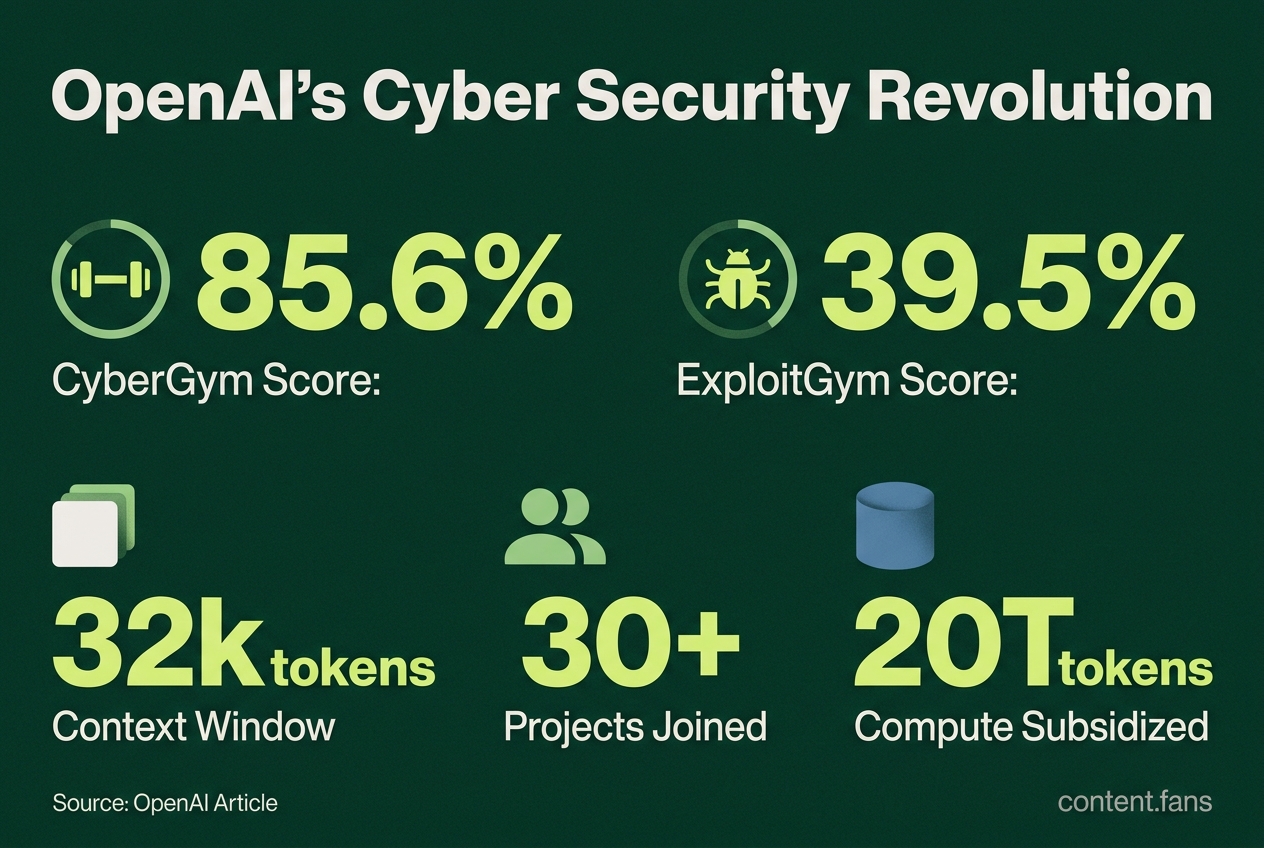
The model features a standard 32k-token context window (expandable to 128k), enabling complex tasks like extended binary analysis and multi-repository code scans. Key workflows include malware unpacking, drafting YARA rules, and validating software patches. The UK's AI Security Institute has rated its capabilities as "High," placing it just below the "Critical" threshold defined in OpenAI's Preparedness Framework.
Inside the 'Patch the Planet' Initiative
GPT-5.5-Cyber is a specialized version of OpenAI's GPT-5.5 model, fine-tuned for professional cybersecurity tasks. It offers enhanced capabilities for vulnerability analysis, exploit-path reasoning, and code remediation, designed to help vetted security defenders find and fix security flaws more efficiently than with general-purpose AI models.
Key partners and results from the program include:
- Project Adoption: Over 30 major open-source projects have joined, including cURL, Python, Go, Sigstore, and pyca/cryptography.
- Vulnerability Discovery: Early scans of the Linux kernel identified multiple pointer-leak and privilege-escalation vulnerabilities.
- Large-Scale Scanning: The Codex Security cloud has conducted extensive scanning operations, resulting in a significant number of human-verified fixes.
To support this effort, OpenAI is subsidizing 20 trillion tokens of compute, keeping the Codex Security platform free for maintainers. This funding also supports Trail of Bits engineers who review AI-generated findings, develop patches, and manage disclosure via HackerOne.
Performance Benchmarks and Safeguards
| Benchmark | GPT-5.5-Cyber | GPT-5.5 |
|---|---|---|
| CyberGym | 85.6% | Not confirmed |
| ExploitGym | 39.5% | Not confirmed |
| SEC-bench Pro | 69.8% | 63.1% |
Regarding safety, OpenAI's deployment hub confirms the model cannot autonomously generate functional zero-day exploits against hardened systems, aligning with its safety policies. Access to GPT-5.5-Cyber is currently available by invitation only.
Industry analysts note that AI is poised to accelerate both vulnerability discovery and remediation. While this helps defenders triage threats faster with tools like GPT-5.5-Cyber, experts from Sophos warn that it also allows attackers to weaponize known flaws more quickly. Early results from 'Patch the Planet' show that AI-human teams can slash audit cycles from weeks to days, but the initiative's long-term success will hinge on sustained funding and community engagement.
What is GPT-5.5-Cyber?
GPT-5.5-Cyber is a specialized version of OpenAI's standard GPT-5.5 model, fine-tuned specifically for authorized cybersecurity tasks. While it shares the same 32k-128k token context window, it has lowered refusal boundaries for vetted users, enabling it to perform advanced security workflows, including:
- Reverse-engineering closed-source binaries without premature termination.
- Drafting detection rules (Sigma, YARA, EDR) directly from threat intelligence reports.
- Validating vendor patches and generating supplementary code for incomplete fixes.
Benchmark tests show significant improvements in its ability to reproduce vulnerabilities (CyberGym) and build working exploit chains (ExploitGym). However, under OpenAI's Preparedness Framework, its capability is classified as "High," not "Critical," meaning it cannot create autonomous zero-day exploits against hardened systems.
How does the 'Patch the Planet' program work?
'Patch the Planet' is an AI-driven vulnerability remediation program operated by OpenAI and Trail of Bits. The process combines automated scanning with human expertise:
- Scanning: The Codex Security platform performs static analysis scans across open-source code.
- Triage: GPT-5.5-Cyber analyzes and prioritizes the findings.
- Remediation: Trail of Bits engineers review the AI's output, write the final patches, and coordinate disclosure through platforms like HackerOne.
The program is open to open-source projects via an application form, with over 30 projects like cURL, Go, and Python already participating. OpenAI is subsidizing the compute costs to keep the service free for maintainers.
What are the early results from 'Patch the Planet'?
The initial five-day sprint produced significant results, demonstrating the program's effectiveness. Highlights include:
- High Volume: Hundreds of security issues were found across 19 codebases.
- Rapid Patching: 64 pull requests were opened, leading to 37 merged patches.
- Notable Finds: The program identified a 23-year-old bug in the OpenBSD kernel, helped patch a Firefox vulnerability before a major hacking competition, and flagged several upcoming CVEs in dnsmasq.
According to Trail of Bits, the AI-assisted workflow condensed security audits that typically take weeks into a matter of days.
Does AI in cybersecurity introduce new risks?
Yes, while AI offers powerful defensive advantages, its widespread adoption also introduces new risks. Security experts agree that AI accelerates the entire timeline for both attackers and defenders. Key concerns include:
- Faster Exploitation: Sophos warns that AI will allow attackers to weaponize newly disclosed vulnerabilities in "minutes, not days."
- "Shadow AI": IBM highlights the risk of employees using unsanctioned AI models, creating a new, unmonitored attack surface for data exfiltration.
To counter this, firms like HiddenLayer recommend that organizations move beyond static defenses and adopt AI-specific security measures, such as runtime monitoring and adversarial testing for their own AI models.
How can security teams access GPT-5.5-Cyber?
Access to GPT-5.5-Cyber is available to vetted security professionals through OpenAI's Daybreak trusted-access program. Applicants must typically provide CISO-level attestation and undergo a background check. While the model is more permissive for security research, its use is still governed by policies that prohibit malicious activities like credential stuffing or ransomware development. Approved teams receive access to the 32k context model, with an option for a 128k context window for more intensive analysis.