
OpenAI Unveils 2028 Plan For Steerable AI Researchers, Economic Shift
Serge Bulaev
OpenAI has announced a plan to create a steerable AI researcher by March 2028, which may help reshape the economy and make advanced AI more available and safe. The company says its goals include building an automated AI researcher, boosting economic growth, and giving everyone a personal AGI, while keeping systems under human control. Analysts suggest that, by 2028, AI might mostly shift tasks rather than replace entire jobs, with some uncertainty about exactly how much work will change. Regulators in the EU and US are preparing new rules for these advanced AI systems, and business leaders are watching how OpenAI meets its targets and how governments handle safety and oversight. OpenAI's leaders also say they do not want to fully automate everything, so it is not clear how much power AI will get.

OpenAI published a roadmap centered on three goals: an automated AI researcher that remains steerable and accountable, accelerating economic growth through scientific progress with broadly shared gains, and delivering personal AGI access to everyone. In a recent blog post, the company will now focus on making advanced AI systems abundant, safe, and aligned with human oversight. This announcement serves as a public roadmap, detailing how OpenAI intends to integrate powerful AI models from research labs into daily economic workflows while ensuring they remain under strict human oversight.
What the plan actually says
OpenAI described a third phase focused on abundance, safety, and accessibility, with goals including an automated, steerable AI researcher, broad economic growth from scientific progress, and personal AGI for everyone. The plan sets a concrete deadline for a steerable, human-directed AI research agent.
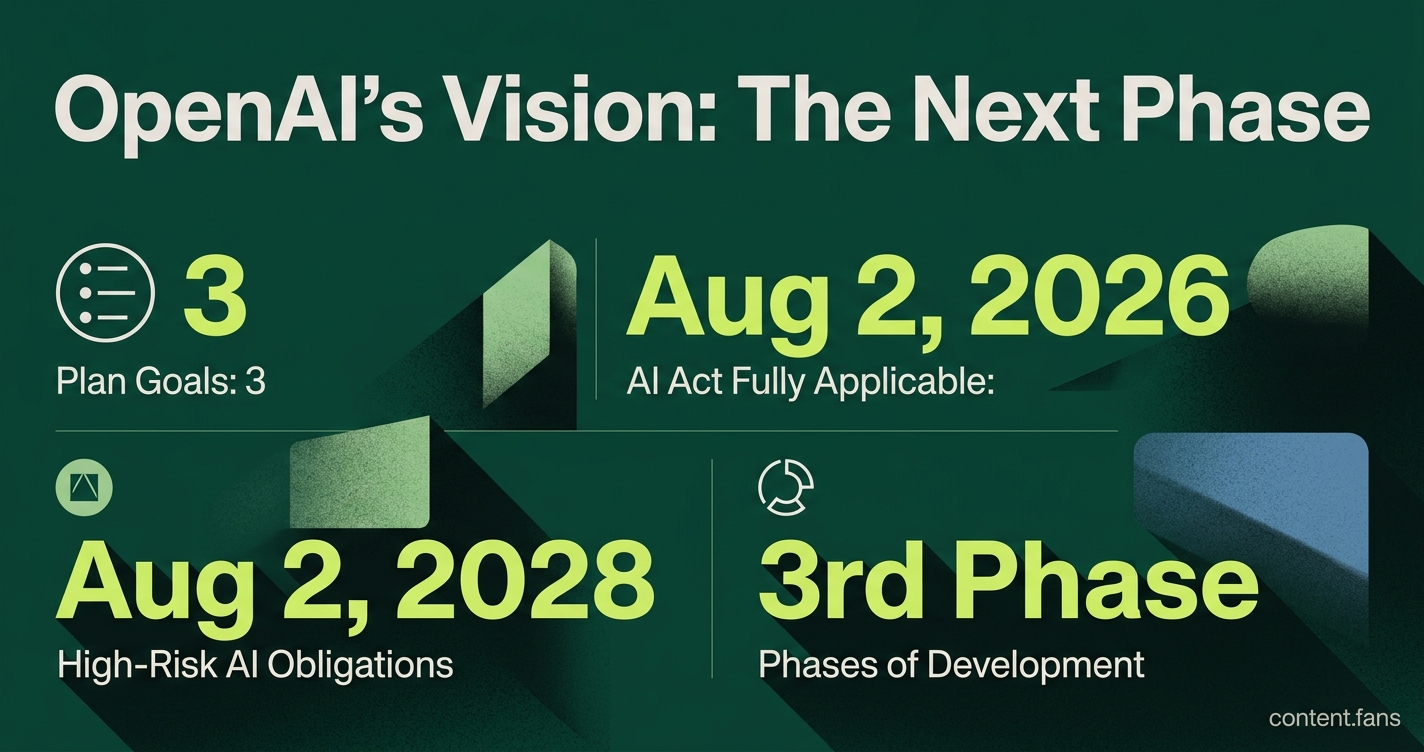
In its official post, "Built to benefit everyone: our plan," OpenAI outlines its entry into a "third phase" with three primary objectives: building an automated AI researcher, accelerating economic growth, and providing individuals with a personal AGI. Reporting from Business Insider highlights that CEO Sam Altman frames these ambitions as inseparable from safety, emphasizing that all systems must remain "aligned with human intent" and "subject to human control."
The plan highlights one concrete milestone: a steerable AI researcher. Engineers would direct such an agent to tackle long-horizon research questions while remaining auditable - a feature the authors call essential for risk management. The post clarifies the system is not imminent and outlines the significant technical and policy work still required.
Economic and labor implications
The steerable-researcher target is seen as a key indicator of accelerating AI capabilities. Industry reports indicate that AI primarily automates specific tasks rather than eliminating entire jobs, affecting a significant portion of roles with high automation potential. Economic projections suggest notable worker displacement over a decade, implying that the main impact will likely be task reallocation affecting entry-level and knowledge-work positions.
Growing governance pressure
Global regulators are already preparing for the rise of agentic AI systems. The AI Act becomes fully applicable on 2 August 2026, with some high-risk AI system obligations extending to 2 December 2027 and 2 August 2028 depending on the system type. In the US, standards organizations are working to establish controls for identity, authorization, and auditing. These moves reflect widespread industry concern, as many CISOs worry about agent security and lack visibility into machine identities, signaling rising governance and compliance costs.
What businesses watch next
- Timeline Proof Points: The release of intermediate demonstrations ahead of key deadlines.
- Regulatory Convergence: Alignment between EU, US, and UK regulators on standards for AI auditability and liability.
- Labor Market Indicators: Evolving hiring patterns for roles in scientific research, AI compliance, and entry-level knowledge work.
Crucially, Altman and Pachocki state that "entirely automating everything is not the future we want," leaving the ultimate scope of AI autonomy as a key question for industry and society to resolve.
What exactly does OpenAI mean by "steerable AI researchers" and when is this expected?
OpenAI intends to deploy autonomous AI systems that can design, run, and refine research agendas under human oversight. The company has outlined this capability as a key milestone. The phrase appears in the blog post "Built to benefit everyone: our plan"; it is not yet a technical term in labor-economics literature.
How might steerable AI researchers reshape scientific discovery?
If this milestone is met:
- Research velocity could rise steeply: models would iterate on their own hypotheses 24/7, compressing multi-year grant cycles into weeks.
- Cost per experiment falls: one pilot study at Anthropic estimates that agent-driven biology labs could cut wet-lab costs by up to 40 %.
- Human role shifts from hands-on bench work to high-level goal setting, safety review, and governance monitoring, creating demand for "agent supervisors" and compliance analysts.
What new risks and governance questions arise from autonomous research agents?
Regulators in the EU, US, and UK are already drafting rules that target identity management, audit trails, and human oversight:
- Identity: A significant number of large-enterprise CISOs report they cannot yet track which digital identities belong to AI agents.
- Liability: courts have no settled precedent for who is at fault when a fully autonomous agent signs a harmful contract or violates export-control rules.
- Timetable: the EU AI Act's final wave of obligations for high-risk systems extends to various dates through August 2028, requiring firms to run dual-track compliance programs.
How could accelerated deployment of AI researchers affect the job market?
Empirical work by Anthropic, MIT, and Yale suggests nuanced outcomes:
- Displacement is selective, not economy-wide: roles with high automation potential see reduced hiring, but overall unemployment remains stable.
- Entry-level researchers and data-labeling staff face the sharpest pressure, whereas senior scientists and AI-governance specialists gain leverage.
- Goldman Sachs Research says AI adoption could temporarily raise unemployment by about half a percentage point during the transition and could displace 6 - 7% of the US workforce if widely adopted, but the source does not specify a 10-year transition or sector-specific shock timing.
What can policymakers and business leaders do now to prepare for a steered-research world?
- Governance: invest early in agent inventories, automated audit logs, and scoped machine identities to stay ahead of compliance deadlines.
- Workforce: pivot training budgets toward AI safety, oversight, and interdisciplinary policy skills that complement rather than compete with autonomous systems.
- Policy coordination: OpenAI itself calls for an international body with the power to slow frontier development if safety metrics slip, signaling that early industry-regulator alignment will be decisive.