
OpenAI, TikTok, Amazon Integrate AI for Conversational Ad Buying
Serge Bulaev
OpenAI, TikTok, and Amazon are making changes that may make advertising more focused on conversations instead of traditional ads. OpenAI is expanding its ad program for ChatGPT to more countries, but its reported revenue has not been confirmed. TikTok is adding more automation to its ad system, which might let outside tools like ChatGPT help manage ads. Amazon is combining its shopping chatbots, so asking questions while shopping may become easier, but it is not clear yet if this will lead to a new ad product. These updates suggest that advertising could soon focus more on what people are saying and asking, but some details are still uncertain.

Major AI updates from OpenAI, TikTok, and Amazon are paving the way for conversational ad buying, signaling a fundamental shift away from cookie-based targeting. These moves indicate a future where advertising is driven by user dialogue. OpenAI is expanding ChatGPT ads internationally, TikTok is launching an agent-ready ad stack, and Amazon is unifying its shopping assistants to answer questions earlier in the customer journey.
ChatGPT ads cross borders
OpenAI is expanding its sponsored answers pilot in ChatGPT to new international markets, including the United Kingdom, Japan, and Brazil, according to MarketMaze. Industry reports suggest the program is generating significant revenue. The rollout follows a familiar ad-tech pattern: ad-free premium tiers, a drop in minimum spend from $200,000 to a reported $50,000, and upcoming self-serve tools. This pivot means brands will bid on conversational intent, challenging traditional keyword-based search advertising models.
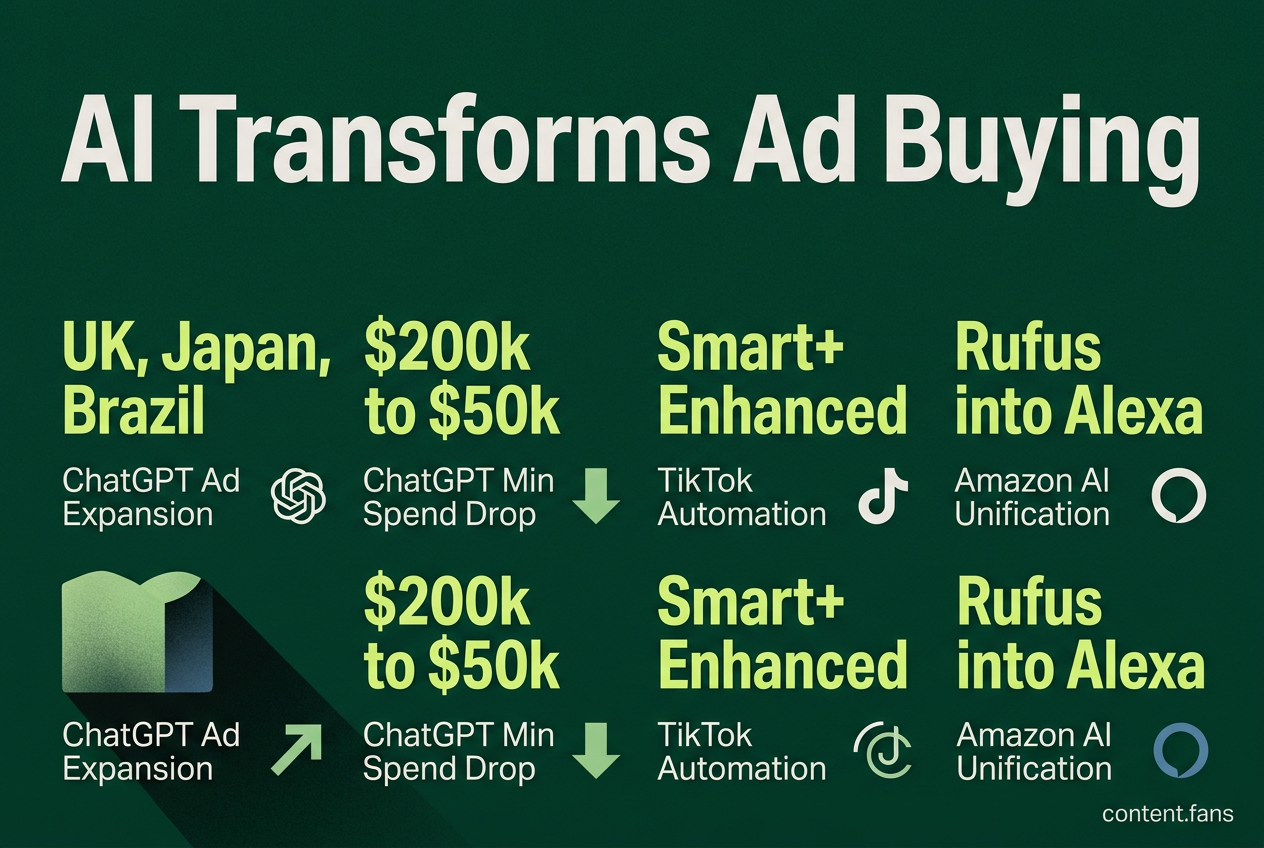
These platforms are integrating AI to make advertising more conversational. OpenAI is selling sponsored answers in ChatGPT, TikTok is automating campaign management with AI agents, and Amazon is using its AI assistant to answer product questions, shifting the focus from keywords and cookies to direct user dialogue.
TikTok World doubles down on automation
At its recent TikTok World event, the company fortified its commitment to automation by enhancing Smart+, its AI performance suite. The TikTok Newsroom highlights new features like Auto Selection for creative optimization and an AI-powered Summary for dashboard insights. The platform has introduced advanced tools that allow external AI agents to programmatically manage bidding, creative, and pacing, signaling a move toward cross-platform AI campaign management.
Amazon unifies its shopping assistant
Amazon is unifying its AI commerce experience by merging its Rufus chatbot into a single assistant, Alexa for Shopping. This integrated AI will operate across the Amazon app, website, and Echo devices, allowing customers to ask natural-language questions directly in the search bar. According to About Amazon, the assistant leverages deep product knowledge and user history. This move could fundamentally alter sponsored placements, making ad relevance dependent on structured product data for conversational queries rather than just bid-based keyword results.
Reading the tea leaves
Collectively, these developments from OpenAI, TikTok, and Amazon show a clear convergence of search, social, and retail media around conversational AI. While current announcements focus on regional rollouts and developer toolkits, the underlying trend is unmistakable: the future of digital advertising inventory is shifting from being priced on displays and clicks to being valued based on dialogue and intent.
How is OpenAI monetizing ChatGPT for advertisers?
OpenAI is rolling out sponsored placements inside ChatGPT for markets beyond the United States. Early pilots list the UK, Japan, South Korea, Brazil, Mexico, Canada, Australia and New Zealand. Campaigns are sold with a lowered minimum buy of $50,000, down from the original $200,000, and the company is adding self-serve tooling to widen access beyond enterprise brands.
Premium tiers (Pro, Business, Enterprise, Education) remain ad-free, so monetization focuses on the free user base. Industry reports suggest significant advertiser adoption, with brands including Target, Ford and Adobe participating in the program.
What AI campaign controls did TikTok introduce recently?
At TikTok World the platform unveiled a suite of AI-first controls:
- Smart+ - an already-deployed AI-automated performance system that now adds Auto Selection to pick the best mix of creator content, product assets and Symphony-generated creative.
- AI-powered Summary - surfaces actionable optimization suggestions by analysing live campaign data.
- Asset Manager - a central hub that combines product catalogues, data feeds and creative assets to shorten campaign-launch time.
- TikTok Ads MCP Server - lets external AI agents (for example, Claude or ChatGPT) manipulate campaign variables directly.
- TikTok Ads Skills - a toolkit so agencies and brands can build custom AI scripts for budget pacing, audience discovery and creative ranking.
How is Amazon consolidating its shopping-AI stack?
Amazon is retiring the standalone Rufus chatbot and folding its capability into a single voice-branded assistant: "Alexa for Shopping". The new interface surfaces across Amazon.com, the shopping app, Echo Show and even the main search bar, unifying shopper history, wish-lists, web reviews and voice queries in one place.
Behind the scenes, Rufus still powers the product models, but shoppers will interact only with Alexa for Shopping. Amazon reports that a significant number of customers used the beta Rufus experience recently.
Why does the convergence matter for media buyers?
The week's moves show three separate ecosystems adopting the same playbook:
- OpenAI treats every prompt as potential ad inventory.
- TikTok automates creative and bidding with AI agents.
- Amazon collapses search, voice and chat touchpoints into a single AI agent.
The practical outcome is that keywords, placements and legacy channel boundaries are dissolving. Buyers now need creative that works in conversational context, budget models that adapt to AI-driven pacing, and measurement that tracks intent across voice, text and video in one report.
What should brands test first?
- Localized ChatGPT campaigns - start with the new $50k minimum in at least one non-US market to benchmark cost-per-conversation.
- TikTok Smart+ splits - run an A/B test where half of the spend uses manual controls and half uses Auto Selection to quantify performance lift.
- Alexa for Shopping optimization - update Amazon listings to include plain-language answers and structured attributes so the agent can surface your SKU in voice comparisons and Buy for Me flows.