
OpenAI Targets Enterprise Revenue Parity with Consumer by 2026
Serge Bulaev
OpenAI is focusing more on selling its AI products to businesses, aiming to have equal revenue from enterprise and consumer customers by 2026. The company says that over 40% of its revenue may already come from business clients, and leaders are promoting features like custom models and better workflow integration. Some companies remain unsure about using AI due to challenges with data, risk, and skills, but OpenAI is offering guides and support. There might be a shift to pricing based on business results, though details are not clear yet. Whether these efforts lead to long-term business deals is still uncertain.

OpenAI says enterprise now makes up more than 40% of its revenue and is on track to reach parity with consumer revenue by the end of 2026. OpenAI says its enterprise business now makes up more than 40% of revenue and is on track to reach parity with consumer by the end of 2026, with Chief Revenue Officer Denise Dresser leading the charge. The company's executives are positioning enterprise AI as the primary engine for future growth. According to an official blog post, OpenAI aims for revenue parity between its enterprise and consumer divisions by the end of 2026.
OpenAI's Enterprise Strategy and Leadership
Dresser's strategy focuses on delivering measurable returns through deep workflow integrations and flexible pricing models. According to industry reports, this executive push is a coordinated effort involving multiple senior leaders focused on enterprise growth initiatives. The goal is to move businesses beyond experimentation and into widespread adoption.
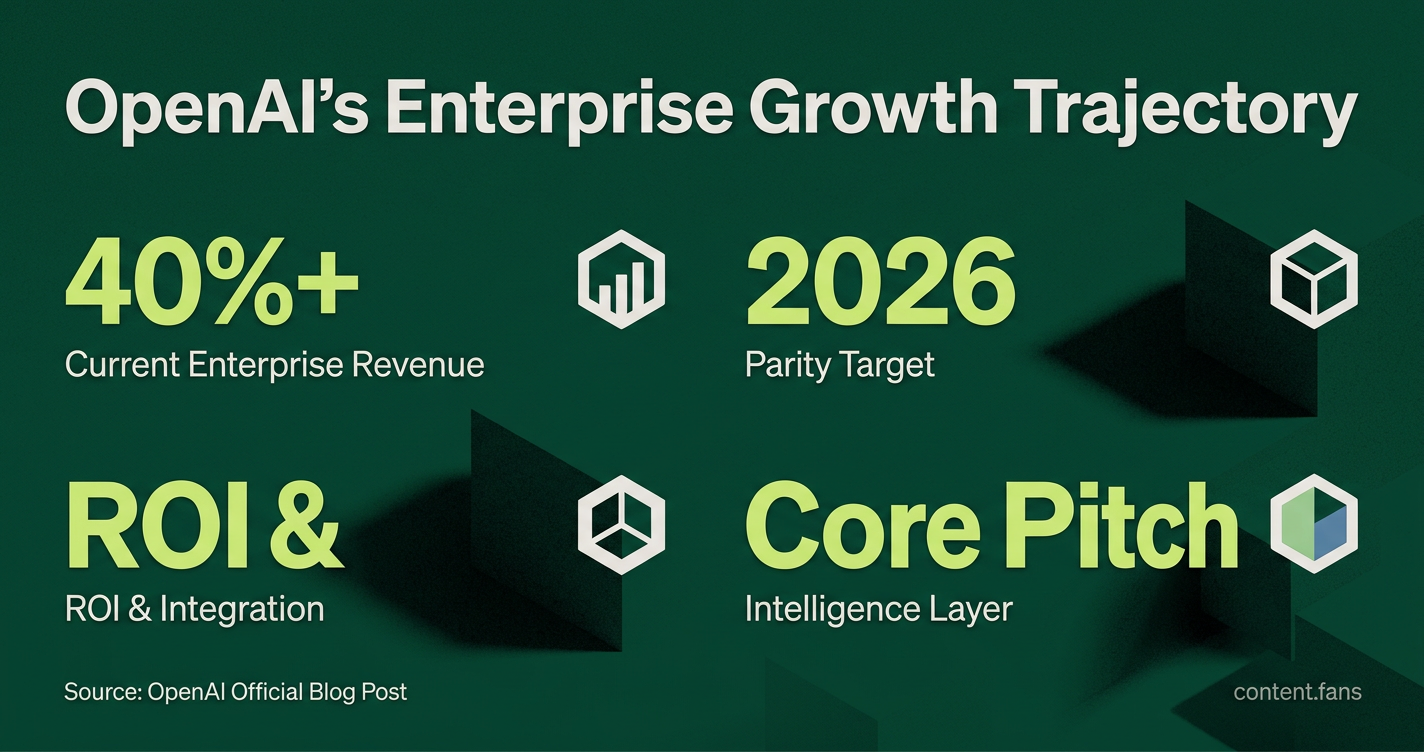
OpenAI is actively courting enterprise clients by demonstrating clear ROI and seamless integration into existing business processes. The company's strategy involves offering custom-tuned models, dedicated support, and clear governance frameworks to address common corporate concerns, aiming to establish its technology as a core intelligence layer.
The Pitch to Enterprise Customers
OpenAI pitches its technology as a foundational "intelligence layer" capable of managing internal automated agents and creating a unified AI "superapp" for employees. To prove its value, sales teams highlight case studies showing significant improvements in business outcomes with ChatGPT Enterprise. The core sales pitch emphasizes:
- Custom models tuned to industry lexicons
- Integrations with popular SaaS suites so employees avoid context-switching
- Usage dashboards that map model calls to cost centers
- Post-sales support for governance, including bias and safety checks
Overcoming Enterprise Adoption Hurdles
Despite high interest in AI, significant adoption hurdles remain. Many large corporations are cautious due to governance concerns, data infrastructure gaps, and internal talent shortages. According to industry reports, a significant portion of firms feel unprepared across these areas. OpenAI is addressing this by providing implementation guides that prioritize building an AI-ready culture and present strong governance as a business enabler, not a roadblock.
The Evolving Role of the Chief Revenue Officer
The CRO's responsibilities now extend beyond contract negotiation. The role encompasses managing partner-led distribution channels with system integrators, developing retention programs, and experimenting with value-based pricing. Industry analysts speculate that OpenAI may move from token-based fees to outcome-based pricing, linking costs directly to business impact - a model highly attractive to CFOs focused on clear ROI.
Key Market Signals and Future Indicators
The success of OpenAI's enterprise strategy will be measured by several key market signals:
- Enterprise vs. Consumer Revenue Ratio: Tracking the shift toward the 2026 goal of parity.
- Global Support Expansion: The growth of enterprise support hubs outside North America will signal increasing demand from multinational corporations.
- Adoption of Agentic AI: A rise in pilot programs for autonomous AI agents, as predicted by industry analysts, will indicate a move toward more advanced, integrated workflows.
The evolution of these indicators will reveal whether the company's strategic push can successfully convert widespread interest into durable, large-scale enterprise contracts.
What is OpenAI's near-term revenue goal for enterprise vs. consumer?
OpenAI told investors it wants enterprise and consumer revenue to reach parity by the end of 2026.
Enterprise already accounts for more than 40% of total revenue and the gap is narrowing fast, driven by new workflow-specific products and white-glove onboarding led by Chief Revenue Officer Denise Dresser. (Source: cryptorank.io news, cryptorank.io)
Who is steering the enterprise push inside OpenAI?
Day-to-day execution sits with Denise Dresser, Chief Revenue Officer, while according to industry reports, senior leadership has designated enterprise growth as a strategic priority. (Source: TechCrunch, techcrunch.com)
How does OpenAI prove ROI to cautious CIOs?
Sales teams arm themselves with outcome-based case studies. According to company materials, enterprise customers have reported significant improvements in business metrics, which OpenAI repackages into board-ready ROI slides. (Source: openai.com case study)
What adoption stage are most businesses at today?
According to industry reports, many North American firms are using AI in multiple business functions, with a growing number running several processes on generative models. However, only a small portion has mature governance for autonomous agents.
OpenAI positions itself as the "infrastructure play" for companies moving from pilots to production-scale workflows. Deloitte's 2026 State of AI in the Enterprise report emphasizes that enterprise AI adoption is broadening faster than integration, with gaps in systems integration, data quality, governance maturity, workforce capability, job design, and compliance still slowing transformation.
Where do deals still get stuck?
In Deloitte's 2026 report, insufficient worker skills are identified as the biggest barrier to integrating AI into existing workflows. OpenAI's answer is to bundle system-integrator partnerships, vertical-specific blueprints and adoption dashboards to shorten time-to-value for resource-strapped IT teams.