
OpenAI Reports Nearly $6 Billion in Q1 Revenue, Fueled by Codex
Serge Bulaev
OpenAI reported nearly $6 billion in revenue for the first quarter of 2026, which may be one of the highest for an AI company. Much of this revenue appears to come from business and developer customers, with Codex being a key driver. Business customers now make up over 40% of OpenAI's revenue and could match consumer sales by the end of 2026. However, OpenAI also faces high costs for data centers and cloud capacity, and it is unclear if this revenue growth will keep up with expenses. Some reports suggest OpenAI's lead could shrink if competitors lower their prices or increase their capacity.

The news that OpenAI reports significant revenue growth in Q1 2026 marks a major milestone, representing one of the largest single-quarter results for a private AI company. This performance, largely fueled by its enterprise tools and developer adoption, places the company ahead of competitor Anthropic for the same period, according to data from The Information.
This revenue surge highlights a critical shift in OpenAI's financial model, where spending from developers and enterprise customers now significantly outweighs income from consumer chat subscriptions.
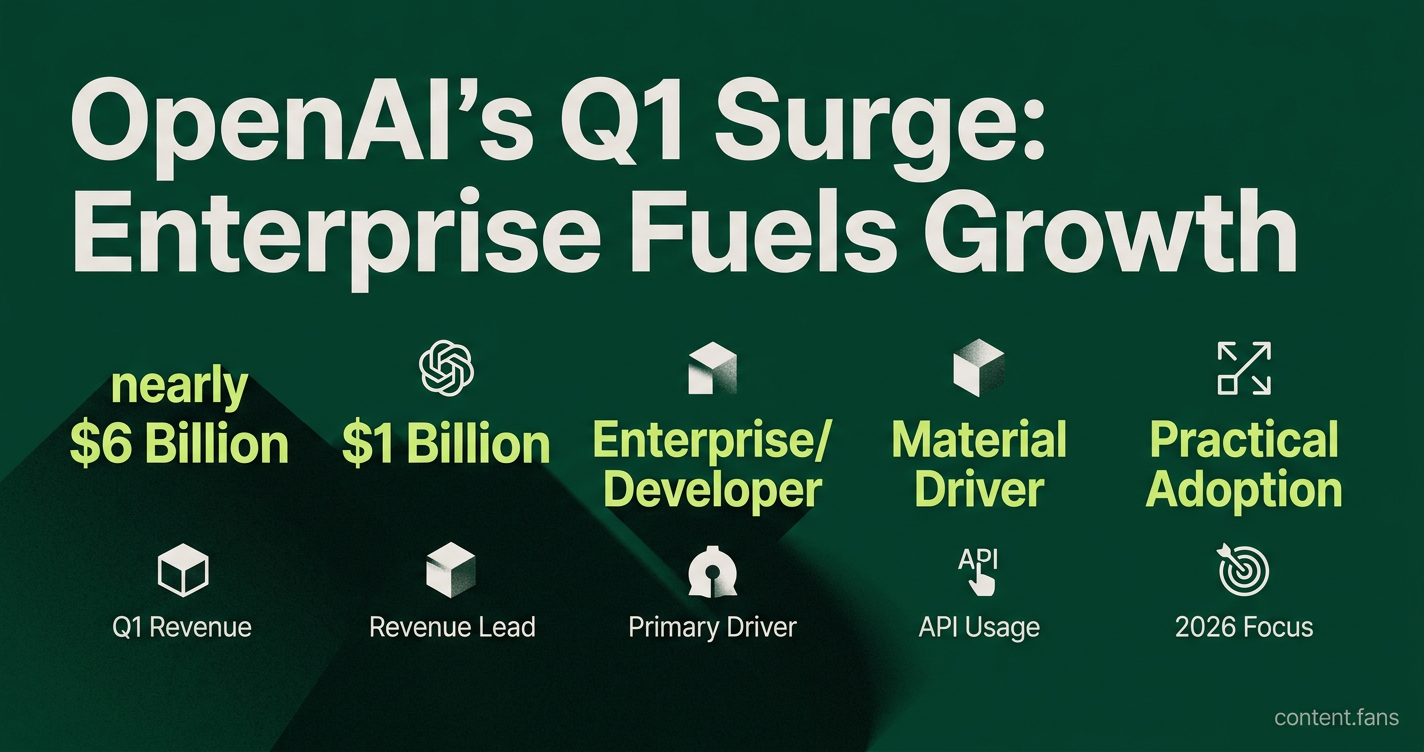
Enterprise share shows substantial growth
OpenAI's reported Q1 2026 revenue growth was primarily driven by strong enterprise and developer adoption, with its API services being a significant factor. Business customers now represent a significant portion of total revenue, signaling a shift from consumer subscriptions to integrated business workflow tools.
According to OpenAI, business clients contribute a growing share of total revenue and show strong momentum heading into the remainder of 2026 (OpenAI post). This trend suggests companies are moving beyond limited trials and are deeply integrating tools like ChatGPT Enterprise into core operations.
The API services are central to this enterprise adoption. Although official figures are unavailable, industry analysis consistently points to API usage as a "material driver" of Q1 bookings. Strong developer demand for code generation capabilities has secured OpenAI a strong foothold within software development teams.
Balancing Revenue Growth with Infrastructure Costs
However, this impressive revenue growth is matched by significant operational costs. To support model training and inference, OpenAI has committed to large-scale data center projects, leading to substantial cash burn in Q1 (CNBC). Furthermore, with extensive contracted cloud capacity, its revenue must continue scaling to meet these massive infrastructure obligations.
Key expense buckets frequently cited:
* Long-term GPU and data-center leases
* Frontier model training runs
* Enterprise sales and customer success hiring
* Safety and alignment research
Developer momentum shapes the 2026 product roadmap
CFO Sarah Friar has designated 2026 as the year of "practical adoption." This signals a product strategy focused on ease of deployment and enterprise governance over purely chasing larger model sizes. The company's roadmap highlights five key themes for upcoming releases:
- Deeper workflow integration inside a unified ChatGPT interface.
- Expanded agent orchestration primitives in the API.
- Enterprise-grade admin, audit, and policy tooling.
- Outcome-oriented pricing experiments, particularly for high-volume use cases.
- Vertical templates that move beyond generic chat to domain workflows.
This strategic focus clarifies why API services, originally code-centric tools, are now a cornerstone of the company's growth. Developers who integrate the API into their workflows often become key advocates for broader enterprise adoption of AI.
Market ripple effects
The market is responding swiftly to OpenAI's dominance. Competitors like Anthropic and Google are intensifying the battle for enterprise clients, leading to what some analysts call an "AI token pricing crisis" where per-token costs are falling despite rising demand (Investing.com). Consequently, OpenAI's lead could shrink if rivals can scale their capacity and offer more competitive pricing, particularly for code-generation tools.
Currently, OpenAI's Q1 performance provides the necessary capital and market confidence to fund its long-term infrastructure commitments, expand its sales force, and advance its developer roadmap. The key question for industry analysts remains whether this financial momentum can sustainably outpace the escalating costs of compute power.