
OpenAI Remains Silent Amid GPT-5.6 Launch Rumors, 2M Token Context
Serge Bulaev
Rumors about OpenAI soon launching "GPT-5.6" with a very large context window and new features have increased, but OpenAI has not confirmed anything. Some leaks suggest GPT-5.6 might support up to 1.5 million tokens per prompt, with possible improvements in coding tools and lower prices, but all information comes from leaks or prediction markets, not official sources. Experts warn that none of these details are confirmed, and the only certain facts are the leak origins and market predictions. The true features and release date of GPT-5.6 remain uncertain.

Intensifying GPT-5.6 launch rumors suggest a release with a significantly expanded token context window and new agent features, but OpenAI remains silent on the matter. As of now, no official model card, pricing, or benchmarks for GPT-5.6 exist. Despite the lack of confirmation, prediction markets indicate confidence in a potential release.
Industry analysts stress the difference between hard evidence and pure speculation. According to reports, "GPT-5.6 does not officially exist," as OpenAI has released no official documentation. Likewise, sources confirm that all circulating details originate from leaks and prediction markets, not official company statements.
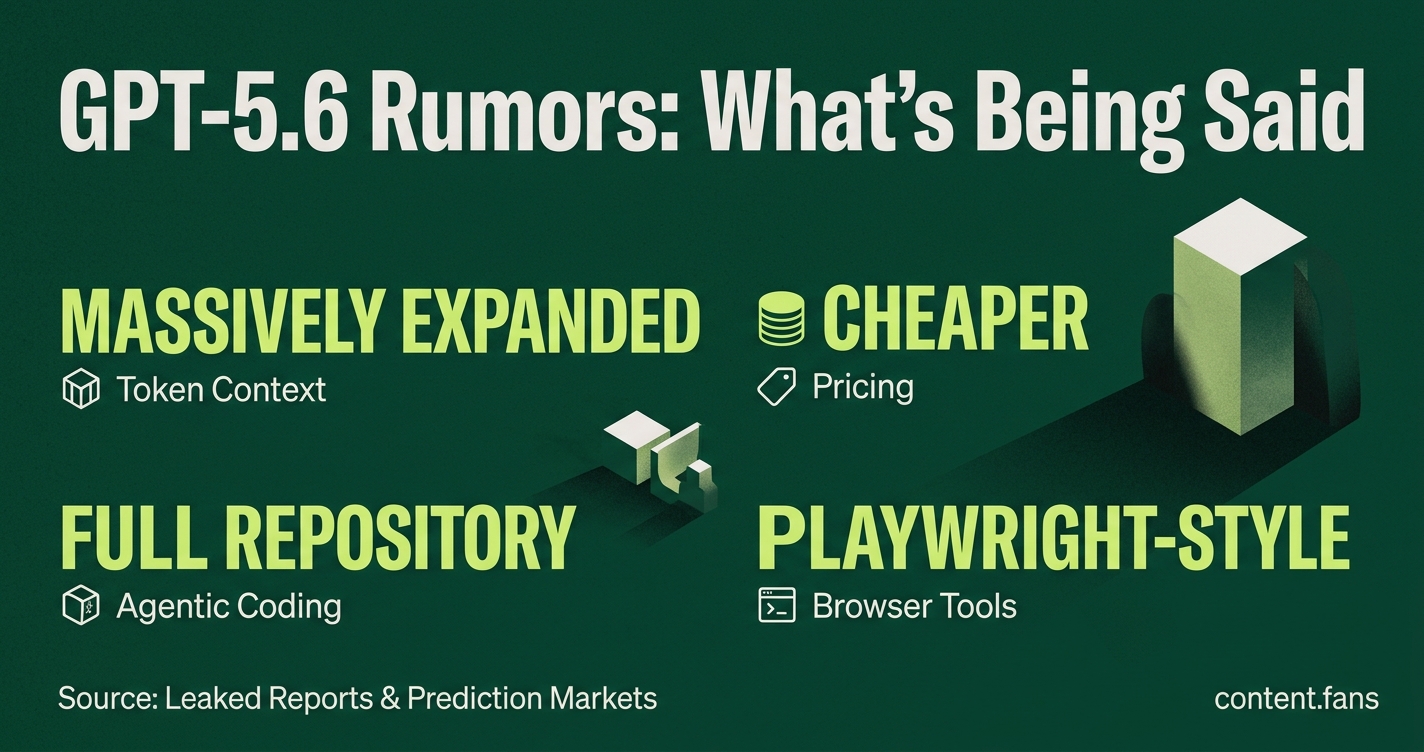
The debate over context size centers on various figures being discussed in leaked information. Leaked developer logs suggest a substantially expanded token context window, a capacity potentially large enough to process entire codebases in a single prompt. While specific numbers vary across reports, a massive context window appears to be the core of the rumored upgrade.
What the leaks actually describe
Leaked information points to GPT-5.6 featuring a significantly expanded token context window, more affordable pricing than GPT-4 models, advanced agentic coding for full repository analysis, and integrated browser automation tools. These details, however, remain unconfirmed by OpenAI and are based entirely on third-party reports and developer logs.
- Substantially expanded token context window (widely reported across sources)
- Cheaper pricing relative to current GPT-4 class models (unconfirmed reports)
- Stronger agentic coding that can traverse full repositories (speculation)
- Playwright-style browser testing tools potentially exposed inside ChatGPT sessions (rumored)
Why a mega context window matters
Research into long-context models highlights a strategic shift from retrieval-augmented generation (RAG) pipelines toward single-prompt reasoning. For developers, a model that can ingest an entire repository at once could eliminate chunking errors and accelerate agentic workflows. However, experts caution against "context rot," where recall quality degrades in very large context windows, potentially limiting practical applications.
Agentic tooling and Playwright rumors
Among the circulating rumors is the potential integration of Playwright for automated test generation. Existing Playwright servers already enable language models to control a browser, inspect its structure, and automatically correct failing tests. If GPT-5.6 integrates this capability, users could potentially direct ChatGPT to perform end-to-end testing without manual intervention. Since competing models already generate reliable Playwright code, observers see this as a logical, albeit unconfirmed, development.
Pricing talk and competitive context
Speculation on pricing suggests GPT-5.6 could be significantly cheaper than competitors, though this is unverified without an official price sheet. Regarding the release date, prediction markets show confidence in a potential launch, but it's important to note that OpenAI's release schedules have historically deviated from market expectations.
Without official confirmation from OpenAI, all rumored specifications for GPT-5.6 should be considered provisional. The only verifiable information consists of the origins of the leaks, data from prediction markets, and the broader industry trend toward models with large context windows.
Has OpenAI officially confirmed the GPT-5.6 launch date?
No. OpenAI has not confirmed the existence or release date of GPT-5.6. There is no official press release, model card, or blog post. The rumored launch date originates entirely from social media and prediction markets. As reports note, the model does not officially exist.
What size context window do the leaks actually describe?
The leaks describe various figures for an expanded token context window, with reports suggesting a substantial increase over current capabilities. This would represent a significant upgrade, potentially capable of holding large codebases in a single prompt, though specific numbers remain unconfirmed.
How would a substantially expanded token window change day-to-day engineering?
A dramatically expanded token context window could enable a major architectural shift in engineering workflows:
- End of RAG Chunking: Entire code repositories could potentially be loaded into a single session, eliminating the need for retrieval-augmented generation.
- True Cross-File Reasoning: The model could potentially analyze dependencies and impacts across multiple files simultaneously without external lookups.
- Extended Session Memory: Agentic sessions could potentially maintain context over extended periods, enabling complex, long-running refactoring tasks.
This could potentially extend agent coherence significantly compared to current capabilities.
Are the rumored Playwright-style features already available elsewhere?
Yes. Similar capabilities are already available through existing tools and protocols. Various AI coding assistants currently use browser automation to drive live browser sessions and write automated tests. If the rumors are true, OpenAI would be integrating existing capabilities rather than creating entirely new functionality.
Should teams delay tooling decisions while waiting for confirmation?
Probably not. Basing a product roadmap on unconfirmed rumors introduces significant schedule risk. Teams needing large-context or agentic features now should explore existing solutions, such as other models with expanded context windows, and leverage established tools for UI test automation.