
OpenAI raises $5.7 billion in Q1 2026 revenue, driven by Codex
Serge Bulaev
OpenAI reported about $5.7 billion in revenue for the first quarter of 2026, with its Codex coding assistant appearing to play a big role. Codex may be one of the fastest-growing products, and weekly users are said to be in the millions, but exact numbers for each product are not given. OpenAI's revenue was about $1 billion more than its closest rival Anthropic, though this gap could change soon. There are questions about how much profit OpenAI is actually making, since high cloud costs might hurt margins. Companies seem interested in AI tools like Codex, but they are careful about spending and want to see real productivity gains.

OpenAI's reported Q1 2026 revenue reached strong levels, with its developer-focused Codex coding assistant playing a significant role in this growth. The figure, first reported by The Information and relayed via Sherwood News, underscores strong demand for generative AI tools. While OpenAI has not detailed revenue by product, insiders identify Codex adoption, ChatGPT subscriptions, and API sales as the company's core business pillars. This disclosure also raises critical questions about profitability and long-term market sustainability.
Breaking Down OpenAI's Strong Quarter
OpenAI's reported Q1 2026 revenue was driven by ChatGPT subscriptions, API sales, and significant adoption of its Codex coding assistant. The figure places OpenAI substantially ahead of its closest rival, Anthropic, highlighting strong but competitive demand for generative AI tools.
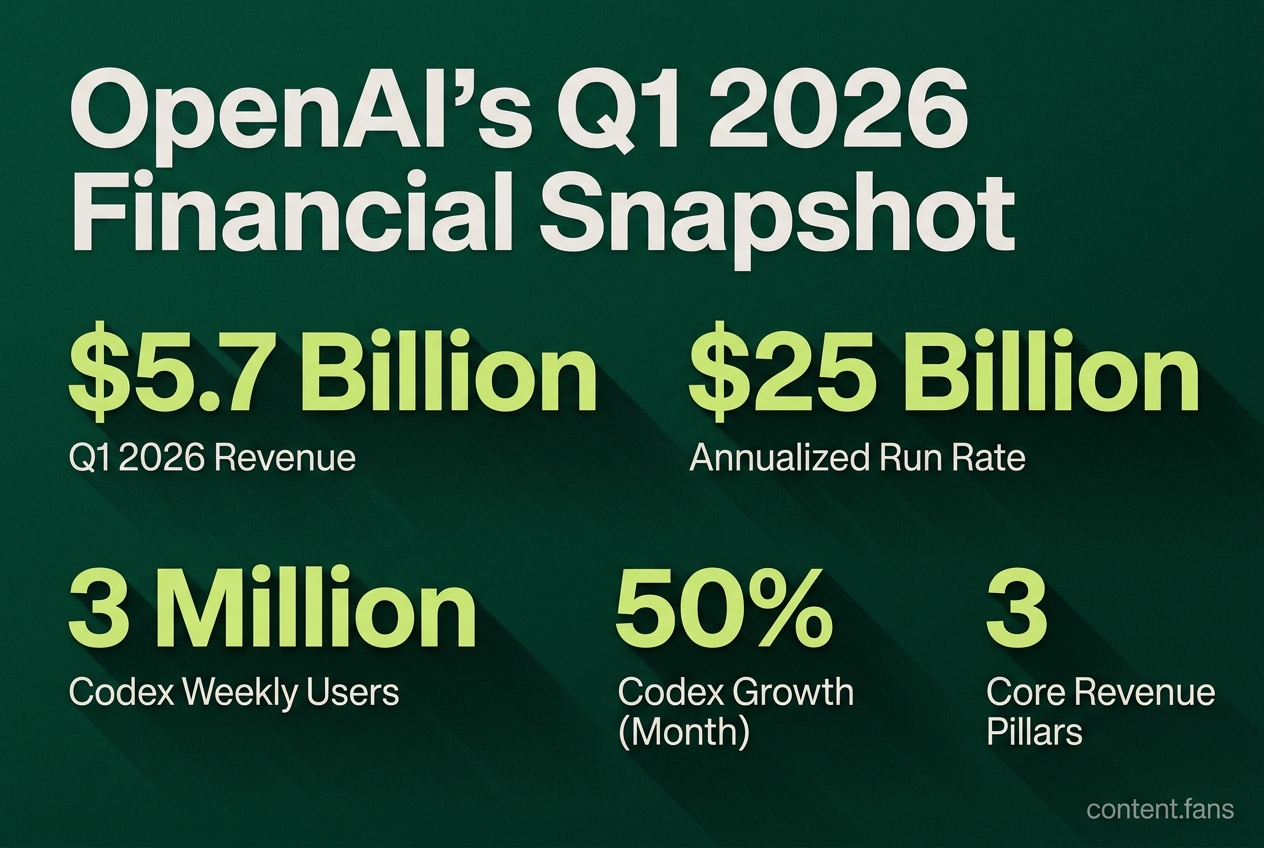
The company's Q1 performance outpaced its nearest competitor, Anthropic, which reported strong revenue in the same period. According to data from a Sacra profile, OpenAI had already achieved a $25 billion annualized revenue run rate by February 2026, with enterprise contracts driving a significant portion of its sales.
Analysts identify three primary revenue streams for the quarter:
- Subscriptions: ChatGPT Plus and enterprise licenses remain the largest contributor.
- API Access: Billed per token, access to foundation models like GPT-4 is a key driver.
- Codex and Other Products: The AI coding assistant was reported to have 3 million weekly users, up from 2 million the month before, and earlier in March 2026 it was reported at more than 1.6 million weekly users, making it one of the fastest-growing products in OpenAI's portfolio.
While a detailed product-level breakdown is unavailable, the rapid growth of Codex highlights the increasing importance of developer-focused AI tools in the company's financial success.
Market Competition and Profitability Concerns
The substantial revenue gap between OpenAI and Anthropic may shrink as both companies compete for enterprise clients. The market is also facing pressure from rivals like Google's Gemini and xAI's Grok, which are competing on price for high-end models. Furthermore, open-source alternatives such as DeepSeek are gaining traction with budget-conscious users.
Despite its revenue growth, OpenAI's profitability remains a concern. The massive scale required for training advanced models increases both capabilities and cloud computing costs, which negatively impacts operating margins. Some reports even estimate a significant negative non-GAAP operating margin, highlighting the company's reliance on compute subsidies from partners like Microsoft.
Implications for Enterprise AI Adoption
As demand for AI coding assistants continues to grow, enterprise buyers are increasingly focused on return on investment (ROI). Monetization is shifting toward usage-based pricing, governance features, and workflow integrations. Vendors who can demonstrate measurable productivity gains and offer robust compliance tools are better positioned to retain market share.
Key indicators for CIOs include Codex's millions of weekly users and the fact that enterprise sales constitute a significant portion of OpenAI's revenue. However, with the supplied sources indicating OpenAI is about $6B ahead of Anthropic in annualized revenue, the market remains highly competitive. This environment suggests that future purchasing decisions will be heavily influenced by switching costs and integrated platform value, not just raw model performance.
What prompted OpenAI to report strong Q1 2026 revenue?
According to The Information, OpenAI closed this quarter substantially ahead of Anthropic, driven mainly by accelerated adoption of Codex, ChatGPT subscriptions, and enterprise API sales. While the exact dollar amount Codex contributed remains undisclosed, external estimates place developer-focused revenue at roughly 20 % of the total, indicating that tools aimed at programmers have become important.
How large is Codex's user base and how fast is it growing?
According to industry reports, Codex was reported to have 3 million weekly users, up from 2 million the month before, and earlier in March 2026 it was reported at more than 1.6 million weekly users. Enterprise seats now account for a significant portion of OpenAI's total revenue, and Codex is bundled into most large-organization tiers, signalling that developer productivity is being monetized at the team level, not only individual licenses.
Which rivals are gaining ground and where?
- Anthropic is the closest rival, with strong reported revenue, though OpenAI maintains a substantial lead.
- Google Gemini and xAI have improved model quality and lower per-token pricing, putting pressure on OpenAI's margins.
- DeepSeek and other open-source families are winning cost-sensitive workloads, which could force OpenAI to re-balance pricing tiers.
Is the current level of revenue sustainable?
According to industry reports, OpenAI faces significant challenges with substantial projected losses despite the revenue surge, mainly from inference and training costs. Key risk factors:
- Compute cost growth continues to rise significantly.
- Buyers are demanding usage-based pricing rather than flat seats, compressing gross margins.
- Enterprise procurement teams now require clear ROI metrics such as time-to-deploy or bugs-prevented per sprint.
What monetization strategies should enterprise buyers expect going forward?
Leading AI developer-tool vendors, including OpenAI, are converging on four revenue models:
1. Tiered consumption pricing - light users pay per token, heavy users buy committed capacity.
2. Enterprise bundles - Codex + ChatGPT Team + security add-ons wrapped into a single contract.
3. Compliance premiums - separate SKUs for audit logs, data residency, and policy enforcement, priced at significant uplifts.
4. Workflow expansion - upselling from code generation into testing, security scanning, and observability modules, lifting ARPU substantially per customer according to Sacra benchmarks.
These shifts mean enterprises should budget for higher costs in year-two contracts if they intend to stay on the latest model versions and governance features.