
Google 2026 Update: Brand Authority Speeds First Recovery Wave
Serge Bulaev
The Google 2026 Update caused many websites to lose search traffic overnight, with drops ranging from 15 to 70 percent. Early data suggests well-known brands and official sites tended to recover faster, sometimes within four to six weeks, while smaller or less trusted sites took longer. Recovery for standard ecommerce sites may happen in two to six months, but for health, finance, and other sensitive topics, it might take six to twelve months or more. Google says there may not be specific steps to guarantee recovery, and full traffic restoration often appears only after another major update. The data also suggests that sites with clear authority and expertise signals may bounce back sooner than those without.

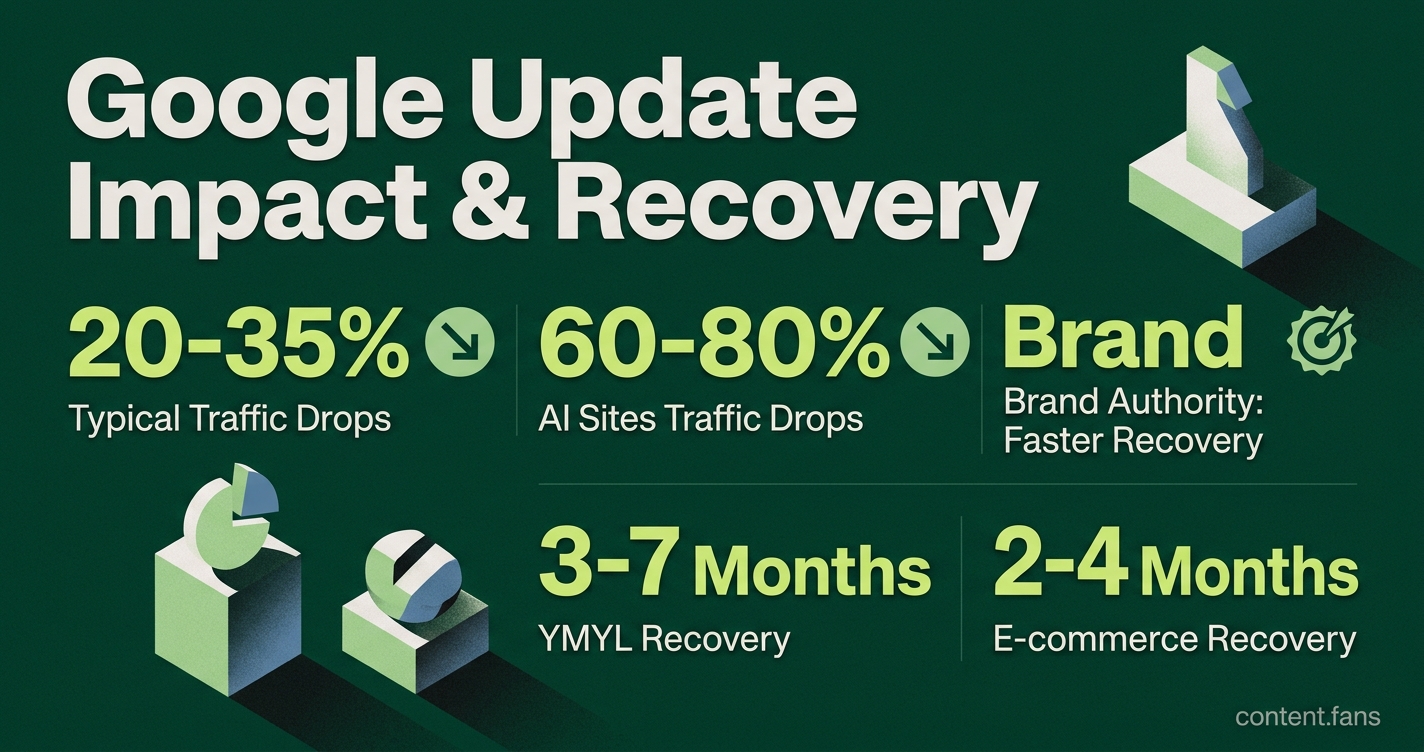
The March 2026 Core Update caused typical traffic drops of 20 - 35% for heavily affected sites, with some pages losing over 50%; programmatic AI sites saw 60 - 80% drops, while generic informational sites lost ~15%, making recovery a top priority for site owners. Analysis of the March and May 2026 core updates shows that sites with strong brand authority are recovering faster according to industry reports. This guide synthesizes data from industry reports to outline realistic recovery timelines, actionable strategies, and Google's official guidance.
Why Brand Authority Is the Key to Faster Recovery
Brand authority emerged as the primary recovery accelerator in 2026. Data shows sites with established domain trust, clear expertise, and official brand status rebounded faster, while aggregator sites and pages with weaker signals saw prolonged drops in visibility.
Following the updates, data confirmed a clear shift favoring established domains. According to industry reports, homepage authority scores for brands showed significant increases. Simultaneously, Search Engine Land reported that aggregator platforms and sites without clear E-E-A-T (Experience, Expertise, Authoritativeness, Trust) signals lost significant visibility. The earliest gains went to official brand sites, government portals, and recognized niche experts, with improvements appearing in the weeks after the rollouts completed.
Google Update Recovery Timelines by Industry
Recovery windows vary significantly by vertical, with YMYL (Your Money or Your Life) and affiliate sites facing the longest paths. Data from firms like Digital Applied and Dataslayer reveals distinct patterns based on content type and industry-specific challenges.
| Industry | Typical Recovery Window | Primary Challenge |
|---|---|---|
| Affiliate Sites | 3 - 7 months | AI Overviews reducing CTR; high content quality threshold. |
| YMYL (Health/Finance/Legal) | 3 - 7 months | Stricter "trust gating" checks and higher E-E-A-T standards. |
| Publishing & News | 2 - 4 months | Over-reliance on syndicated content; lack of original reporting. |
| Standard E-commerce | 2 - 4 months | Thin product descriptions and generic user reviews. |
What Is Google's Official Guidance on Recovery?
Google's official stance is that there is no simple checklist for recovery. The company's Search Guidance documentation states, "There aren't specific actions to take to recover. A negative rankings impact may not signal anything is wrong with your pages." This position has been consistently communicated by Google's Search team.
Instead of a quick fix, Google emphasizes:
- Waiting for stabilization before making drastic changes.
- Focusing on creating helpful, reliable, people-first content.
- Understanding that a full recovery is often not logged until the next broad core update.
A Practical Recovery Playbook for Site Owners
Based on field notes from SEO practitioners, a phased approach offers the best chance for a timely recovery. This sequence prioritizes careful analysis before implementation.
Phase 1: Observation (Weeks 1 - 3)
* Confirm the update rollout is complete via Google's Search Status Dashboard.
* Avoid hasty changes during peak volatility. Map traffic drops against official update dates to isolate the impact.
Phase 2: Audit & Prioritization (Weeks 4 - 8)
* Analyze Search Console data after waiting at least seven full days post-rollout for numbers to stabilize.
* Prioritize fixes on your most valuable pages. Focus on merging cannibalized content and enhancing articles with expert bylines and primary research to boost E-E-A-T.
Phase 3: Ongoing Fixes
* Improve Core Web Vitals: Address pages where LCP is above 2.5s or INP is above 200ms.
* Enhance Content: Instead of deleting underperforming content, follow Google's advice to rewrite or restructure it to better serve user intent.
* Publish Substantively: Aim to have significant content improvements live by week eight, allowing ample time for Google to crawl and re-evaluate them before the next core update.
How to Measure Recovery Progress Accurately
During volatile periods, metrics can be misleading. Analysts recommend using GA4 organic sessions for a cleaner signal initially, as Search Console impressions and clicks can fluctuate wildly.
Compare a seven-day period one month after the rollout completes to the equivalent seven-day period one month before it started. If the negative gap between these two periods narrows week over week, you may be seeing incremental recovery.
Search Console becomes reliable again once impressions stabilize. At that point, look for pages that fell significantly (e.g., from position 4 to 20+), as these may signal deeper quality issues compared to pages that only shifted a few positions.