
CPG Brands Adopt AI for 2026 Shopper Marketing Trends
Serge Bulaev
CPG brands are using AI to make shopping more personal and helpful for customers who care about value and service. Some brands, like Ferrara and Sephora, report big increases in audience size and booking rates by using AI tools to connect shopping and behavior data. Many shoppers are looking for value, so brands are focusing on better packaging and highlighting sustainability instead of just lowering prices. Physical stores are being redesigned to use more technology, such as shelf sensors and AR, so both people and digital agents can shop easily. Inside companies, AI may help teams work faster, but experts warn that AI-generated content should be checked for accuracy, and success often depends on keeping customers loyal.

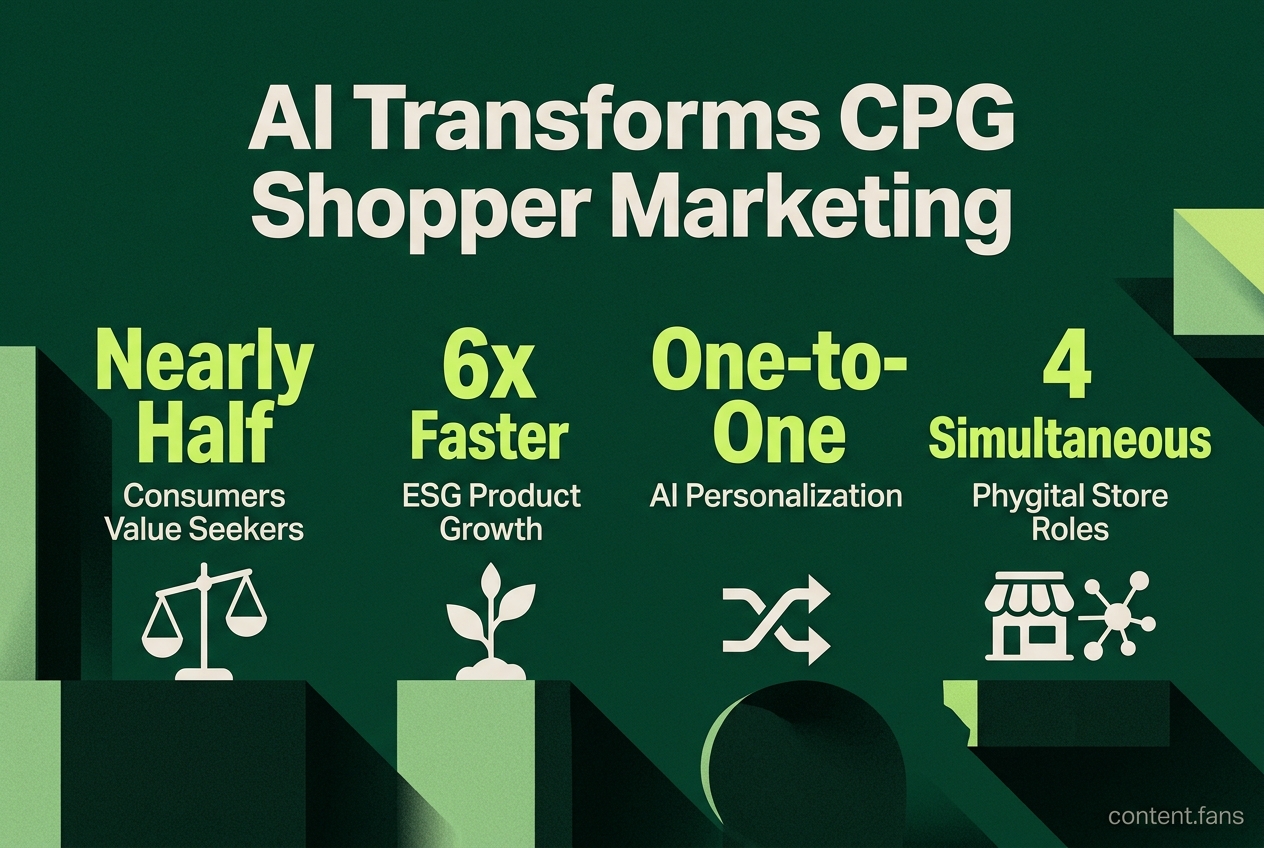
CPG brands are adopting AI for 2026 shopper marketing with a fundamental shift in how they connect with customers. Instead of broad demographic targeting, companies now deploy AI-driven one-to-one personalization and predictive shopper insights to replace outdated models. This evolution comes as nearly half of global consumers identify as "value seekers," demanding more than just low prices.
Leading brands have already demonstrated measurable returns. By unifying first-party data, companies like Ferrara and John Frieda have seen significant gains during product launches. The transformation extends into agentic commerce, where AI agents now handle a substantial portion of enterprise applications. For value-conscious shoppers, the strategy is shifting from price cuts to proving value through sustainability and smarter packaging, as ESG-marketed products grow nearly six times faster than conventional ones.
How are CPG brands using AI to personalize shopper marketing?
CPG brands are leveraging AI to deliver hyper-personalized experiences, moving from general segmentation to one-to-one orchestration. This includes using predictive models for timely replenishment emails, AI chatbots for customer consultations, and dynamic product pages that adapt to individual shopper data to increase conversion and loyalty.
Brands have moved beyond basic segmentation to deploy predictive replenishment, dynamic pricing, and AI-optimized product detail pages. AI now tracks purchase intervals to predict when shoppers need replenishment, triggering proactive outreach. Other brands use AI for service; Sephora's chatbot has significantly improved in-store booking rates by acting as an always-on consultant.
What strategies are brands using to reach value-conscious shoppers without eroding margins?
Rather than universal discounts, brands employ AI-tailored offers by segment: high-value shoppers receive bundle offers, while budget-conscious shoppers get targeted coupons. This approach lifts conversion without eroding margin. The core strategy emphasizes "more-value-for-the-price" (MVP) branding - proving emotional and practical worth rather than competing solely on price. Flavor-first innovation has also become a primary defense against private label competition.
How is technology transforming physical retail experiences for CPG shoppers?
Stores are evolving into experiential hubs through phygital (physical-digital) immersion. Flagship concepts now blend interactive technology with hands-on discovery, serving four simultaneous roles: fulfillment nodes, showrooms, service centers, and media stages for livestreams. This enables contextual offers and dynamic bundles based on real-time, in-store shopper behavior.
What role do AI agents play in 2026 shopper marketing?
Agentic commerce represents a significant operational shift, with AI agents now handling a substantial portion of enterprise applications. Consumers increasingly delegate shopping decisions to these agents rather than browsing manually, requiring CPG brands to ensure product discoverability in AI answer engines. In-store systems are also being developed to recognize and interact with these agents, creating a new discipline of generative engine optimization (GEO).
How are CPG brands improving marketing efficiency through AI integration?
Generative AI workflow automation has significantly reduced the time spent on key marketing tasks, accelerating product launches and increasing marketing ROI. AI-optimized product detail pages that use natural language to answer shopper questions have substantially improved conversion rates. Furthermore, AI-scraped review sentiment is increasingly driving product discovery in AI-powered search engines.