
OpenAI Raises $122 Billion, Expands Datacenter Buildout
Serge Bulaev
OpenAI has raised $122 billion and plans to use the money to build more datacenters, aiming to secure enough computer power before future demand possibly outpaces supply. Big investors include Amazon, NVIDIA, and SoftBank, and some investments depend on OpenAI reaching certain goals like an IPO or major AI achievement. The company is adding new data sites across the U.S., and may soon have much more computing capacity than is needed today. Some analysts and competitors question if the spending makes sense and warn there might be financial risks if revenue does not keep up. OpenAI says owning so much capacity could give them a long-term advantage, but it is not certain if this strategy will work out.

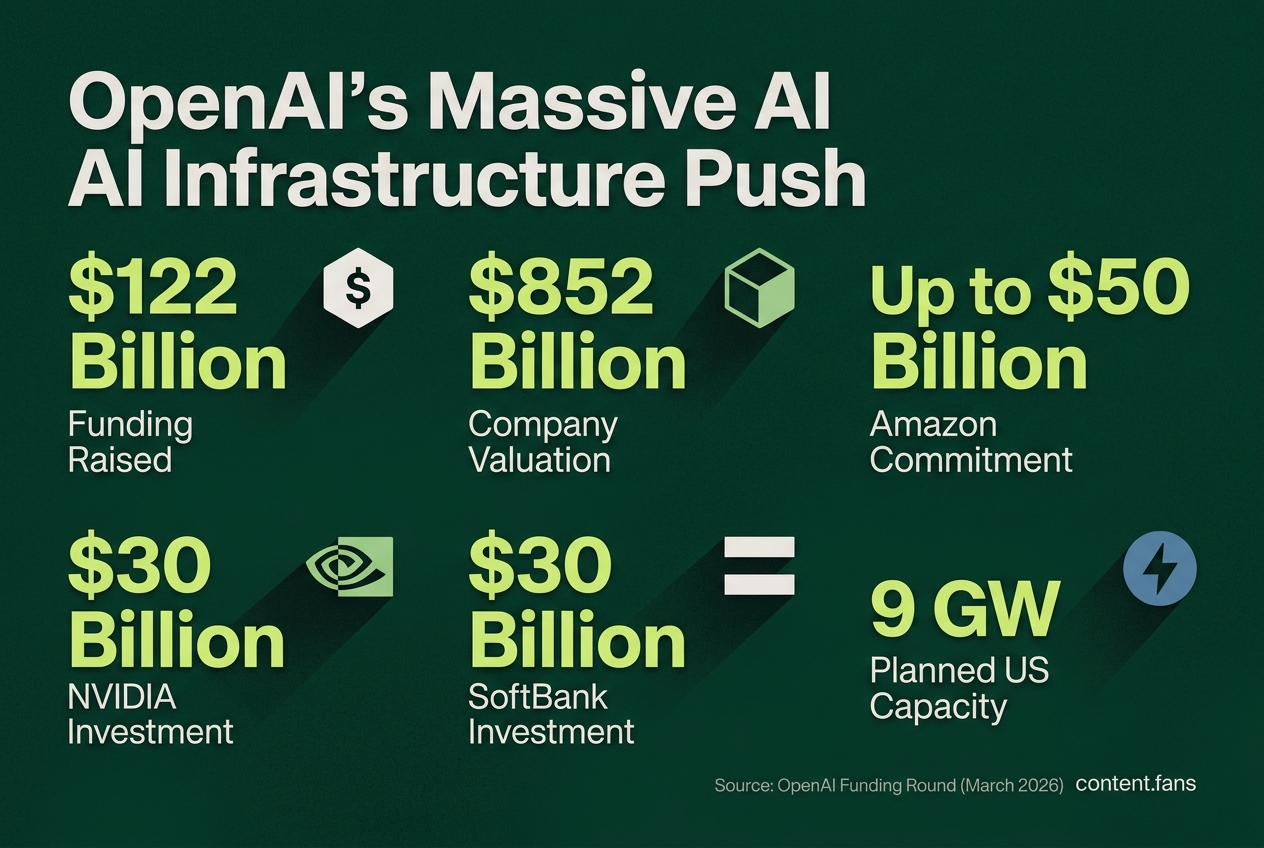
In a landmark move, OpenAI raised $122 billion to fund a massive datacenter buildout, a strategic investment confirmed on March 31, 2026. This funding round established an $852 billion valuation and, for the first time, allowed retail investment through banking channels, as reported by CNBC.
This capital infusion empowers the San Francisco-based firm to accelerate its Stargate infrastructure program. The project's primary goal is to secure essential computing resources and power ahead of anticipated supply shortages driven by the increasing demand for agentic AI.
Key investors and terms
OpenAI's $122 billion round included Amazon, NVIDIA, and SoftBank as major participants, with SoftBank co-leading alongside a16z, D. E. Shaw Ventures, MGX, TPG, and others. The capital is designated for a significant expansion of its datacenter infrastructure, known as the Stargate program, to meet future computational demands for advanced artificial intelligence development.
Official filings identify three anchor investors alongside numerous follow-ons. Amazon's substantial commitment is reportedly tied to performance milestones, a structure that provides downside protection for the cloud provider. The largest contributions include:
- Amazon - up to $50 billion, with $35 billion contingent on an IPO or AGI milestone
- NVIDIA - $30 billion in a mix of equity and long-term purchase contracts
- SoftBank - $30 billion, as a co-lead in the round
- Roughly $12 billion from other investors, plus more than $3 billion aggregated from individual investors
The company also revealed a lending syndicate with JPMorgan Chase, Citi, and HSBC. This arrangement highlights that a portion of the funding is structured more like infrastructure project finance than a traditional venture capital round.
How the capital is being deployed
The capital is primarily directed toward Stargate, a network of hyperscale datacenter campuses operated in partnership with Oracle and SoftBank. According to industry reports, recent updates announced new U.S. sites and a major expansion in Texas, as detailed in OpenAI's joint release. Subsequent filings added another campus, elevating the total planned U.S. capacity to an estimated nine GW.
Industry reports suggest the completed Abilene hub alone could accommodate a significant number of NVIDIA GB200 GPUs. With substantial new Nvidia systems potentially operational by late 2026, OpenAI's capacity would far exceed current needs for frontier AI models. OpenAI leadership justifies the expenditure as a preemptive strategy to secure power, land, and silicon before supply chains face greater constraints.
Rising skepticism from rivals and analysts
However, the massive spending has drawn public skepticism from competitors and analysts. According to industry reports, some analysts have cautioned that firms are making substantial compute agreements that could create financial challenges if revenue growth doesn't keep pace. Industry observers have echoed these concerns, projecting significant cash burn in the coming years, potentially triggering financial pressures without margin improvements.
Critics further contend that this level of infrastructure spending creates a barrier to entry that is insurmountable for most startups. According to industry reports, the substantial cost to train next-generation models effectively limits true competition to a small circle of heavily capitalized companies.
OpenAI's Strategic Rationale
OpenAI's leadership defends the strategy by framing it as a long-term investment in owning strategic capacity. They draw parallels to historical shifts in the semiconductor industry, where early movers secured advantages for over a decade. The ultimate success of this massive bet hinges on two critical factors: the sustained demand for agentic AI and how quickly the company can transition that demand into production-level revenue.