
OpenAI Plans 10GW Ohio Data Center, Eyes Nvidia Backing
Serge Bulaev
OpenAI is in advanced talks to lease a very large data center site in Ohio, which may become one of the biggest projects in AI infrastructure. Reports suggest the deal could include financial help from Nvidia, and the investment may be over $500 billion. The location might be an old energy site in Pike County and could use as much power as a big city, possibly affecting U.S. data-center energy use. Experts warn that building such a large facility may increase costs for utilities and households and could create new risks for the power grid. The project is not final yet and depends on lease approvals and securing enough financing.
OpenAI is advancing plans for a monumental 10GW Ohio data center, a project poised to become one of the largest AI infrastructure investments ever. According to industry reports, the company is negotiating to lease federal land with potential financial backing from Nvidia, a leading AI accelerator supplier.
Industry sources suggest the proposed deal would grant OpenAI operational hardware control via a long-term lease, with payments commencing upon the activation of the first phase. The lifetime investment is expected to represent a significant portion of AI infrastructure spending, accounting for inflation in advanced components and utility connections.
The potential site, reportedly the former Portsmouth Gaseous Diffusion Plant in Pike County, provides ample space and a secure Department of Energy perimeter. A 10GW facility at full capacity would consume substantial electricity annually, potentially raising total U.S. data center consumption significantly by 2028 according to industry projections.
Grid and power-market context
OpenAI's proposed Ohio data center is a massive 10-gigawatt campus planned on federal land, representing a major investment in AI infrastructure. The project, which may receive financial backing from Nvidia, aims to consolidate AI training infrastructure and could significantly impact U.S. power consumption and grid stability.
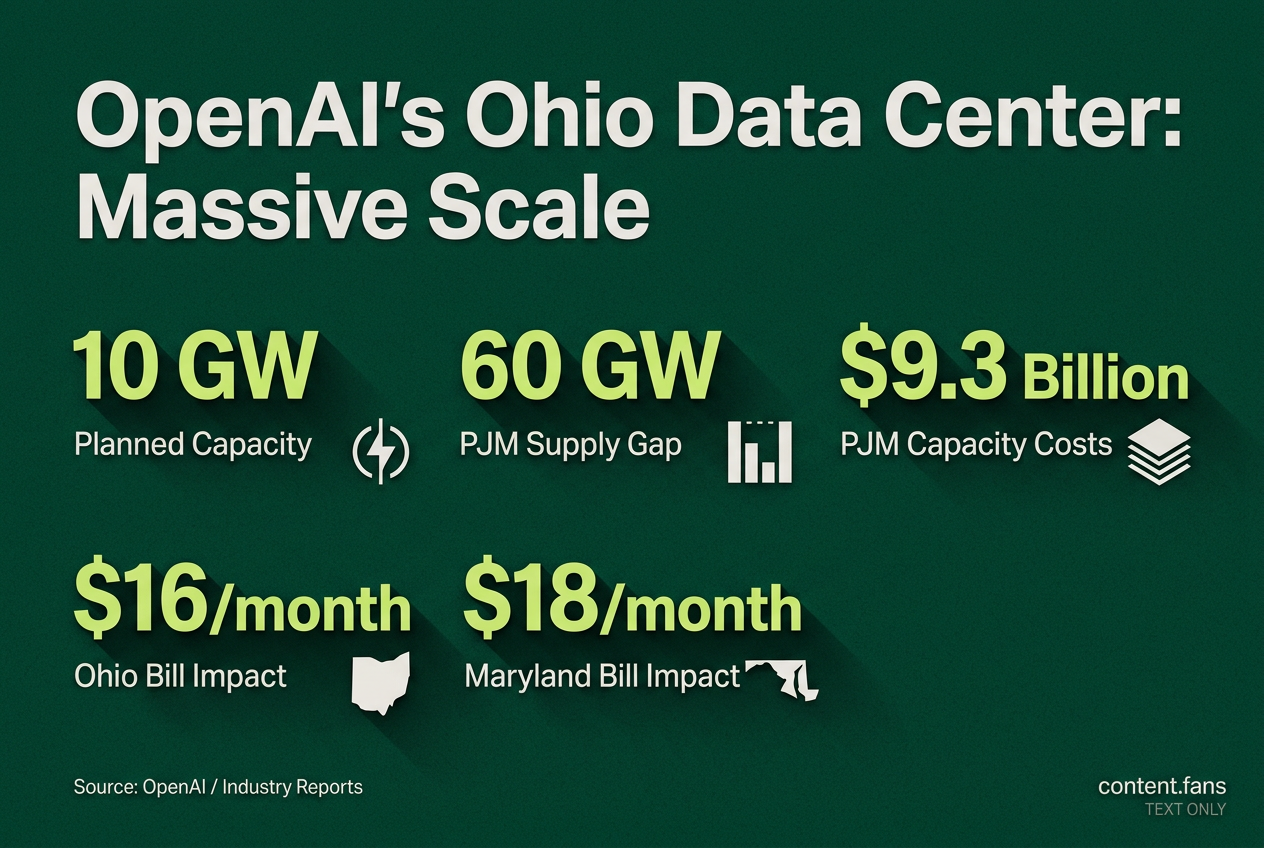
Regional grid operators like PJM are already planning for new capacity amid warnings of a 60GW supply gap within the next decade. The surge in data center development has added substantial capacity costs for recent planning windows. To manage the voltage instability from high-density compute clusters, utilities in Ohio and Virginia are investing in new transmission lines and large-scale storage.
These infrastructure upgrades are already impacting household bills. Data center load was reported as responsible for about $9.3 billion in higher PJM capacity costs, with estimated monthly bill impacts of about $16 in Ohio and $18 in western Maryland. If the OpenAI project moves forward, these costs could rise further without corresponding increases in power generation and transmission.
Financing signals
The project's cost far exceeds OpenAI's balance sheet, highlighting a shift toward alternative financing. A significant portion of the funding needed for global AI compute through 2028 is expected to come from outside capital. AI infrastructure financing increasingly uses operating/finance leases, SPV/project-finance structures, and GPU-collateralized debt such as CoreWeave's $7.5 billion facility led by Blackstone.
Nvidia is reportedly being considered as a potential partner, aligning with a trend of vendor-anchored credit. While major firms like Apollo, Goldman Sachs, and JPMorgan are exploring AI infrastructure financing, they have no confirmed connection to the Ohio project.
Strategic implications
While a campus of this scale offers significant economies for training advanced AI models, it also concentrates major risks related to grid stability, supply chains, and capital markets. The outcome of this project will likely set a precedent for how regulators handle land use, grid interconnections, and financing for future hyperscale developments. According to industry reports, OpenAI has not officially commented, and the project remains contingent on lease and financing approvals.
What exactly is OpenAI proposing in Ohio and how big is it?
OpenAI is reportedly in advanced negotiations to lease a proposed 10-gigawatt federal data-center campus in Ohio, according to multiple stories citing The Information.
- 10 GW of power represents substantial electricity consumption at full load, a significant portion of projected U.S. data-center electricity demand.
- The site is said to be on U.S. Department of Energy land, most likely the former Portsmouth Gaseous Diffusion Plant in Pike County.
- According to industry reports, OpenAI would control the equipment under a long-term lease arrangement.
Why does a single 10 GW site matter for AI training?
A 10 GW facility would let OpenAI run sustained, high-throughput training runs on a single footprint instead of spreading workloads across many smaller clusters.
- Economics: concentrating compute can drive per-unit training costs down through tighter integration with hardware vendors and lower network latency.
- Scale comparison: today's largest AI sites draw 0.5-1 GW, so the proposed campus would be an order of magnitude larger than anything currently operating.
How would the deal be financed and what role could Nvidia play?
Under the current outline, Nvidia has been floated as a possible financial or strategic backer, although no binding agreement has been confirmed.
The broader market is already moving toward vendor-anchored and outside capital structures:
- Blackstone led a $7.5 billion private-credit facility for CoreWeave collateralized by GPUs and customer contracts.
- GPU-backed operating leases, sale-leasebacks, SPV project finance, and securitized notes are replacing traditional corporate debt for hyperscalers.
- Analysts estimate a significant portion of the funding needed for global AI build-out will come from private credit and structured finance vehicles.
What does 10 GW of new demand mean for the U.S. power grid?
Grid studies warn that even incremental data-center growth is already straining the system; adding 10 GW in one location would intensify these pressures.
- Regional price impact: PJM's 2025-26 capacity auction produced sharply higher prices, and coverage attributes a large part of the increase to rising data-center demand.
- Transmission bottlenecks: utilities may need multi-billion-dollar upgrades to substations and long-distance lines; PJM alone has flagged potential supply shortfalls of up to 60 GW in coming decades.
- Reliability episodes: voltage fluctuations can affect concentrated data center loads, illustrating how sensitive these facilities can be to grid instability.
What happens next and what key milestones should we watch?
- Near term: industry reports suggest environmental reviews and lease negotiations with the Department of Energy may be expected.
- Medium term: power procurement contracts, grid-interconnection studies, and construction financing would need to be secured - watch for filings with PJM and Ohio regulators.
- Longer term: the first phase is reportedly targeted for the coming years; any delay in generation, transmission, or semiconductor supply could affect the timeline.