
OpenAI Pivots Stargate Strategy, Names New Infrastructure Leaders
Serge Bulaev
OpenAI has changed its plan for building computer infrastructure. Instead of one giant data center, it now uses a mix of rented cloud space, its own smaller sites, and regional partners. Reports suggest this new approach may help OpenAI get computer chips faster and avoid big financial risks. The company also named Sachin Katti to lead the new infrastructure team. Spending plans have been reduced, and OpenAI appears to be focusing on flexibility and different ways to get computing power.

In a significant strategic shift, OpenAI pivots its Stargate strategy, moving away from constructing a single mega-data-center network. This new approach involves a diversified portfolio of rented cloud capacity, targeted self-funded sites, and regional partnerships. To lead this new direction, OpenAI has appointed veteran technologist Sachin Katti to run its reorganized industrial-compute group.
How the Stargate Idea Was Reframed
OpenAI's Stargate pivot redefines the project from a singular mega-data-center build into a flexible, multi-channel compute strategy. This portfolio model now blends rented cloud capacity with targeted, self-funded regional sites and strategic partnerships to accelerate GPU access while mitigating long-term capital investment risks.
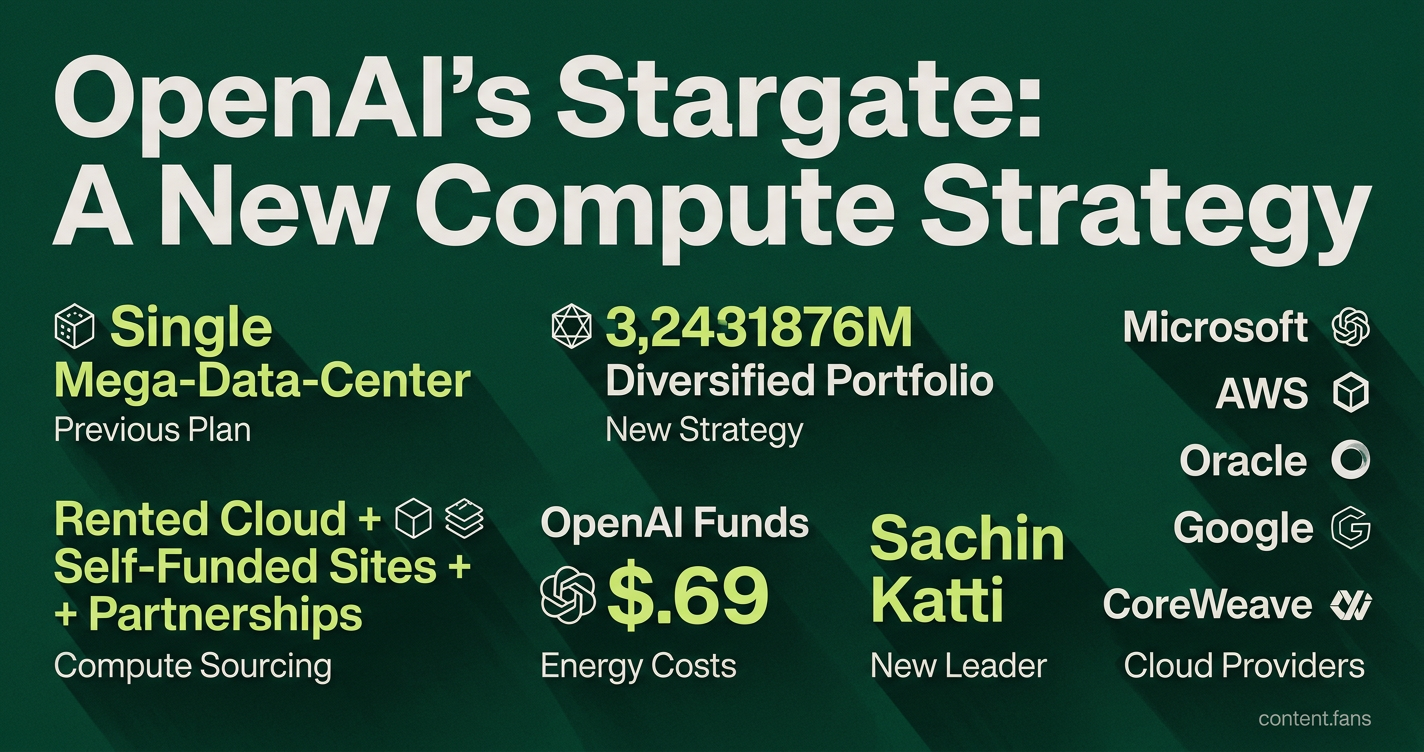
Initially framed as a stand-alone venture in 2025, Stargate is now described by leadership as an "umbrella term" for various compute-sourcing tactics. Industry reports suggest this shift reflects a significant scaling back of the original spending commitments, with the company moving toward a more flexible approach that emphasizes renting infrastructure rather than building it from scratch.
According to a Stargate Project guide, the program is now structured into three teams reporting to Katti: design, commercial partnerships, and facility operations. Analysts suggest this structure enables a flexible strategy, combining short-term cloud rentals with selective long-term builds in economically favorable locations.
Compute, Energy, and Cloud Impacts
OpenAI has publicly committed to funding all energy-related upgrades at its Stargate sites, ensuring costs are not passed to local utilities or ratepayers, as noted in Bloomberg coverage. This pledge aims to foster grid stability and community acceptance while the company seeks scalable, low-carbon power sources.
To meet immediate compute needs, OpenAI is leveraging multi-cloud contracts with providers including Microsoft Azure, Amazon Web Services, Oracle, Google Cloud, and CoreWeave. While renting provides faster GPU access than ground-up construction, it also introduces potential exposure to volatile spot-market pricing.
Possible Ripple Effects for Vendors and Enterprises
The strategic pivot has significant ripple effects for vendors and partners:
- Cloud Providers: While Microsoft remains the primary partner, it loses exclusivity. Competitors like AWS and Oracle now gain incremental OpenAI workloads.
- Chipmakers: Nvidia, AMD, and Broadcom are poised to benefit from substantial, multi-year orders for GPUs and accelerators to fuel Stargate's capacity needs.
This shift to a rental-heavy model has led to tactical adjustments across various planned facilities. Experts interpret these moves as a preference for a modular, flexible supply chain that can adapt to demand spikes, rather than being locked into a static infrastructure footprint.
Leadership Signal
The appointment of former Intel AI chief Sachin Katti to lead the revamped compute division signals a clear drive toward professionalized supplier management. His mandate is to integrate architectural design with commercial negotiations, aligning decisions on power, silicon, and real estate. This suggests OpenAI now treats infrastructure as a dynamic operating system - where flexibility, cost, and scale are continuously optimized - rather than a single, massive construction project.
While OpenAI's initial 2025 vision was "building the infrastructure for the Intelligence Age," recent spending adjustments and leadership changes confirm a continued, massive investment in compute. The key difference is the pivot to a more diversified and flexible set of sourcing channels.
What exactly is the 'Stargate' pivot OpenAI announced in 2026?
'Stargate' began as a headline-grabbing $100 - 500 billion plan to construct OpenAI-owned, U.S.-based mega data centers. By May 2026 the term had been reframed into an umbrella label for a multi-channel compute-sourcing strategy that mixes rented cloud capacity (Microsoft Azure, AWS, Oracle, Google Cloud, CoreWeave), self-funded regional sites, and energy infra upgrades paid for by OpenAI itself.
- Original vision: Build-and-own flagship sites in key strategic locations.
- 2026 reality: Significant adjustments to planned facilities, with greater emphasis on flexible partnerships and leasing arrangements.
Bottom line: less concrete pouring, more flexible contracts.
Who are the new infrastructure leaders and what do they control?
OpenAI tapped Sachin Katti, former Intel AI chief, to head its reorganized industrial-compute division. Katti split the unit into three teams:
1. Design - architecture and hardware road-map (GPUs, custom ASICs, power delivery).
2. Commercial partnerships - cloud contracts, chip supply deals (Nvidia, AMD, Broadcom), regional utility PPAs.
3. Facility operations - site selection, permitting, energy-cost negotiations.
The structure lets OpenAI treat compute like an OS - picking the best channel per workload instead of locking everything into one build.
How does the pivot change OpenAI's hardware and vendor mix?
- Less Nvidia-only risk: OpenAI has signed multi-year supply pacts with Nvidia, AMD and Broadcom for both GPUs and custom accelerators.
- Multi-cloud reach: AWS is now an approved inference host; Oracle and CoreWeave also carry OpenAI models. Microsoft retains the largest share but loses exclusivity.
- Energy as a lever: OpenAI agreed to cover all grid-upgrade costs at Stargate sites, a promise worth hundreds of millions that keeps regulators and rate-payers happy and speeds permits.
What should enterprise buyers expect from this strategy shift?
Opportunities
- Choice of cloud - AWS-native companies can run ChatGPT or Codex on Bedrock without re-platforming.
- Better negotiating leverage - multi-vendor competition drives prices down and SLAs up.
- Regional flexibility - new regions come online faster via rental contracts than bespoke builds.
Watch-outs
- Contract complexity - different feature sets, support tiers and egress fees across clouds.
- Capacity discipline - ask whether reserved instances are contractually guaranteed or subject to burst pricing.
- Dual-cloud governance - prepare IAM, logging and data-residency policies that span multiple providers.
How will the broader cloud and chip ecosystem feel the impact?
| Stakeholder | 2026 Effect | Evidence |
|---|---|---|
| Microsoft Azure | Remains primary but no longer exclusive; loses guaranteed volume leverage | Built In, Nextgov |
| AWS, Oracle, CoreWeave | Gain incremental GPU workloads and new cross-sell opportunities | Same sources |
| Nvidia, AMD, Broadcom | Higher near-term orders as OpenAI diversifies silicon portfolio; long-term risk mitigated by multi-vendor stance | TechCrunch |
| Enterprise buyers | More leverage but must manage multi-cloud compliance overhead | Multiple enterprise analyses cited above |