
OpenAI, Microsoft, Google Ship Enterprise AI Agents Ahead of EU Act
Serge Bulaev
OpenAI, Microsoft, and Google have each released new AI agents for businesses, which may signal a shift in how companies use AI in daily work. These agents are designed to run tasks automatically, share progress, and follow rules for safety and privacy. Google's and Microsoft's tools appear to help teams automate tasks and handle routine jobs, but setup and costs might vary. The European Union has set August 2, 2026, as a key deadline for new AI rules, suggesting that companies must make sure their AI systems are well-documented and follow strict controls. This may mean that both speed in creating AI and following new laws will become very important for companies in the coming year.

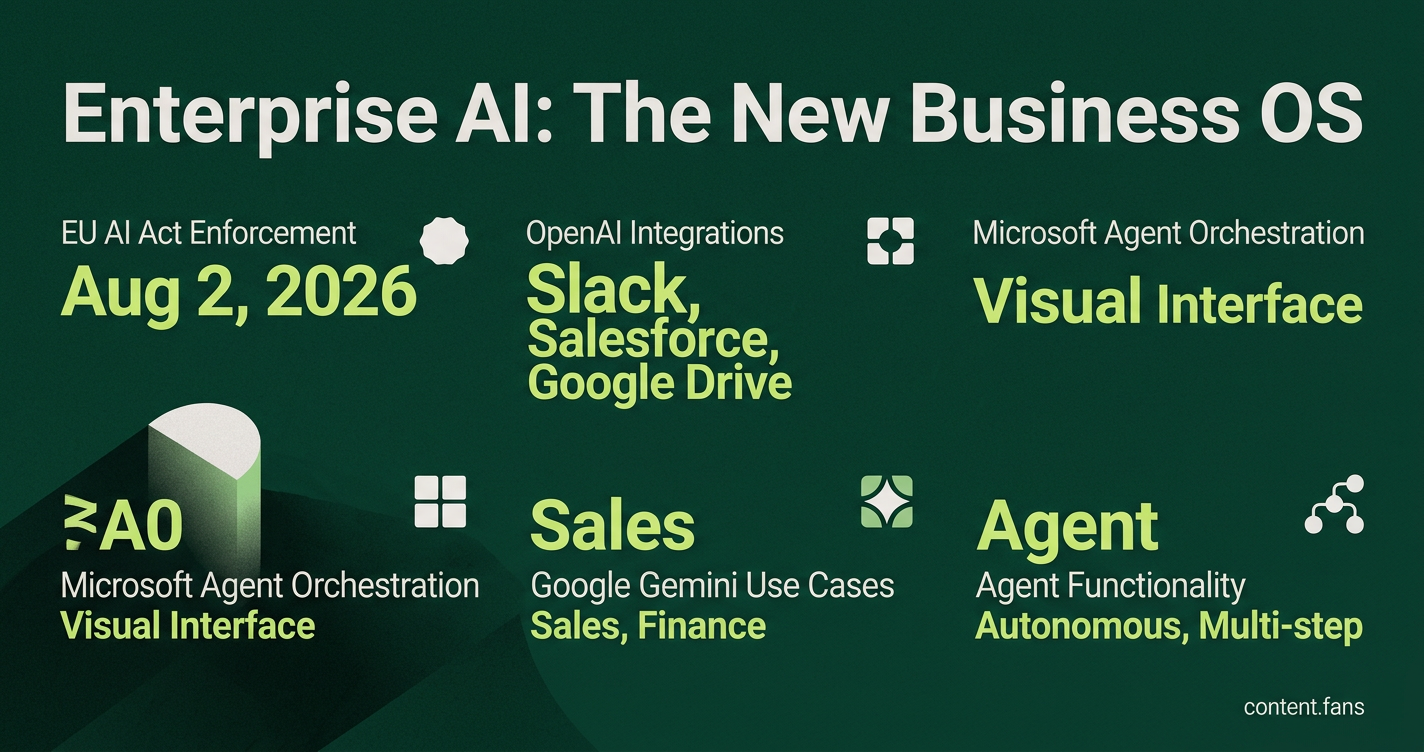
In a pivotal move, OpenAI, Microsoft, and Google ship enterprise AI agents, transforming AI from a simple productivity tool into a core business operating system. This execution-layer pivot coincides with the EU AI Act's staggered timeline, with major enforcement starting August 2, 2026, with some extensions to 2027/2028, establishing both execution speed and governance quality as key competitive differentiators.
According to industry reports, recent enterprise launches are establishing a new operating layer for business: OpenAI Workspace Agents, Microsoft Agent Framework developments, and enhanced Google Cloud capabilities. These new platforms enable agents to operate autonomously, share state across tasks, and adhere to built-in compliance controls.
OpenAI and Microsoft embed agents in live workflows
These enterprise AI agents are advanced autonomous systems designed to execute complex, multi-step business processes without direct human supervision. They integrate with existing software, automate routine workflows, and are built with governance and security protocols to operate reliably within corporate environments, heralding a new era of automation.
OpenAI launched its Workspace Agents with confirmed integrations including Slack, Salesforce, and Google Drive (research preview), with Microsoft 365 in development, as noted by LinkedIn analyst Jon Goodey link. According to early access details from DeepSense AI, their "Runner + RunState" architecture captures a snapshot of each step, allowing for resumable tasks and critical human-in-the-loop reviews link.
Key pillars for Workspace Agents:
- Background execution without a human at the keyboard
- Native sharing so teams reuse agent templates
- Permission-scoped access with auditable logs
Microsoft has responded with developments in its Agent Framework. According to industry reports, the framework provides a visual interface for orchestrating multiple agents, using checkpoints to ensure fault tolerance and persist state. Microsoft's agent capabilities reportedly offer discovery, observation, and governance for agents across Azure, SaaS, and on-premises environments. In practical applications, Copilot Studio has automated a significant portion of routine queries, leaving complex reasoning tasks for pro-code agents.
Google pushes Gemini deeper into day-to-day work
Google Cloud is leveraging Gemini Enterprise to automate complex workflows within Google Workspace. According to industry reports, demonstrated use cases feature sales agents that consolidate data from Gmail, Google Meet, and Salesforce into concise account briefs. Similarly, finance teams are using agents for treasury reconciliation, comparing SAP records with banking APIs and improving accuracy via an Agent Memory Bank. In another example, a telecom company reportedly improved support ticket response times by automating the triage of a significant portion of incoming emails with Gemini.
Implementation effort varies. While the no-code Agent Designer handles straightforward tasks, integrating with custom ERP systems typically requires the Vertex AI SDK or partners like n8n. Organizations must also consider costs, as advanced agent capabilities are tied to premium Ultra or Pro tiers, with compute charges scaling based on usage.
Governance deadlines tighten inside the EU
Although the EU AI Act became law in 2024, it is being implemented in phases. A critical deadline is August 2, 2026, when high-risk AI rules (Annex III), Article 50 transparency requirements, innovation measures, and enforcement mechanisms take effect, with sandboxes required, as confirmed by the European Commission's timeline link. Article 6(1) requirements are delayed to 2027. According to analysis from DataGuard, this means operators of high-risk systems - including those used for biometrics or essential public services - must have robust classification, incident handling, and documentation procedures in place by that date link.
The Act includes retroactive clauses, meaning AI systems deployed before the deadline will still be subject to its rules if they undergo significant modifications. Before enforcement begins, EU member states must establish penalty frameworks and create at least one regulatory sandbox. For enterprises deploying AI agents now, this necessitates a parallel investment in comprehensive audit trails, strict access controls, and diligent post-market monitoring.
This convergence of vendor innovation and regulatory pressure establishes a new industry standard. Modern agentic platforms must include state management, orchestration visibility, and compliance hooks as core features, not afterthoughts. OpenAI, Microsoft, and Google have already integrated these capabilities into their production systems, setting the stage for the next 15 months to be a race toward scale, reliability, and verifiable governance.
What exactly are "execution layer" agents, and how do OpenAI and Microsoft versions differ?
According to industry reports, OpenAI's Workspace Agents run as background, scheduled, or trigger-based micro-services inside a single tenant. Each agent stores its full state in a serializable RunState object, so it can pause for human approval and resume without memory loss. Microsoft's Agent Framework is reportedly an orchestration bus that chains multiple agents into workflows with checkpoints, sandboxed runtimes, and built-in DevUI for real-time observability. In short, OpenAI ships single agents that act, while Microsoft ships a control plane that coordinates fleets of agents.
Which enterprise systems can these agents touch on day one?
OpenAI lists confirmed integrations including Slack, Salesforce, Google Drive (research preview), and Microsoft 365 in development. Microsoft keeps the list Azure-centric but adds MCP and A2A protocol support, meaning any system that exposes a Model Context Protocol endpoint - SAP, ServiceNow, on-prem SQL - can be enrolled without custom code. Both vendors use managed OAuth layers (Composio for OpenAI, Agent 365 for Microsoft) so IT keeps the keys, agents keep the scope.
How does the EU AI Act change on 2 August 2026, and do these agents fall under it?
On August 2, 2026: High-risk AI rules (Annex III), Article 50 transparency requirements, innovation measures, and enforcement mechanisms start, with sandboxes required. Article 6(1) is delayed to 2027. The Act applies retroactively if you materially alter an agent after that date. Fines reach €30 M or 6 % of global turnover, and every EU member state must have at least one AI regulatory sandbox ready. If your agent can deny a loan, short-list a candidate or control infrastructure, expect mandatory risk-classification, documentation, human oversight and post-market monitoring.
What concrete workloads are Google Gemini agents already automating?
According to industry reports, Google Cloud customers are using the no-code Agent Designer to:
- Build sales briefs that pull Gmail, Meet notes and Salesforce pipeline into summary memos
- Run treasury reconciliation between SAP and banking APIs, learning from past false positives via an Agent Memory Bank
- Triage a significant portion of routine support tickets by reading Gmail, ServiceNow and Salesforce, improving response times
- Generate pitch decks that combine campaign ROI data from Salesforce with auto-created Slides for prospects
These capabilities are reportedly available, but custom SAP fields or non-Google connectors still require Vertex AI SDK and careful permission scoping.
Who is ahead in the race - OpenAI, Microsoft or Google - and what should CIOs do now?
According to industry reports, recent months represent an "enterprise agent tipping point" because multiple major stacks became generally available in close succession. OpenAI wins on immediate SaaS breadth, Microsoft on governance and hybrid low-code/pro-code balance, Google on Workspace-native user experience. There is no single leader; the winner will be the enterprise that pilots fastest while documenting risk. CIOs should:
1. Inventory every AI workflow that touches employment, credit or safety before August 2026
2. Pick one vendor stack for 90-day proof-of-value instead of waiting for a perfect multi-cloud abstraction
3. Enable audit trails and human-in-the-loop checkpoints on day one - the EU Act rewards "explainable by design" systems with lower fines and faster sandbox entry