
OpenAI Launches Personal Finance Tools for ChatGPT Pro Users
Serge Bulaev
OpenAI has launched new personal finance tools for US ChatGPT Pro users, allowing them to connect their bank accounts through Plaid and see live financial data in their AI chats. This feature may help users get more accurate answers about their spending, budgeting, and subscriptions. OpenAI says the tool only has read-only access, and users can disconnect at any time, with data usually deleted within 30 days. There are concerns about privacy and how long data is kept, and experts suggest these issues might affect how many people use the new tools. Whether people will trust AI with their money management may depend on how well OpenAI handles privacy and accuracy questions.

OpenAI has launched new personal finance tools for its U.S.-based ChatGPT Pro users, introducing a feature that connects real-time bank data directly into their AI conversations. This early release, targeting the growing number of finance-related questions asked by users, uses Plaid to link with thousands of financial institutions. This allows ChatGPT to analyze balances, transactions, and investments without accessing full account numbers, according to TechCrunch. The shift from generic advice to context-aware answers could redefine how users manage budgets, plan goals, and audit subscriptions.
How the Plaid connection works
The feature allows users to authorize a secure, read-only connection to their financial accounts via Plaid. ChatGPT can then analyze live data from checking, savings, investment, and loan accounts to provide context-aware answers about spending, budgeting, and financial planning, all within a conversational chat interface.
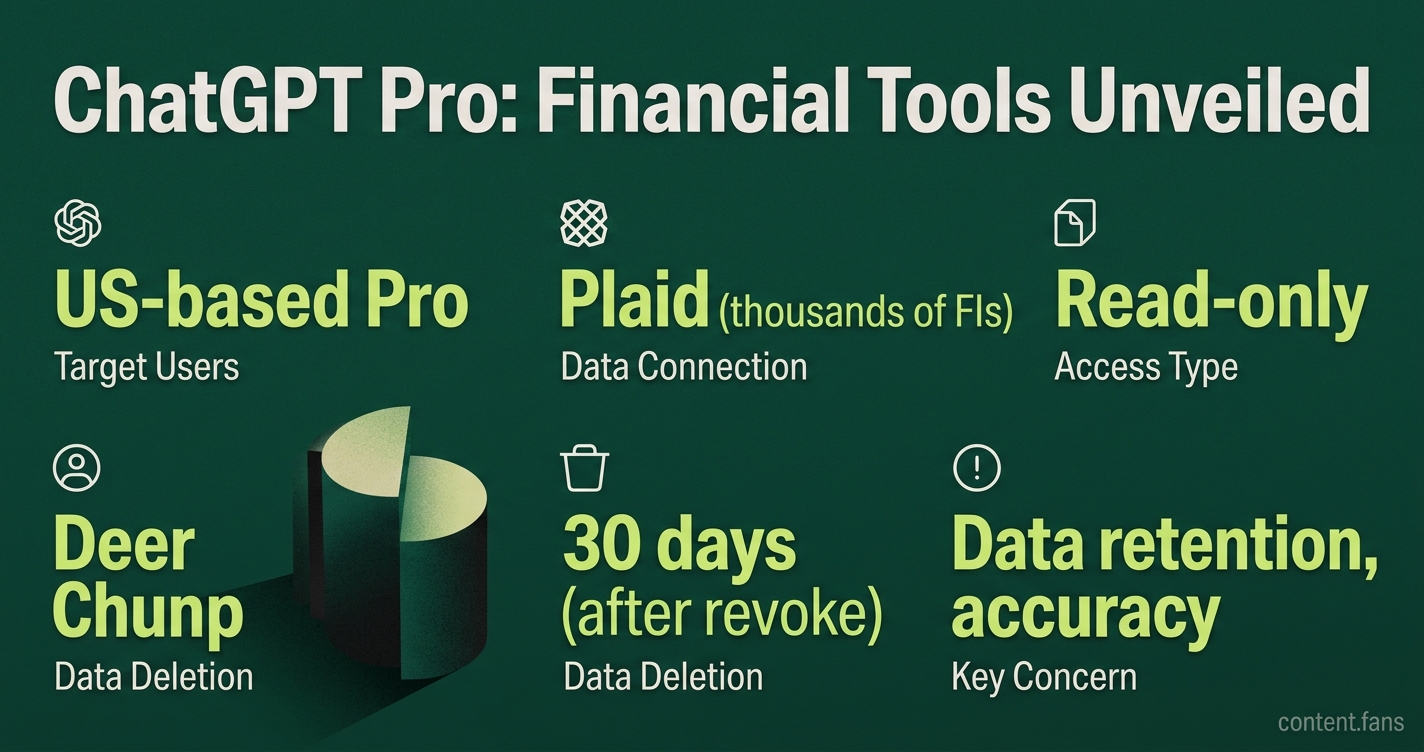
Once a user authorizes the connection, ChatGPT can display dashboards highlighting spending patterns, upcoming bills, and portfolio performance. Users can ask conversational questions like, "Have my grocery costs increased since January?" or "What is the impact of paying an extra $200 toward my loan?" ChatGPT provides answers using tables and clear summaries based on live data. OpenAI strongly emphasizes the tool's read-only permissions, confirming it cannot initiate transfers or see full account details. As The Verge notes, users can revoke access anytime, with their data being deleted within 30 days.
Early security and privacy questions
The integration of sensitive financial data with AI chat logs is drawing significant scrutiny. TNW describes banking details as "the most intimate data category left," suggesting intense observation from regulators, privacy advocates, and consumers. Key concerns include:
- The concentration of financial history and personal conversations in a single platform.
- The 30-day data retention window after an account is disconnected.
- Ambiguity regarding how long financial data persists in system backups.
- The risk of receiving inaccurate or "hallucinated" financial advice.
To address this, OpenAI allows users to delete specific financial "memories" or use temporary chats that are not saved, according to Mashable. However, experts agree that widespread adoption will depend heavily on the company's data retention policies and the model's reliability.
Potential impact on advisors and fintech
Industry analysts view this feature as a significant move toward making AI a primary interface for personal finance management. It can automate tasks like identifying unnecessary subscriptions or flagging investment risks - duties that often overlap with entry-level financial advisory work, as SiliconANGLE points out. This could lead human advisors to focus more on high-level interpretation and fiduciary oversight, leaving routine data analysis to AI. Consequently, fintech apps centered on simple dashboards may face increased competition from a single, conversational tool. TechCrunch reports OpenAI is planning future integrations, including Intuit, to broaden ChatGPT's capabilities into tax and credit analysis.
OpenAI is positioning this initial rollout to U.S. Pro users on web and iOS as a learning phase. The company plans to gather user feedback to refine the model before extending access to Plus subscribers and eventually all users. Ultimately, whether consumers will trust and adopt AI for money management hinges on how effectively OpenAI addresses the critical questions surrounding data privacy, model accuracy, and overall accountability.
What exactly does ChatGPT's new finance feature do for Pro users?
The integration allows U.S. ChatGPT Pro subscribers to connect checking, credit, investment and loan accounts through Plaid. Once linked, ChatGPT can:
- show real-time balances, transactions, investments and liabilities
- spot spending patterns and unused subscriptions
- model "what-if" scenarios such as the effect of a stock sale on taxes or the odds of qualifying for a new credit card.
OpenAI stresses the assistant can read only this data; it cannot see full account numbers or move money.
Which banks and apps can I link?
Through Plaid, the service covers thousands of financial institutions - virtually every major U.S. bank, credit-union, brokerage and fintech app that already supports services like Venmo or Robinhood. You connect each account once inside ChatGPT and can revoke permission at any time.
How secure is my data and what stays private?
- Limited read-only scope: balances, transactions, investments and liabilities - no access to account numbers or credentials.
- 30-day deletion window: if you unlink an account, synced data is purged from ChatGPT servers within 30 days (per TechCrunch and The Verge).
- Granular controls: users can delete individual "financial memories," use temporary chats that are not saved, or wipe the entire history on the Finances page.
Regulators and privacy advocates are watching closely because conversational logs plus banking data is the "most intimate data category left," as TNW notes.
Who can use the feature right now and will it expand?
Currently the rollout is a preview for U.S.-based ChatGPT Pro users paying $200 per month (web and iOS). OpenAI says it will gather insights from early usage and then extend the feature to Plus users, with the goal of offering it to all customers after the preview phase.
Could this replace my financial advisor or budgeting apps?
- Routine tasks - subscription audits, basic budgeting questions, cash-flow summaries - may now start inside ChatGPT instead of a separate app, putting pressure on generic budgeting tools.
- Human advisors remain essential for fiduciary duty, complex tax strategies and behavioral coaching. The trend is toward "advisor + AI co-pilot", where professionals use ChatGPT to speed up data aggregation and scenario modeling.