
OpenAI Launches $4B Enterprise AI Deployment Unit, Acquires Tomoro
Serge Bulaev
OpenAI has started a new $4 billion unit to help companies use AI in their most important work. The unit is supported by several investors and consulting firms, and OpenAI plans to add about 150 engineers by buying Tomoro, if regulators approve. The goal appears to be helping businesses find the best uses for AI and connect it to their own systems. Some experts think this move may increase competition and dependence on model providers like OpenAI. Success might look like more companies using AI in banking, retail, and telecom, but there could be challenges with integration and scaling.

OpenAI announced the OpenAI Deployment Company to help businesses build and deploy AI, and said it had agreed to acquire Tomoro. The move, disclosed in May 2026, establishes a dedicated 'Deployment Company' to help businesses scale AI beyond pilot programs. Analysts view this as a strategic pivot toward outcome-focused services that will directly challenge established cloud providers and consulting firms.
A Strategic Alliance of Capital and Expertise
Backed by a $4 billion financing round led by TPG, the venture brings together a formidable coalition of investors and partners. The roster includes prominent firms like Advent, Bain Capital, Goldman Sachs, and SoftBank. Implementation will be driven by consulting giants such as Capgemini and McKinsey, with BBVA participating as a key strategic enterprise partner. To accelerate its capabilities, OpenAI has also moved to acquire Tomoro, a deal poised to add approximately 150 forward-deployed engineers to staff its new hands-on implementation arm pending regulatory approval.
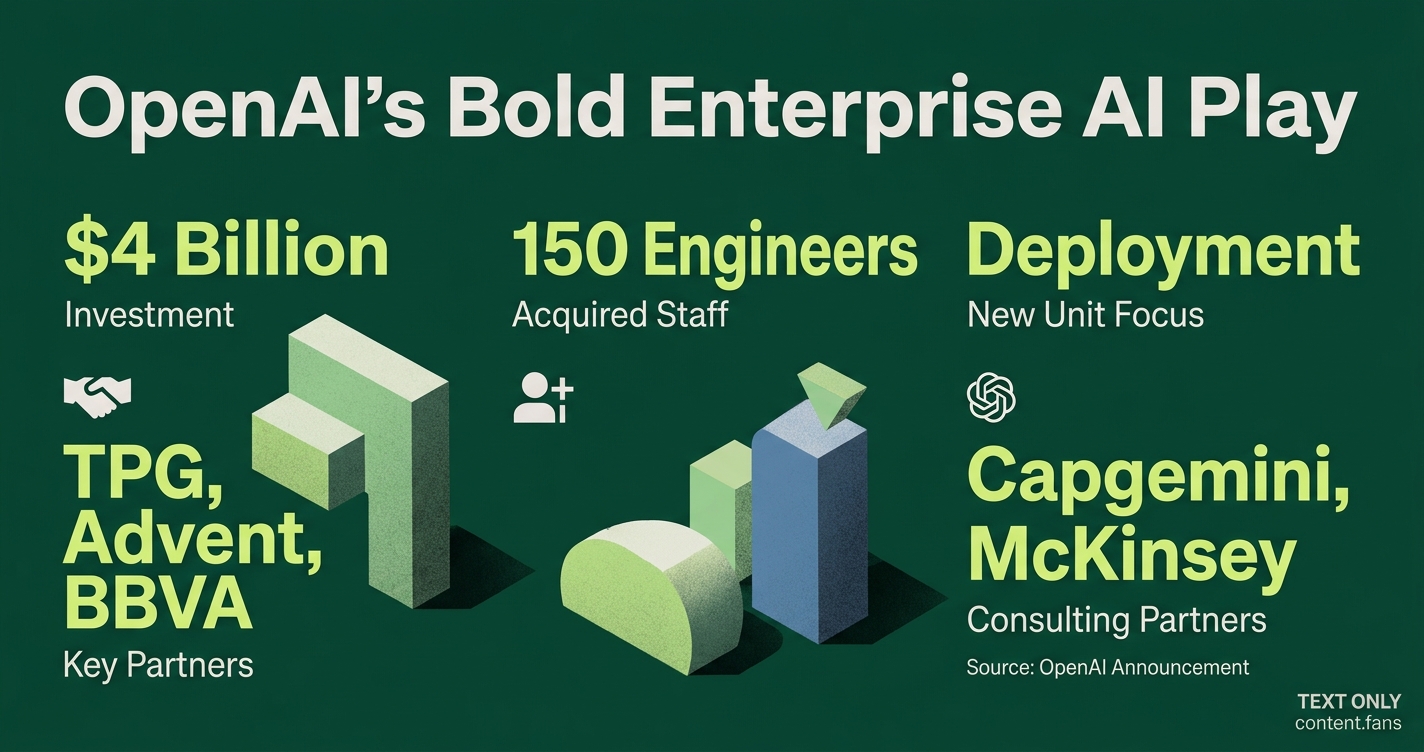
This new $4 billion unit is an implementation-focused company designed to embed AI experts directly within businesses. Its purpose is to overcome common deployment hurdles, scale AI from pilot projects to core operations, and ensure enterprises realize tangible value from their AI investments.
Solving Enterprise AI's "Last Mile" Problem
The new unit directly addresses a critical pain point for enterprise buyers: the struggle to scale AI initiatives. According to OpenAI, its embedded teams will identify high-value use cases, redesign workflows, and integrate models with customer data and systems. This hands-on approach is designed to close the gap where many companies struggle to move beyond the pilot stage.
However, this direct service model introduces new competitive dynamics. Industry observers note that while Microsoft continues to provide the underlying Azure infrastructure for OpenAI, this move could increase customer dependency on OpenAI and create friction over ownership of the end-to-end AI stack.
Market Impact and Competitive Landscape
Early reactions from partners and analysts underscore the initiative's significance. Capgemini highlighted the opportunity to accelerate "core operations" deployments for clients. Meanwhile, the involvement of investors like Brookfield signals a growing trend of private equity flowing into hands-on AI implementation ventures. The move also intensifies competition, particularly as rivals like Anthropic gain momentum, suggesting that the speed of production rollouts will be a key differentiator in a crowded market.
Measuring Success and Future Outlook
The success of this venture will be measured by its ability to drive deep, large-scale deployments in key sectors like banking, retail, and telecom. While OpenAI's ChatGPT Enterprise usage grew significantly, the new unit must prove it can overcome persistent challenges related to complex integration, governance, and scaling. For investors, the initiative represents both capital for acquiring top talent and a strategic position in the competitive AI services market.
1. What exactly is the $4B OpenAI Deployment Company and why was it created?
OpenAI launched the OpenAI Deployment Company on May 11 2026 as a multi-year committed partnership with 19 global investment firms, consultancies, and system integrators (source).
The core goal is to help businesses deploy AI across their most critical operations, turning frontier models into production-ready processes rather than leaving enterprises stuck in small pilots. By pairing $4 billion in capital with 150 embedded deployment engineers acquired from Tomoro, the venture aims to own the implementation layer that has traditionally been dominated by cloud hyperscalers and big consulting houses.
2. Who are the key partners and what roles do they play?
- Capital & governance - TPG (lead investor), Advent, Bain Capital, Goldman Sachs, SoftBank, Brookfield and other PE funds are supplying the money and board-level direction (Reuters).
- Implementation & change management - Capgemini, McKinsey & Company, and unnamed system integrators will embed teams inside customer orgs to redesign workflows, govern data pipelines, and connect OpenAI models to existing tools.
- Enterprise lighthouse - BBVA is both a founding partner and an early customer, planning to use the initiative to accelerate AI enterprise transformation (BBVA release).
3. How will the Tomoro acquisition accelerate deployments?
OpenAI agreed to acquire Tomoro, instantly adding ≈150 Forward Deployed Engineers and Deployment Specialists to the new company (The Rift). These specialists already have experience placing embedded AI teams inside Fortune 500 companies, which means the Deployment Company can start delivering "hands-on" integration projects immediately rather than recruiting and training a new services workforce.
4. What enterprise pain points will this solve?
- Pilots stuck in limbo - Industry reports indicate that while many enterprises use AI somewhere, a significant portion struggle to scale beyond pilots (TechInformed).
- Integration risk - Enterprises cite "deep integration with internal data, workflows, and governance systems" as the #1 barrier (CIO). The new unit tackles this end-to-end, from identifying high-value use cases to managing change with frontline staff.
- Governance & controls - The partnership provides regulatory templates, security frameworks, and audit trails baked into the rollout plan, reducing the compliance burden that usually stalls AI expansion.
5. How does this reshape competition with Microsoft, Google, and AWS?
OpenAI is moving up the value chain from "model vendor" to "managed transformation partner".
- Microsoft faces the biggest tension: Azure still hosts models, but customer ownership of the AI layer may shift to OpenAI-led teams, forcing Microsoft to differentiate on broader cloud services (Channel Insider).
- Google Cloud must now prove Vertex AI can deliver faster time-to-value than an OpenAI team embedded in the customer's office.
- AWS risks being demoted to infrastructure plumbing if enterprises choose the OpenAI Deployment path even while running workloads on AWS (ITPro).