
OpenAI Launches DeployCo: $4 Billion Unit Embeds AI Engineers for Enterprises
Serge Bulaev
OpenAI has announced DeployCo, a new company with over $4 billion in funding, to help businesses use AI by embedding its engineers directly into client companies. These engineers, called forward-deployed engineers (FDEs), work closely inside businesses to set up and support AI systems, which may make it harder for clients to switch to other vendors later. Reports suggest this setup helps companies solve problems faster and may lead to higher customer retention, but large-scale results are not yet published. DeployCo will start with about 150 FDEs from OpenAI's acquisition of Tomoro, and investors may gain special data rights as part of these partnerships. The shift to these deep deployment partnerships may indicate that businesses now value real results from AI over just test scores.

With the launch of DeployCo, OpenAI is embedding AI engineers into enterprises using a new strategic unit. This initiative represents a pivotal shift from self-serve APIs to hands-on, high-touch deployment partnerships designed to integrate advanced AI directly into critical business operations.
This model centers on Forward-Deployed Engineers (FDEs) who embed within a customer's organization, co-develop the integration layer, and ultimately create high switching costs that lock in the client for the long term.
Why Embedded Engineers Are a Game-Changer
Embedded engineers, or Forward-Deployed Engineers (FDEs), accelerate AI adoption by writing custom code and managing integrations on-site. This deep partnership solves problems faster than traditional support models but also increases a client's dependency on the vendor, significantly raising the costs and complexity of switching providers.
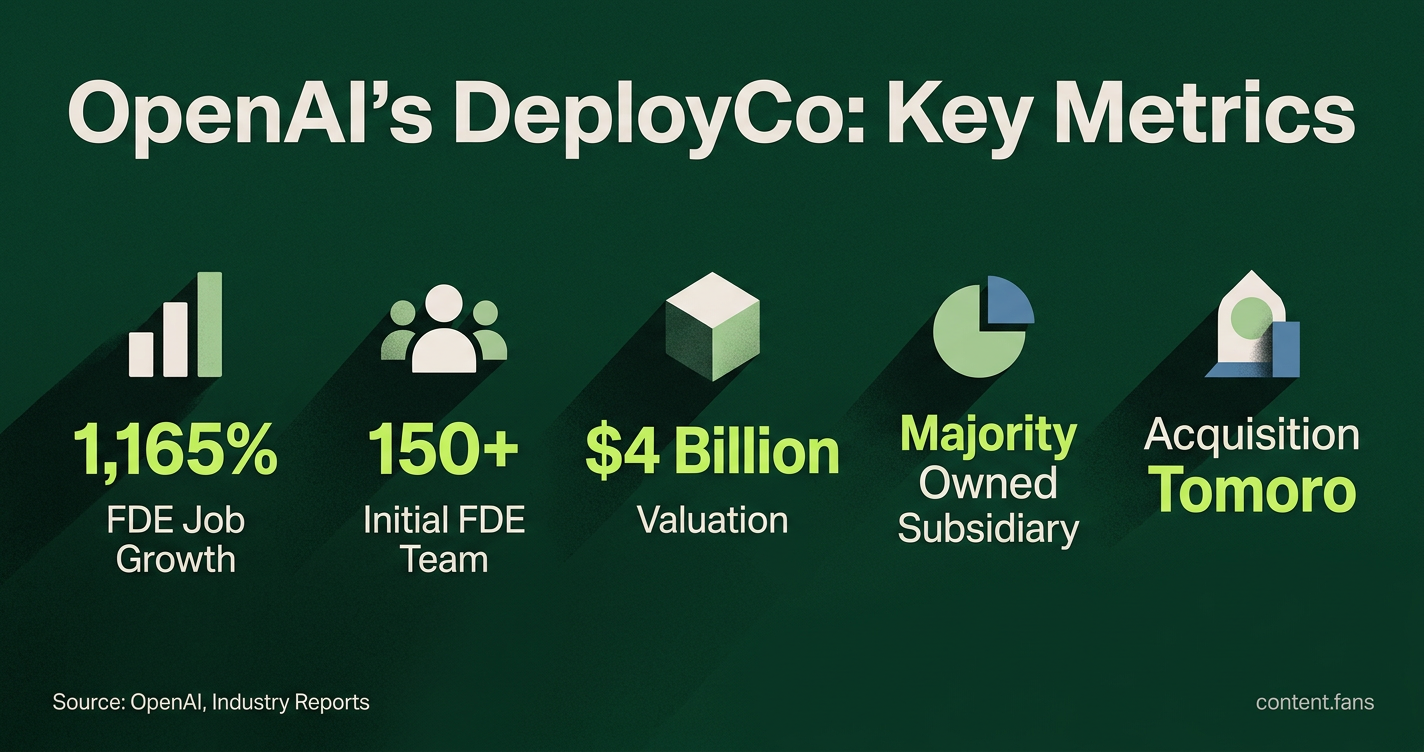
FDEs raise these switching costs by creating custom code paths, customer-specific integrations, and unique governance workflows. When a vendor's team helps design your data pipelines and operating procedures, replacing them means overhauling both software and embedded operational knowledge. The demand for this role is surging, with job postings for FDEs jumping 1,165% year-over-year, showing how quickly this deployment strategy is scaling. Analysts note this model surfaces and resolves implementation issues in real time, leading to faster fixes than a standard support ticket queue and suggesting higher customer retention.
OpenAI's DeployCo: The Strategic Playbook
DeployCo, officially the OpenAI Deployment Company, is a new majority-owned subsidiary. According to industry reports, it begins with significant initial capital from a consortium led by TPG Advent International press release. Key co-lead partners include Advent, Bain Capital, and Brookfield. Industry sources report a substantial valuation for the new arm, with its goal being to build "AI systems enterprises can rely on every day" Axios coverage.
To staff the unit, OpenAI has agreed to acquire the applied-AI consultancy Tomoro, bringing in an initial team of roughly 150 Forward Deployed Engineers and Deployment Specialists. This acquisition provides a bench of seasoned experts ready to pair advanced models with deep enterprise process knowledge.
Equity, Data Access, and the Business Model
The DeployCo model will likely include equity-linked deals. A recent Federal Trade Commission study on cloud-AI alliances found that such partnerships often bundle equity, revenue-sharing, and cloud-spend commitments. In exchange, vendors gain access to valuable performance data and customer usage patterns. This creates a powerful feedback loop: the vendor improves its models using proprietary operational data, while the client gets preferred pricing but accepts long-term vendor lock-in.
What Comes Next: Ambitious Growth Plans
According to industry reports, the initial capital is intended to prove the embedded-deployment model at scale. Investor materials reportedly reference ambitious expansion plans for significantly larger funding rounds, although commitments are still being finalized. The initial fund is designed to onboard dozens of Fortune 500 companies and generate the verifiable ROI needed to justify much larger capital raises. In essence, the initial investment aims to de-risk larger ambitions by first delivering hard-to-fake operational proof.
Key Considerations for Enterprise Buyers
As enterprises evaluate these deep integration partnerships, they should closely monitor three key areas:
- Staffing Ratios: Early deployments often require one FDE for every three to five of the client's internal developers during the initial six months.
- Exit Clauses: Scrutinize service contracts, as some may tie source code ownership to multi-year renewal commitments.
- Data Governance: Be aware that equity-linked deals can include shared rights to derived data sets, which has significant implications for data sovereignty.
The market's pivot toward deployment partnerships signals a maturation of the AI industry, where measurable business outcomes are eclipsing leaderboard scores. For now, enterprises that prioritize rapid time-to-value seem willing to trade a degree of control for the embedded expertise this new model provides.