
OpenAI Integrates Codex into ChatGPT for Cross-Platform Coding Agents
Serge Bulaev
OpenAI is working to combine Codex with ChatGPT, so coding agents can be used easily across phones, desktops, and other tools. This update is rolling out gradually and may reach all users in the next few weeks, but the company has not shared a final release date. Early data suggests the new system could shift some programming jobs, as AI tools may reduce the need for entry-level coders but increase demand for people who can work with these tools. Many companies are interested but remain cautious due to concerns with security, rules, and costs. It appears that full use of these coding agents will depend on careful controls and step-by-step updates.

OpenAI's integration of Codex into ChatGPT is creating a unified, cross-platform coding agent, making advanced development tools accessible across mobile, desktop, and IDEs. This phased integration, which developers have observed in recent months, unifies the previously separate tools under a single ChatGPT account. According to industry reports, OpenAI announced the Codex rollout in May/June 2025, with immediate availability for some ChatGPT tiers and Plus/Edu support coming soon; by later updates, Codex was already available in ChatGPT subscriptions (OpenAI Puts Codex in ChatGPT). The goal is to evolve beyond simple code generation toward conversational engineering agents for daily enterprise workflows.
The Status of the Codex and ChatGPT Rollout
OpenAI is progressively merging Codex with ChatGPT across all platforms. The integration is currently "rolling out" to mobile and desktop apps, with backend systems already unified under a single user account. While no final release date is set, the company expects a full launch within weeks.
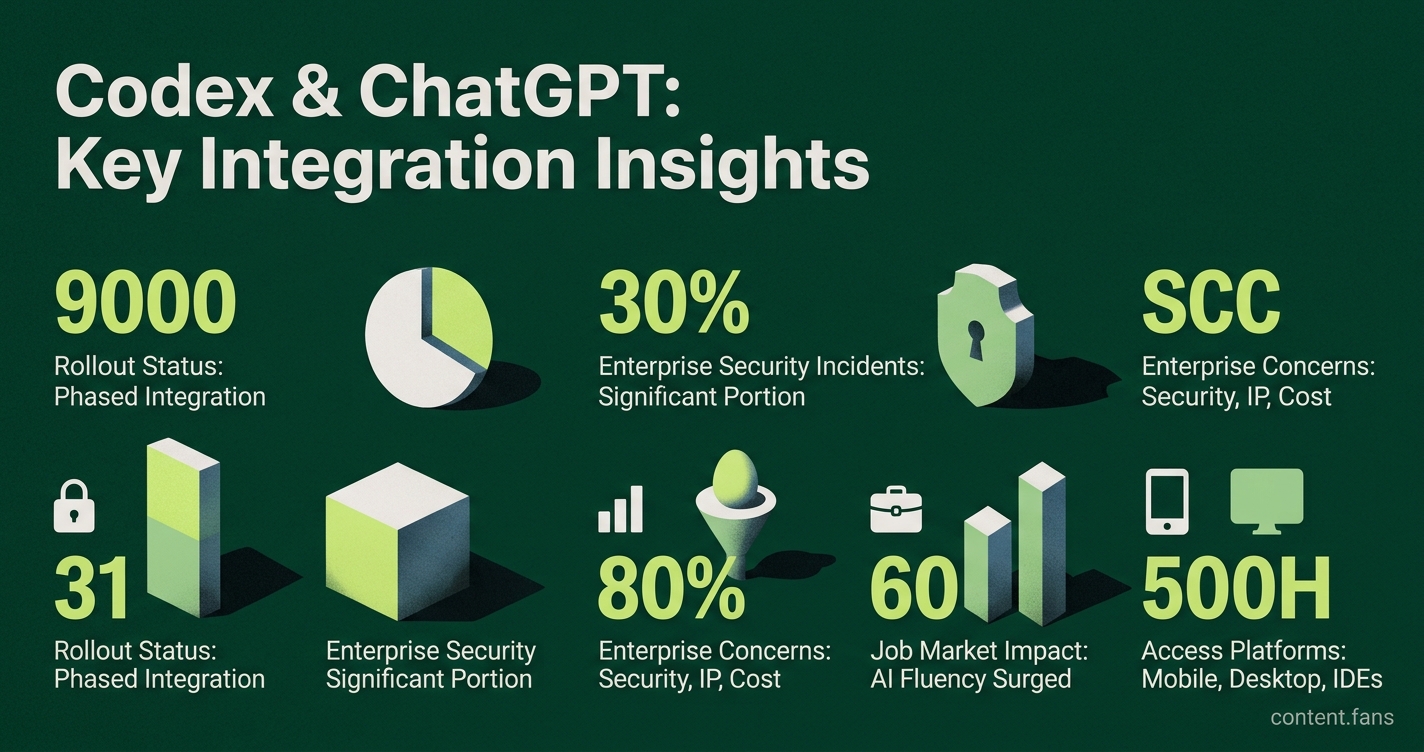
Official release notes confirm this staged approach. According to the OpenAI Help Center, Codex capabilities are gradually appearing in ChatGPT's iOS and Android apps, with a Windows desktop client available for paid plans (ChatGPT Release Notes). This backend unification began recently, with documentation already referencing a "single product experience" before the front-end updates.
What Partial Rollout Means for Developers
With the integration, developers can now access Codex via the CLI, popular IDE extensions for VS Code and JetBrains, and the ChatGPT mobile and desktop apps. This cross-platform availability enables workflows like initiating a pull request from a phone or using the desktop agent for automated tests. The impact on the job market appears nuanced; while roles focused purely on implementation are declining, demand for developers with AI tool fluency has surged, alongside positions in software architecture, security, and code review.
Enterprise Hurdles: Security, IP, and Cost
Despite enthusiasm, enterprise adoption faces significant hurdles. Surveys of large organizations highlight three primary blockers:
- Security & IP: A significant portion of enterprises have logged security incidents involving AI agents, and concerns over IP protection and data governance remain paramount.
- Compliance: Many companies cite governance and compliance rules as a major adoption pain point.
- Cost Management: A substantial number of organizations struggle with the unpredictable costs of continuous AI inference and tool calls.
Analysts suggest that successful enterprise-scale deployment will depend on careful controls - such as least-privilege access and human-in-the-loop reviews - rather than just model performance.
Impact on Tooling Ecosystems
In response, the developer tooling ecosystem is evolving. IDE vendors are embedding features like agent orchestration, automated diff reviews, and policy enforcement directly into their products. Market analysis shows no single interface is dominating; instead, developers are using a mix of CLI, IDE, and web portals, all becoming more "agent-native." This supports a new standard workflow centered on prompting the AI, then verifying and approving its output.
What to Watch Next
OpenAI has not announced a final release date for the fully unified Codex and ChatGPT experience. The company's vague timeline of "rolling out" and "in the next few weeks" suggests a gradual release involving feature flags and regional rollouts. Developers should monitor ChatGPT's mobile and desktop applications for incremental updates, as new capabilities will likely appear before any formal announcement.
What is the current status of OpenAI's Codex integration into ChatGPT?
According to industry reports, Codex is already partially integrated across ChatGPT surfaces. OpenHelp release notes confirm that Codex is rolling out inside the ChatGPT mobile app for iOS and Android for Free, Go, and Plus users in supported regions.
A desktop Codex app for Windows is also available for eligible ChatGPT plans, and the backend product ecosystem has been unified under one ChatGPT account according to recent updates (OpenAI Help Center).
OpenAI announced Codex rollout in May/June 2025, with immediate availability for some ChatGPT tiers and Plus/Edu support coming soon; by later updates, Codex was already available in ChatGPT subscriptions.
How does the integration aim to change day-to-day coding workflows?
The largest shift is from text editing to orchestration: instead of typing every line, developers describe a task in natural language and review, approve, or refine the agent's multi-file proposals.
OpenAI's stated goal is to turn coding agents from niche helpers into everyday productivity platforms used for everything from small scripts to enterprise-scale pull requests.
Industry reports show fewer job postings for pure implementation roles and significantly more listings requiring AI-coding-tool fluency (State of AI Coding Agents 2026).
What challenges are enterprises facing when scaling AI coding agents?
Three blockers dominate recent pilots:
- Security and governance - A significant portion of enterprises report AI-related security incidents and prompt-injection attempts (Enterprise AI Agent Adoption 2026).
- IP and data leakage - agents can ingest proprietary code; legal teams must review data-retention and model-training clauses.
- Cost predictability - continuous inference plus tool calls can spiral; many surveyed enterprises cite unpredictable spend as a top barrier (Digital Applied Enterprise Data 2026).
How might this reshape the job market for software developers?
Rather than mass layoffs, the evidence points to task reallocation:
- Pure implementation roles face declining postings while security, architecture, and code-review positions rise.
- Overall developer employment actually grew in recent years, indicating role transformation instead of replacement (State of AI Coding Agents 2026).
- AI-tool fluency is now a hiring prerequisite: postings mentioning GPT-5.3-Codex or similar have climbed significantly year-over-year.
Will traditional IDEs disappear, or will they adapt?
Recent data shows no single interface will dominate; instead, CLI, cloud agents, and IDEs will coexist but IDEs must become agent-native to stay central.
Leading IDEs are already adding agent orchestration panels, inline diff review, and security gates to handle multi-file changes proposed by Codex-like agents.
The competitive edge is shifting from code-editing features to workflow governance, model integration, and team collaboration (Tessl Jobs Blog).