
OpenAI integrates Codex into ChatGPT, Anthropic updates Claude with 5 new agent features
Serge Bulaev
OpenAI and Anthropic are updating their main AI assistants to handle more complex tasks, such as working on files, using tools, and completing long projects. OpenAI has added Codex into ChatGPT, giving users new ways to use code and special plugins that may help non-technical staff in areas like finance and marketing. Anthropic's Claude now has five new features, including the ability to handle multiple smaller tasks at once and add-ins for Word and PowerPoint, which might make it easier for companies to use. Early reports suggest users may be seeing these AIs as helpful digital coworkers rather than just simple tools. However, there may still be issues with connecting to other systems, keeping track of long tasks, and making sure security is strong enough.

With OpenAI integrating Codex into ChatGPT and Anthropic updating Claude with agentic features, the race to create the definitive AI work platform is intensifying. Both companies are enhancing their flagship assistants to manage complex, multi-hour tasks involving files, tools, and code execution. This evolution is moving AI from simple chat assistants toward fully autonomous digital colleagues, fundamentally reshaping enterprise AI strategies, security models, and user interfaces.
OpenAI: Codex moves into the ChatGPT front office
OpenAI is integrating its powerful Codex engine directly into ChatGPT, creating new entry points and role-specific features for non-technical users. The company is focusing on orchestrating complex enterprise workflows, measuring outcomes, and embedding the AI into productivity software.
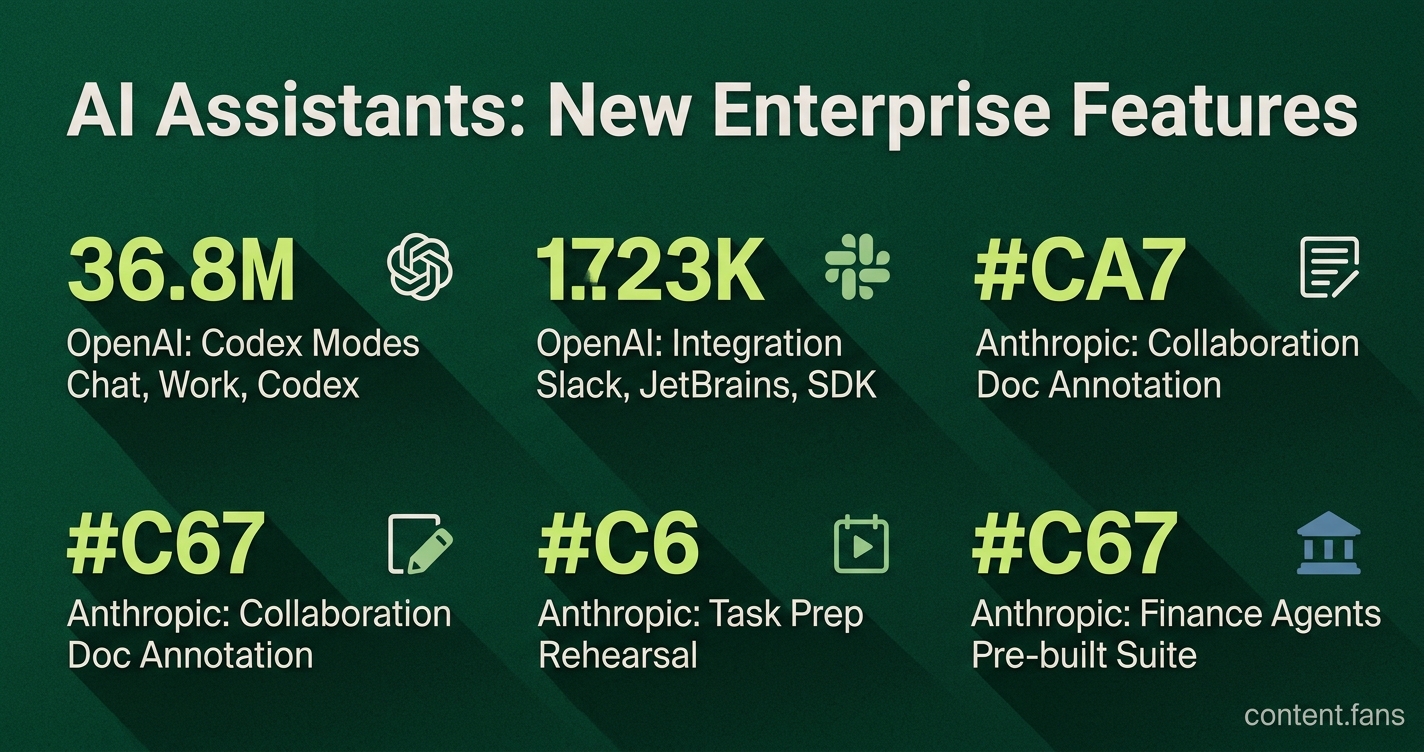
- Simplified Entry Points: The desktop experience now offers three distinct modes - Chat, Work, and Codex - to ease newcomers into the platform while giving power users direct access to autonomous code execution.
- Enhanced Integration Features: New capabilities include Slack integration and an SDK to enable non-technical staff in departments like finance and marketing to leverage Codex's power without writing complex prompts, accelerating adoption.
- Effort Level Controls: OpenAI allows users to set an 'effort level' for tasks in ChatGPT Work and Codex, enabling users to define the AI's level of control from generating single responses to executing more complex operations, addressing key security concerns.
Further expanding its ecosystem, OpenAI previewed Codex Sites for converting agent outputs into hosted web applications. It also deepened developer integration by adding native support for JetBrains IDEs, allowing coders to interact with the agent without switching windows Codex Is Now Integrated Into JetBrains IDEs.
Anthropic: Claude updates target enterprise workflows
Anthropic's latest update emphasizes enterprise-grade workflows by focusing on enhanced document collaboration and built-in performance measurement. The new features include several key additions designed for corporate use cases:
- Enhanced Document Collaboration: Improved capabilities for managing complex projects with better file system integration.
- Annotation Features: Users can make section-level edits on documents, decks, and slides for more precise collaboration.
- Task Rehearsal: Agents can now "rehearse" tasks using historical data, reducing errors before they impact live production files.
- Claude Finance: A suite of pre-built financial agents is available for common tasks like month-end close procedures.
- Productivity Add-ins: Direct integration with Microsoft Word and PowerPoint eliminates the need for context switching between applications.
Industry reports suggest a significant shift in user behavior, with users treating Claude more as an autonomous digital colleague than a simple code-fixing tool, as time spent on debugging has decreased while tasks related to writing and data analysis have increased substantially.
Balancing ease of entry and depth of control
Despite these advances, early deployments reveal three recurring challenges for enterprise adoption:
- System Integration: Many organizations report difficulties connecting agents to fragmented data stores.
- Long-Horizon Coherence: Agents often lose context and fail to maintain coherence during complex, multi-step projects.
- Security and Permissions: A significant number of AI agents are granted broader permissions than needed, creating security risks.
Both OpenAI and Anthropic are addressing these issues with layered controls. Features like OpenAI's effort level settings and Anthropic's annotation capabilities provide deterministic gates to manage agent behavior. Meanwhile, the Model Context Protocol is becoming an industry standard for securely connecting third-party tools. Experts contend that these safety guardrails are just as critical as model advancements, as they are essential for building the trust required for enterprises to delegate meaningful work to AI agents.