
AI Coding Tools Boost Velocity But Multiply Incidents, Reports Say
Serge Bulaev
Organizations trying AI coding tools report that software is built and delivered faster, but also say there are more problems and slower fixes. New data suggests that every speed gain brings extra complexity, with review times for AI code much longer and acceptance rates lower than for human code. Many teams still need strong human checks, as most companies are not ready for full automation. Experts suggest using careful testing, clear rules, and gradual rollouts to reduce risks. The reports indicate that while AI may lower simple tasks, it might also create more work for teams to keep systems reliable. The most important phrase is: every speed gain brings extra complexity.

The adoption of AI coding tools is accelerating software delivery, yet new reports reveal a troubling paradox: increased development velocity often corresponds with a higher frequency of production incidents. While teams ship code faster, they also face new complexities in quality control and system reliability. This guide addresses the critical questions engineering leaders must ask before scaling AI-assisted development.
How much does AI actually accelerate software delivery?
AI coding tools significantly increase deployment speed, particularly for teams with mature, automated pipelines. However, this velocity gain introduces friction, as AI-generated code requires substantially longer review times and faces higher rejection rates, shifting the primary bottleneck from code creation to ensuring safe and reliable deployment.
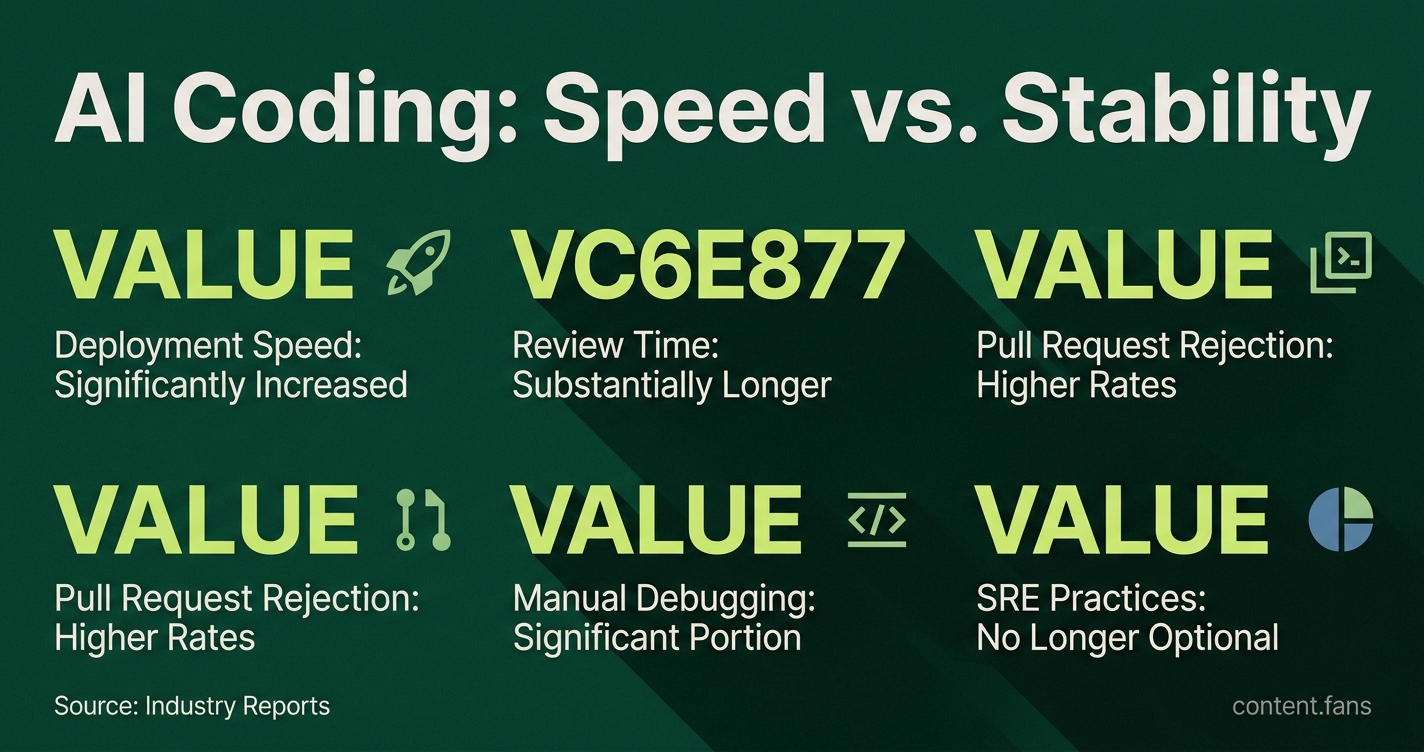
The acceleration depends heavily on existing process maturity. While Harness research shows a majority of organizations ship faster with AI - with even higher rates in automated pipelines - this velocity introduces new friction. Analysis reveals that AI-generated pull requests wait significantly longer for review and have substantially higher rejection rates compared to human code. The primary bottleneck is no longer writing code, but shipping it safely.
What happens to code quality and review processes?
The review process is becoming a significant bottleneck. A substantial increase in review time post-AI adoption highlights the need for more rigorous governance. This isn't just about code volume; it's about managing complexity. In production, the challenges persist: a significant portion of AI-generated code that passes staging still needs manual debugging. This translates into significant engineering overhead, with senior developers dedicating substantial time to fixing machine-generated bugs. The entire delivery system feels the strain, requiring more controls and coordination to manage AI-driven changes.
Which resiliency fundamentals become more critical?
With higher deployment frequency, foundational Site Reliability Engineering (SRE) practices are no longer optional. AI-driven velocity puts pressure on systems, making the following areas critical:
- Monitoring and alerting - needed to catch failures that slip through accelerated pipelines
- Thundering herd protection - essential as more code reaches production faster
- Retries, idempotency, and timeouts - critical for maintaining stability under increased load
- Progressive delivery - canary deployments and feature flags for rapid containment
As emphasized in Google's SRE guidance, adaptive progressive rollouts are essential for containing faulty features. Furthermore, industry recommendations advocate for treating reliability, security, and observability as a single, unified concern. The conclusion is inescapable: AI exposes and amplifies pre-existing weaknesses in a team's delivery process. Strong fundamentals are required to translate AI's speed into business value.
Where should human oversight remain mandatory?
Expert consensus favors a "supervised-by-design" approach. In this model, AI can accelerate diagnostics and automate routine tasks, but humans must retain final authority over high-risk decisions. Key principles include:
- Bounded automation with guardrails - AI assists with diagnosis while policy gates control high-risk actions
- Graduated authority - read-only investigation, then recommended actions, then approval-gated execution
- Blast-radius-based autonomy - scaling automation by action class and potential impact
Industry reports indicate that mature teams prioritize "AI visibility and human oversight before using it to automate." The rationale is clear: human oversight is necessary not due to AI's limitations, but because the risk profile of automated actions is fundamentally different. Ultimately, accountability is not automated: humans remain responsible for system reliability and business outcomes.
How can teams prepare their delivery systems for AI?
Effective AI integration requires preparing the system, not just adopting a new tool. Success hinges on a maturity-focused approach that prioritizes foundational strength over rapid tool deployment. Teams should focus on the following areas:
Immediate priorities:
- Strengthen CI/CD automation before expanding AI use
- Implement observability as a unified control plane correlating telemetry, topology, and business context
- Codify governance across configuration, infrastructure, and release processes
Medium-term investments:
- Build progressive delivery pipelines with automatic rollback triggers
- Establish SLOs based on golden signals extended to AI-specific metrics (inference latency, error rates, drift detection)
- Create policy-controlled automation with human approval gates
Ongoing discipline:
- Measure outcomes by incident reduction and MTTR improvement, not automation volume alone
- Maintain auditability and rollback paths for all AI-influenced changes
- Reduce alert noise to preserve operator effectiveness
The data is consistent: organizations with robust delivery fundamentals successfully harness AI's benefits. Those without simply trade one bottleneck for another, bogging down their process with longer reviews, more deployment failures, and extensive production debugging.