
Nadella Warns AI Needs "Emergency Brake" By 2026
Serge Bulaev
Satya Nadella warns that super-intelligent AI systems act like black boxes and may require strong safeguards. He suggests all companies using these systems should have an emergency brake so a human can stop the AI if needed. This warning comes as rules and best practices for AI safety and transparency are becoming more common. Surveys suggest many leaders worry about not being able to explain or control AI decisions. Nadella and experts say building clear controls and human oversight into AI systems may help keep them safe.

Microsoft CEO Satya Nadella is warning that advanced AI needs an "emergency brake," stating that superintelligent systems are "black boxes" that require strong, deterministic safeguards. In a recent social media post, Nadella argued that any company using these powerful models must have an outer shell allowing a human to pause or stop the system at any time.
Nadella's call for greater control aligns with a broader industry shift where AI governance and explainability are becoming increasingly important. Regulators are demanding greater transparency of an AI's actions, data sources, and controls. For auditors, features like comprehensive logs, versioning, and traceability are becoming essential requirements for system approval.
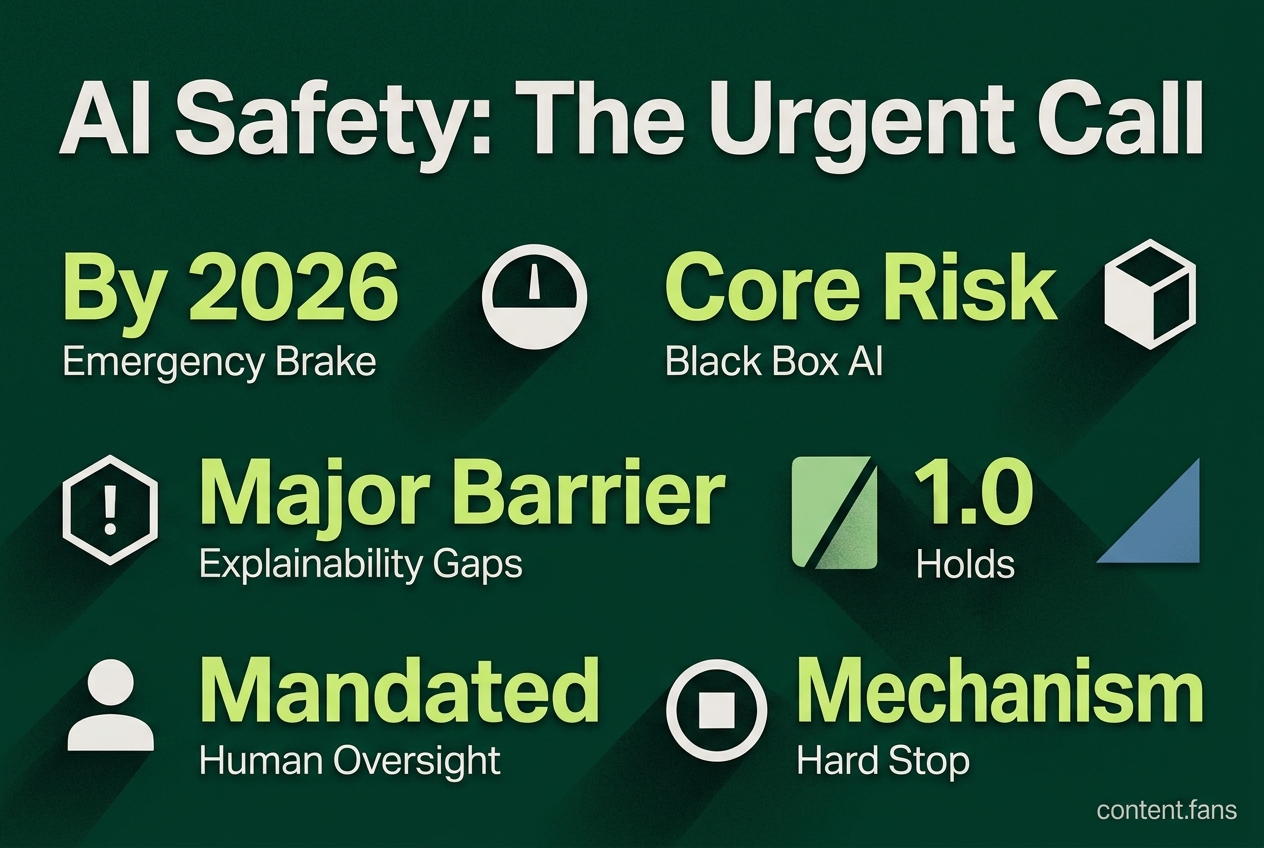
Why the black-box warning matters
Nadella's warning addresses the core risks of opaque AI, including their inability to explain their reasoning, which complicates error detection and auditing. He also highlights the potential for model drift or compromise, making external human controls like a kill switch a final, critical line of defense.
Nadella highlighted key risks of black-box AI. In his view, enterprises must "surround non-deterministic models with strong, deterministic system design, human controls, and reliable operating procedures." This anxiety is reflected across the industry, with research noting that many organizations see explainability gaps as a major barrier to trust. Similarly, surveys have found that a significant number of CIOs face production delays because they cannot adequately defend an AI's decision, signaling a more cautious approach to deploying unauditable models.
Governance signals in 2026
The regulatory landscape strongly supports Nadella's position. Upcoming legislation like the EU AI Act mandates transparency, human oversight, and rigorous testing for high-risk AI. Frameworks such as the NIST AI Risk Management Framework provide structured methods for mitigating threats, while safety engineering principles emphasize fail-safes and continuous monitoring. The "AI emergency brake" concept is gaining traction among lawmakers in both the US and Europe, who are considering mandatory kill-switch requirements for critical systems.
Practical steps enterprises are adopting
Drawing from guidance by consulting firms and technology companies, enterprises are implementing concrete measures to build safer AI systems:
- Pre-deployment red teaming and stress testing
- Real-time monitoring for drift, misuse, and anomalous behavior
- Immutable logs with role-based access controls
- Human-in-the-loop review for high-impact actions
- Hard stop mechanisms that can shut down or isolate a model
Organizations adopting these layers report faster internal approvals and greater confidence in scaling AI. Industry experts note that while rigorous testing adds upfront cost, it enables businesses to "realize value with confidence," especially compared to the higher expense of retrofitting controls later.
Containment over blind trust
Ultimately, Nadella's message promotes a strategy of containment over blind trust. This approach separates the AI model's intelligence from the system's authority, where deterministic elements like APIs, policy engines, and human supervisors control what is actually deployed. This containment-first mindset is expected to define the next generation of AI architecture, making his social media post a significant contribution to the AI safety and governance debate.
What did Satya Nadella actually say about AI "emergency brakes"?
In a recent post on X, Microsoft CEO Satya Nadella warned that super intelligence systems should not be treated as nested black boxes that organizations simply trust or reject. He argued that companies must "assume a model is compromised and contain it from the start" - a significant shift from typical deployment mindsets.
Nadella specifically called for three layers of protection: deterministic system design wrapped around non-deterministic models, human controls, and what he termed an "emergency brake" - a mechanism where authorized personnel can pause or shut down a model mid-task. This framing treats advanced AI as an insider risk requiring active containment rather than passive monitoring.
Why are "black box" AI systems considered particularly dangerous for business-critical processes?
Research shows black box concerns are blocking enterprise AI adoption in sensitive workflows. According to industry surveys, many CIOs have been asked to defend AI outcomes they could not fully explain, and a significant number report that explainability gaps have delayed or blocked production deployments.
The danger compounds in business-critical processes because:
- Audit failures: Only a small percentage of leaders feel "very confident" explaining AI-driven decisions to regulators and customers
- Unseen vulnerabilities: Industry experts note that opaque models create "a landscape of unseen vulnerabilities" that rigorous testing cannot fully surface
- Shadow AI proliferation: Employees increasingly bypass enterprise controls, creating unauditable "shadow AI" usage
How does Nadella's "emergency brake" proposal differ from standard AI safety measures?
Most current AI guardrails operate as preventive constraints - input filtering, output validation, and policy-based restrictions. Nadella's emergency brake adds active intervention capability at runtime, allowing human operators to halt systems mid-execution rather than merely preventing bad outputs.
This reflects a deeper architectural principle: separating model intelligence from system authority. The AI may generate recommendations, but deterministic controls govern what reaches production. As industry research emphasizes, trustworthy AI requires being observable, auditable, and containable - with "human readable evidence" for meaningful actions.
What concrete steps should enterprises take based on Nadella's warnings?
Organizations should prioritize four operational shifts:
- Assume compromise: Design containment from initial deployment, not as retrofit
- Build deterministic wrappers: Surround probabilistic models with strict procedural controls
- Create kill-switch infrastructure: Ensure authorized personnel can interrupt operations without technical escalation
- Maintain evidence trails: Generate human-readable logs that satisfy both technical audits and regulatory scrutiny
The EU AI Act and emerging global standards increasingly mandate such documentation for high-risk systems, making Nadella's recommendations aligned with compliance trajectories.
Is the industry actually moving toward these stricter controls, or is this just Microsoft positioning?
Multiple indicators suggest genuine structural shift rather than isolated corporate messaging:
- Regulatory pressure: The EU AI Act, GDPR Article 22, and NIST AI Risk Management Framework now require transparency documentation and human oversight for high-risk deployments
- Procurement standards: Explainability and auditability are becoming hard requirements in safety-critical sector purchasing
- Investment patterns: Despite AI spending growth, organizations report that operating costs are constraining usage - with opacity-related risk management consuming significant resources
Nadella's public stance reinforces what industry surveys document: a significant number of organizations name explainability as a core trust blocker, and governance investment is now prerequisite to scaling rather than post-hoc compliance activity.