
OpenAI integrates Codex and ChatGPT into a single "AI superapp"
Serge Bulaev
OpenAI plans to combine Codex and ChatGPT into a single "AI superapp" that may let users do coding, chatting, browsing, and more in one place. The company's strategy suggests future models like GPT-5 could work for both chat and coding tasks together. This move appears to make things simpler for users and may help OpenAI compete with other companies. The exact release date, pricing, and how some features will work in the new app are still unclear. OpenAI's goal seems to be easier and more connected workflows for people using its tools.

The plan where OpenAI integrates Codex and ChatGPT into a single "AI superapp" is no longer a rumor but a documented strategic goal. According to the company's [enterprise strategy page] and a [CNBC report], this unified desktop application will merge chat, coding, and browsing into one interface. This move simplifies workflows for developers and knowledge workers by routing tasks to the most capable model.
Why integrate now?
OpenAI is unifying its models to create a single, powerful backend. This strategy treats chat, code generation, and complex agentic tasks as features of one system rather than separate products, streamlining development and preparing for future models like GPT-5 to have combined conversational and coding capabilities.
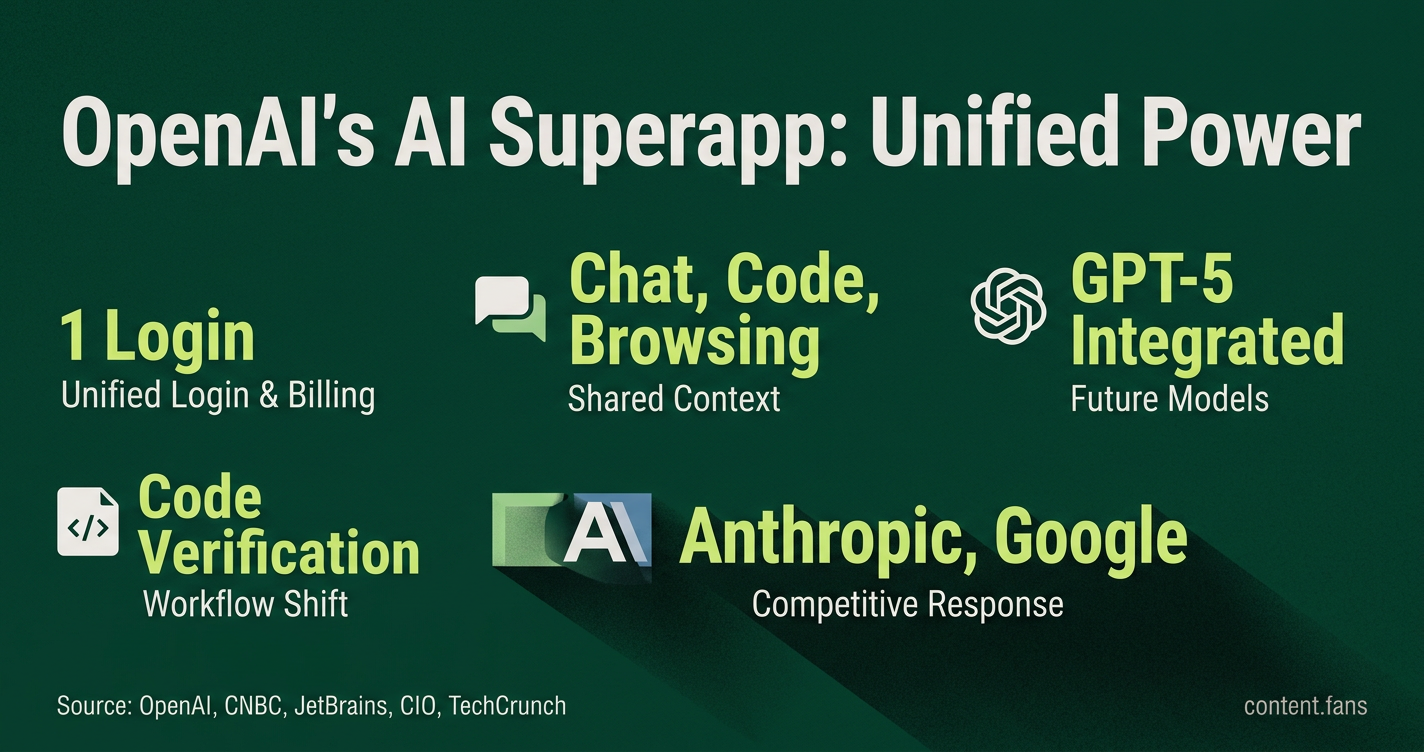
A [community post] from OpenAI reveals a core goal of unifying its model series, signaling that future models like GPT-5 will launch concurrently in both ChatGPT and the API. This points to a unified backend where chat and code are features of a single system. Industry reports suggest that future releases will combine training stacks, creating one pipeline for both conversational AI and coding tasks.
Expected workflow changes
The integrated app is expected to deliver several key improvements:
- One login and unified billing
- Shared context across chat, code, and browsing sessions
- Common SDKs that expose agentic actions alongside text generation
- Centralized audit and governance tools for enterprise customers
This integration directly addresses evolving developer needs. [JetBrains research] on workflows shows AI is shifting the primary bottleneck from code creation to code verification. An all-in-one workspace can shorten this feedback loop by placing review tools alongside generation features. This is supported by [CIO analysis] of software delivery, which finds that validation now demands more time than the initial act of writing code.
Competitive pressure and market context
This strategic consolidation is also a clear response to a competitive market. As reported by [TechCrunch summarised Financial Times reporting], the superapp pivot is designed to strengthen OpenAI's position with enterprise clients, potentially ahead of an IPO, by converting free users to paid services. Rivals like [Anthropic] and [Google] already offer integrated platforms that manage entire codebases. OpenAI's move ensures it remains competitive against rivals that are erasing the boundaries between chat, development environments, and task orchestration.
Adoption outlook
OpenAI's vision is to reduce workflow fragmentation, enabling employees to use AI agents for persistent, day-long tasks across their existing tools. This shift from episodic chatbot use to continuous workflows aligns with findings from [JetBrains] that developers now dedicate significant time to prompt engineering and orchestration alongside manual coding. For enterprises, a unified product eases governance by replacing separate approval processes for ChatGPT and Codex with a single, auditable surface. While this simplifies compliance, it also centralizes risk in the event of system downtime.
Open questions
Despite the clear strategic direction, several key questions remain unanswered:
- Timeline: A formal release date has not been announced, leaving the exact launch window for the superapp unconfirmed.
- Pricing: It is not yet clear if the unified platform will use a tiered subscription model or usage-based billing.
- Extensibility: Details on how the [six existing role plugins] for non-coders will be integrated into the new interface have not been provided.
For now, the available evidence points to an unmistakable conclusion: OpenAI is fundamentally rearchitecting its product suite around a single, integrated agentic layer. This new foundation, powered by GPT-5-era models, is being built to handle both conversational and coding tasks through a common stack, signaling a major shift in how users will interact with AI.
What exactly is the new "AI superapp" that OpenAI is building?
The superapp is a single desktop client that merges ChatGPT, Codex, and a built-in browser into one workspace. OpenAI's own language calls it a "unified AI superapp as the primary experience where employees get things done". Early reports indicate it will ship as a downloadable desktop program that replaces the separate ChatGPT app, the stand-alone Codex tool, and any third-party browser you now use for research.
When can users expect to see the integrated product, and what should they watch for?
OpenAI has not published exact dates, but the most recent wave of reporting (March-June 2026 coverage) points to a desktop launch sometime in 2026. In practice, you should watch for beta invites to ChatGPT Enterprise customers first, followed by broader availability. Industry reports suggest upcoming releases will feature advanced agentic coding models that combine multiple training approaches.
How will this consolidation change day-to-day developer workflows?
Expect three immediate shifts:
* Less context switching: one window handles chat, code generation, repo browsing, and commit actions.
Higher-level tasks: Industry reports suggest developers are increasingly spending significant time on review, prompting, and verification alongside traditional coding.
Faster delivery loops: CIO reports that the bottleneck has moved from coding to verification, because AI systems now generate, validate, and iterate in a single loop.
Will non-coders benefit, or is this just for developers?
Six new role plugins expand Codex for non-technical users, and the bundle already lists 62 apps and 110 skills across marketing, finance, and support domains. OpenAI's stated goal is to make the same agentic layer useful for "writing, research, internal operations, and other business tasks," so the value proposition is deliberately broader than software development.
What competitive pressure does this put on the rest of the market?
By treating the superapp as a control plane for multiple agents, OpenAI is directly challenging the fragmented landscape of separate coding assistants, chatbots, and browser add-ons. The move positions OpenAI against Anthropic's Claude integrations, Google's Gemini Code Assist, and multi-agent startups like Cursor and Windsurf. The key competitive lever is unified billing and identity - one login, one credit line, one quota system that covers chat, code, and web actions across all OpenAI services.