
Anthropic Splits From Google, OpenAI Over Massachusetts AI Safety Bill
Serge Bulaev
Anthropic has taken a different position from Google and OpenAI on a Massachusetts AI safety bill, which may be the strongest in the country. Anthropic supports the bill, saying its safety audit requirements fit their own policies. Google and OpenAI warn that these rules might slow down important security updates and prefer a single national standard. The bill has passed the state Senate but still needs final approval, so company opinions may still affect its final form. Experts suggest this split could encourage more debate as other places consider laws like Massachusetts' bill.

An unusual policy rift has emerged among America's leading AI developers, with Anthropic splitting from Google and OpenAI over a Massachusetts AI safety bill. Anthropic supports the landmark legislation, citing its stringent safety audit requirements. In contrast, Google and OpenAI warn these rules could slow innovation and security updates, advocating instead for a single national standard.
What is the Massachusetts AI safety bill, and what would it require?
The core disagreement stems from the bill's mandatory third-party safety audits. Anthropic endorses this provision as consistent with its own safety-first policies. Google and OpenAI, however, contend that such requirements could delay crucial security updates and prefer a unified national standard over state-by-state regulatory patchwork.
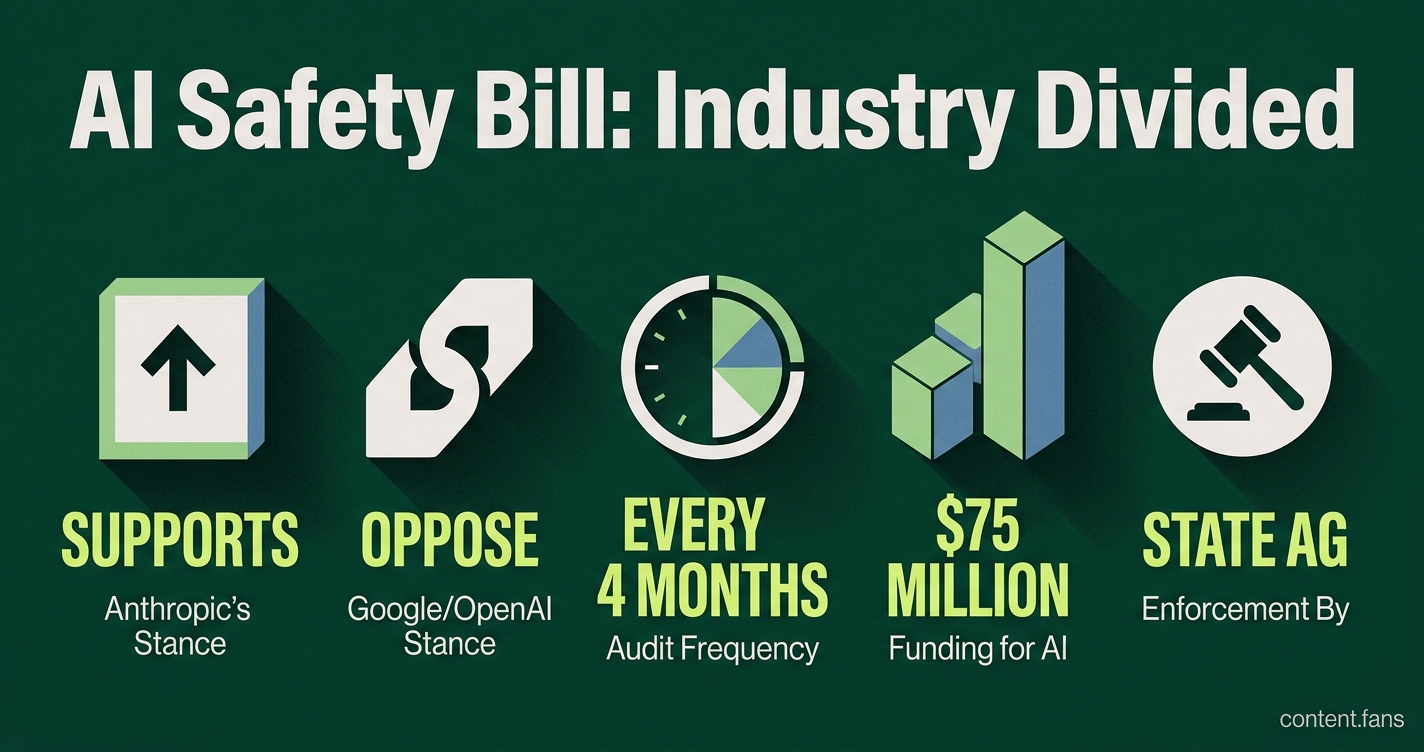
The proposed legislation, S.37 / S.D. 1909, is officially titled "An Act promoting economic development with emerging artificial intelligence models and safety," and proposes strong AI safety and accountability rules in Massachusetts. The bill passed the Massachusetts Senate on July 23, 2026, but still awaits final enactment. Key provisions include:
- Mandatory safety frameworks for "large frontier developers" to identify and mitigate catastrophic risks before a model's release.
- Independent third-party safety audits and in-depth safety testing to be conducted at least every four months.
- Public summaries of each audit must be published for review by regulators and consumers.
- State Attorney General enforcement authority to pursue civil penalties against violators.
- $75 million in funding to support in-state AI research and workforce development.
Why does Anthropic support the bill while Google and OpenAI oppose it?
Anthropic has publicly endorsed the measure, stating it would give Massachusetts "the strongest AI safeguards in the country." The company's position aligns with its corporate policy of engaging independent evaluators and supports the bill's provisions for regular risk reviews and attorney general enforcement.
Google and OpenAI, conversely, have aligned to oppose the bill's stricter mandates. As reported by sources like Yahoo Finance, OpenAI argues that mandatory reviews could slow the release of cybersecurity models and has pushed for a uniform national standard. This public disagreement underscores a significant lack of industry consensus on AI regulation.
How does this divergence affect lobbying and regulatory outcomes?
The split between the AI giants is significantly influencing policy development and corporate lobbying efforts. The key implications include:
- Accelerated State-Level Regulation: Ignoring industry calls to avoid a regulatory "patchwork," states are moving forward with their own bills on advanced model safety and AI auditing.
- Fragmented Compliance: With thousands of AI-related bills introduced nationwide, developers and businesses face a complex and inconsistent web of obligations.
- Direct Influence on Legislation: Vendor lobbying directly impacts the final text of bills. For instance, OpenAI reportedly supported a narrower, less stringent version of the Massachusetts bill, complicating efforts to create a unified industry front.
What risks does this split create for organizations selecting AI vendors?
For public- and private-sector organizations, the vendors' conflicting stances on safety regulations introduce critical procurement and compliance risks. Since the bill would make compliance failures a civil offense, a vendor's lobbying position can be an indicator of its risk profile. Organizations must manage these new challenges:
| Risk Category | Implication |
|---|---|
| Compliance Uncertainty | A vendor's terms of service may not align with evolving state laws where your organization operates. |
| Contractual Liability | The legal responsibility for compliance rests with the deployer, not the vendor. |
| Supply Chain Risk | Public disagreements over safety can lead to a vendor being designated as a high-risk supplier. |
| Future Eligibility | Vendors that oppose specific safety guardrails may be excluded from future state and federal contracts. |
Organizations should now treat a supplier's policy posture as a key part of due diligence, demanding contract addenda that secure audit rights, disclosure duties, and indemnity.
What should businesses and policymakers watch next?
Several upcoming developments will define the future of AI regulation and procurement:
- Final Massachusetts Bill: Whether the strict Senate version or a watered-down compromise becomes law will set a major precedent.
- Evolving State Frameworks: How other states, like Colorado, implement and potentially amend their own AI laws will signal broader trends.
- Federal vs. State Authority: The ongoing tension between federal preemption and robust state-level authority remains a critical area to monitor.
- Procurement Standardization: Whether states collaborate on shared AI contracting standards or continue to create divergent requirements.
The primary takeaway for organizations is that AI procurement contracts must now explicitly address regulatory compliance rather than assuming vendor terms are sufficient.