
OpenAI halves inference costs by 50% with software optimizations
Serge Bulaev
OpenAI reportedly found a way to cut AI inference costs by about 50% in internal tests, mainly through software improvements. These savings may come from methods like model quantization and better request routing, but the exact details are still unconfirmed. If true, this could lead to lower prices for big language tasks, though external checks are still needed. Vendors and analysts suggest that cheaper inference may change how companies use and pay for AI services. Competitors are also lowering prices, so efficiency work appears to be very important now.

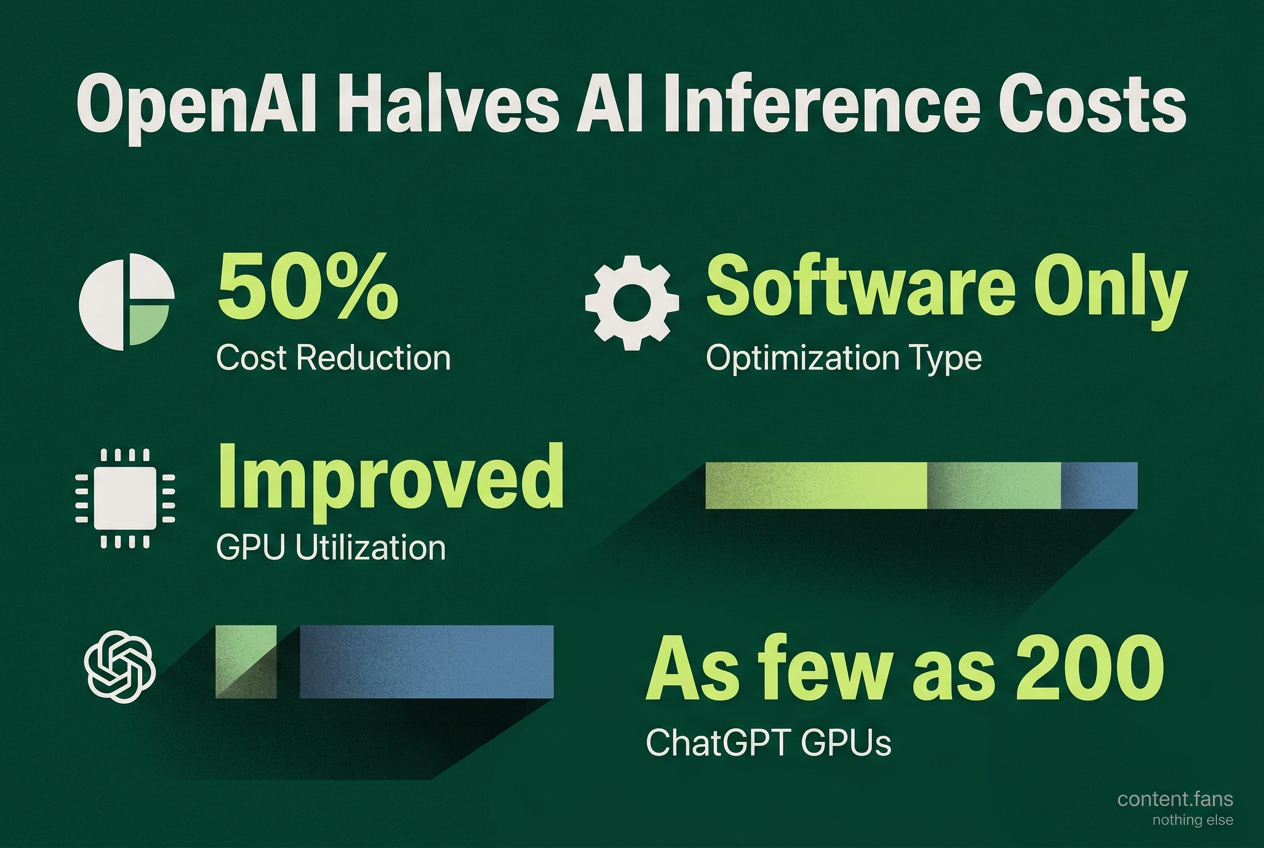
OpenAI has achieved a landmark 50% reduction in AI inference costs, a breakthrough driven entirely by software optimizations, according to reporting from The Information's AI Agenda newsletter. This hardware-free efficiency gain is poised to reshape enterprise AI strategies and accelerate a broader shift in cloud economics. Early reports, reviewed by outlets like Gigazine, suggest the savings come from improved GPU utilization and a compressed cost for every token generated.
How did OpenAI cut inference costs?
The cost reduction stems from a multi-layered software strategy. According to industry reports, OpenAI enhanced GPU utilization by combining techniques like model quantization, dynamic request batching, and speculative decoding. These optimizations work together to shrink computational demands, increase throughput, and reduce redundant processing without requiring any new hardware.
Key techniques behind the efficiency gains include:
| Technique | How It Works | Estimated Impact |
|---|---|---|
| Model Quantization | Reducing model precision (e.g., to INT4/FP8) | Shrinks compute demands significantly |
| Dynamic Batching | Continuously batching requests for better throughput | Increases throughput substantially |
| KV-Cache Optimization | Compressing and sharing cached data to reduce memory calls | Cuts redundant computation on long chats |
| Speculative Decoding | Using a smaller model to draft tokens for a larger model to verify | Accelerates token generation and cuts active GPU time |
| Smart Query Routing | Directing simpler queries to smaller, more efficient models | Optimizes overall cost-per-query |
These optimizations function as "compute multipliers," reportedly allowing OpenAI to serve its high-volume logged-out ChatGPT traffic on as few as 200 GPUs, a dramatic reduction from the thousands required just two years ago.
How does this affect cloud and API pricing?
OpenAI's efficiency breakthrough has triggered a pricing leverage shift in the cloud AI market. The company now employs a two-tier inference strategy, using its most efficient models for low-cost public traffic while reserving premium models for paying customers. The cost reduction targets operational expenses for logged-out ChatGPT users; no current 50% discount on the Batch API has been announced. According to Kucoin's reporting, these optimization techniques are already being implemented across OpenAI's infrastructure.
What new AI applications are now viable?
Lower inference costs unlock previously cost-prohibitive applications, especially those that are latency-critical or require continuous operation:
- Continuous AI monitoring of complex systems and data streams.
- Real-time translation and analytics at a global scale.
- Advanced edge inference for autonomous systems and on-device assistants.
However, enterprises now face a "spend paradox," a concept noted by CIO Dive. While sources confirm a significant reduction in inference costs and a drop in GPU requirements for logged-out traffic, total enterprise AI spending is rising sharply. This is driven by the adoption of agentic workflows that can make multiple LLM calls for a single user task, dramatically increasing overall token consumption.
How is the competitive landscape changing?
The AI market is fundamentally shifting from a performance-driven race to a battle over cost-economics. With the quality gap between top models narrowing, cost is now a primary differentiator.
Key developments include:
- Low-Cost Challengers: New providers are entering the market with aggressive pricing strategies, though specific pricing comparisons vary significantly across providers.
- Defensive Efficiency: OpenAI's efficiency push is partly a defensive move to ensure its GPT tiers remain competitive against these low-cost rivals.
- Hardware Sovereignty: The long-term advantage may go to companies with their own silicon, like Google with its TPUs, which allows them to bypass the "NVIDIA tax" and control costs from the hardware up.
How should enterprises adapt to lower AI costs?
Rather than waiting for the next headline price cut, CIOs and architects should focus on optimizing their own AI architectures to maximize value. The most effective strategy is a tiered approach that matches the task to the right model. Key tactics include:
- Route Routine Work to Smaller Models: Use efficient open-source models (like Mistral Small or Llama 3) for high-volume, low-complexity tasks.
- Implement Caching: Avoid redundant API calls by caching the results of repeated queries.
- Control Context Size: Minimize tokens sent to the model by summarizing, chunking, or capping conversation history.
- Use Batch APIs for Offline Jobs: Take advantage of discounted batch processing for tasks that are not latency-sensitive.
- Measure Cost Per Outcome: Shift focus from cost-per-token to the cost of achieving a successful business outcome.