
How Local AI Infrastructure Buffers Against Export Controls, Cloud Outages
Serge Bulaev
Running AI models locally may help organizations keep their systems working when export controls or cloud outages happen. Reports suggest that after US chip restrictions, more developers in China started using local setups, possibly to avoid problems with outside supply chains. Local AI infrastructure appears to be important because it helps teams follow data rules, reduce delays, and keep control over their systems. Experts recommend steps like using smaller model versions, private registries, and careful management to make this work. However, analysts warn that these solutions might need more computing power, so planning for different backup options is important.

A resilient local AI infrastructure provides a powerful buffer against disruptions from export controls and cloud outages. When model access is interrupted, teams running inference on local hardware can keep services online and user data secure. This strategy has become a critical hedge against policy shocks, as evidenced by a 2024 literature review noting that Chinese developers increased engagement with open-source LLM repositories substantially more than U.S. developers following U.S. export shocks.
Why Localization Is a Strategic Necessity
Geopolitical and technical volatility creates three primary pressures on engineering teams: uncertain access to commercial APIs, strict data-sovereignty rules forbidding external data processing, and latency budgets that are incompatible with round-trips to remote cloud servers. Recent U.S. export controls on AI models illustrate this vulnerability; when API access is revoked, organizations without local alternatives face immediate disruption. In response, teams are leveraging open-weight models that users can run on their own hardware, making access irreversible once downloaded.
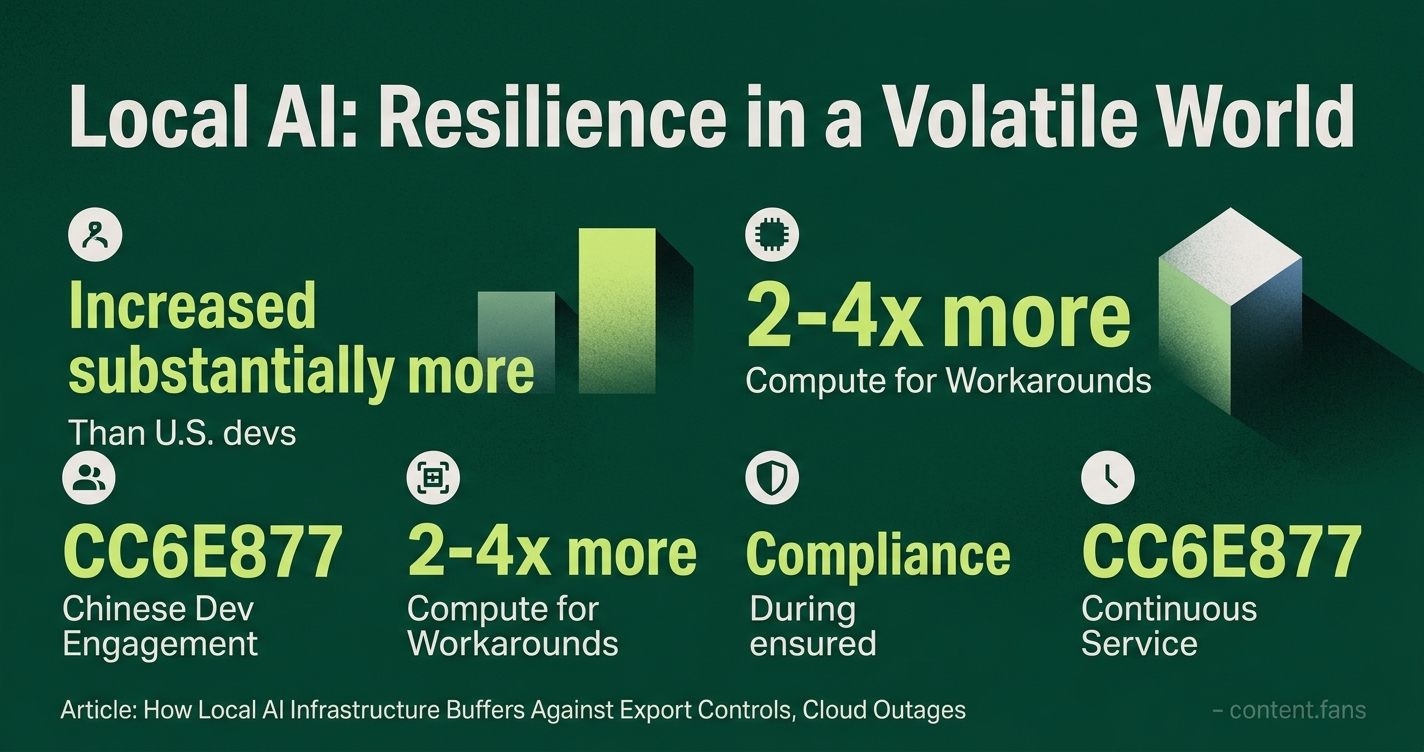
Local AI infrastructure is crucial for resilience because it allows teams to operate independently from external cloud services and supply chains. This autonomy ensures continuous service during outages, compliance with data sovereignty rules, lower latency, and complete control over the AI technology stack and its deployment.
How Export Controls Reshape AI Development
U.S. export controls have not stopped innovation but have instead reshaped it. Hardware bans on advanced GPUs spurred algorithmic workarounds, though analysts caution these can require two to four times more compute. For instance, industry reports suggest that competitive model development continues despite hardware restrictions, with developers finding ways to work around limitations.
Furthermore, controls targeting training-focused chips often fail to address deployment. Distilled and quantized models for real-world applications require far less frontier hardware, making them resilient to chip restrictions. This dynamic, combined with permissive licensing, has created what industry observers describe as a global diffusion engine that undercuts US rivals, making it essential for organizations to have the infrastructure to run these diverse alternatives.
Technical Primer: Building a Resilient Local Stack
Building a fully offline AI system involves several key steps:
- Package into OCI Images: Bundle quantized weights, tokenizers, and libraries into a single, versioned OCI image. Pre-build images in a connected zone, then transfer them to an air-gapped environment via
docker savewith SHA-256 checksum validation. - Quantize Models: Apply 4-bit (Q4_K_M) quantization to reduce model size by up to 75% with minimal quality loss, enabling inference on edge GPUs or CPUs.
- Implement Blue-Green Deployments: Use a blue-green directory structure on the host system. New containers are validated in the "green" directory before a symlink swap promotes them to "blue," preventing corruption during updates.
- Run a Private Registry: Establish private container registries like Harbor and self-hosted DNS root zones to keep all image pulls on the local network.
- Embed a Vector Store: Use an embedded vector store like FAISS to ensure Retrieval-Augmented Generation (RAG) remains functional offline.
Governance and Operational Best Practices
Resilient technology requires resilient workflows. In high-risk domains, humans must retain final decision authority, with AI acting as a reference tool. Organizations should track key performance indicators like System Reliability (uptime) and Error Reduction Rate to measure value in restricted environments.
Success also depends on continuous training and knowledge sharing. Organizations must codify skills like prompt engineering and output interpretation into shared playbooks that make AI a common organizational language. Finally, local stacks do not remove legal duties; teams must pin upstream commits and store license texts inside containers, scheduling regular audits for compliance.
Looking Ahead: Planning for Failure
While local stacks offer resilience, capacity planning is critical. Algorithmic workarounds for hardware restrictions can significantly increase compute demand. Experts advise planning a fallback hierarchy to preserve user trust if a primary model fails: a full-scale GPU model, a smaller CPU-based inference path, and a final, simple rule-based routine for essential functionality.
By combining airtight packaging, disciplined governance, and strategic planning, organizations can transform local model execution from an ad hoc patch into a durable strategic advantage.