
AWS commits $1 billion to new AI unit embedding engineers with customers
Serge Bulaev
AWS is spending $1 billion on a new program that puts its engineers directly into customer teams for short projects. This effort, called Forward Deployed Engineering, may help companies, especially in regulated industries, launch AI systems much faster. Early partners include the NBA, NFL, and Southwest Airlines, and the goal is for customer teams to run the new systems on their own after AWS leaves. Some experts warn there might be risks, such as higher costs, vendor lock-in, and slower moves to other providers. The AI market appears fragmented, which may help service-focused companies like AWS.

In a landmark move, AWS has announced a substantial investment in a new AI unit that embeds engineers directly with customers, a program designed to dramatically accelerate enterprise AI deployment. Called Forward Deployed Engineering (FDE), the initiative aims to help companies, particularly in regulated sectors, launch complex AI systems in significantly reduced timeframes.
A Hands-On Approach to AI Deployment
The Forward Deployed Engineering program embeds small pods of AWS engineers with customers for intensive sprint engagements. These teams co-develop production-ready AI systems, aiming to reduce deployment times and leave clients with self-sufficient teams, a shift from traditional, open-ended consulting models.
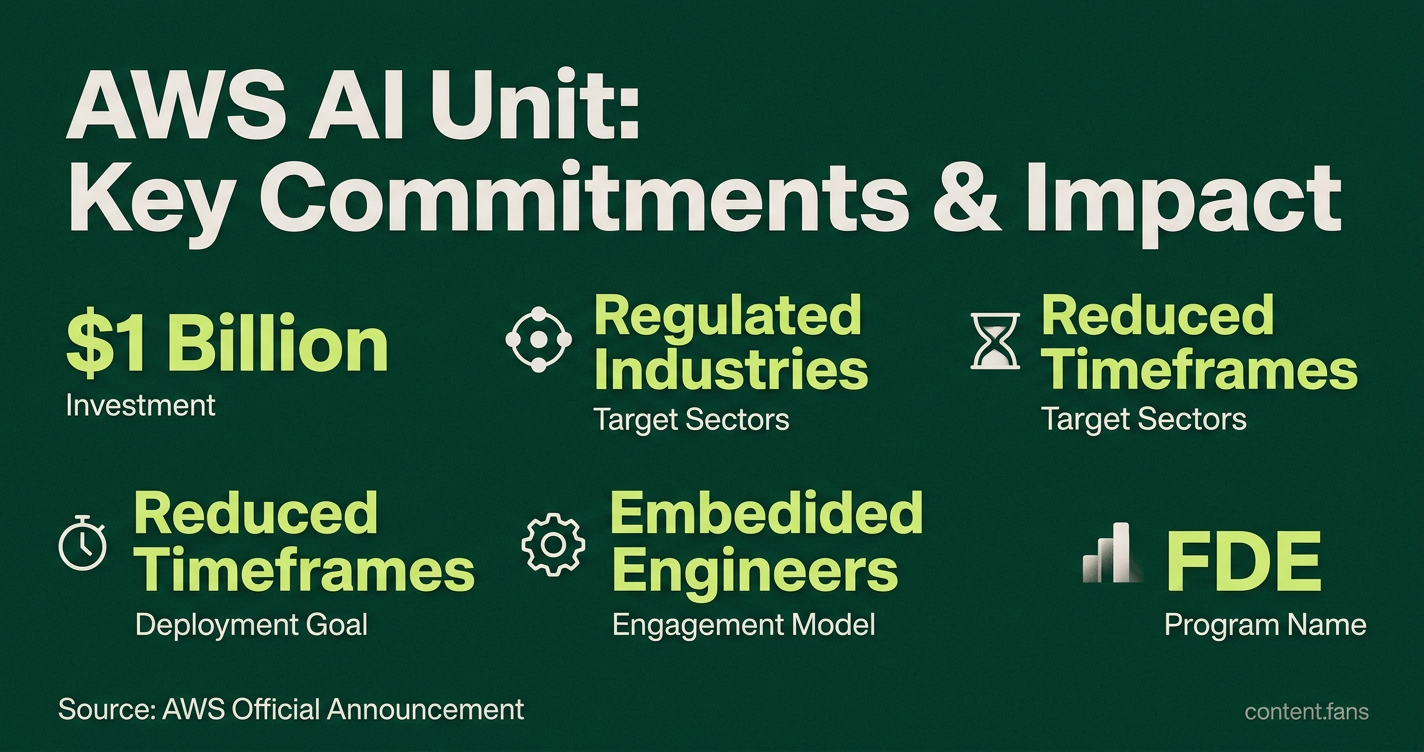
This hands-on model involves pods of AWS engineers working side-by-side with a customer's developers. Instead of providing high-level advice, the FDE teams write production code, with the primary goal of leaving the customer's team fully capable of running and maintaining the new systems independently after the engagement.
Strategic Funding for Long-Term Growth
AWS is funding the initiative directly from its balance sheet, with substantial resources allocated for salaries, travel, and internal tooling. This model allows AWS to prioritize long-term cloud consumption and customer retention over traditional hourly consulting fees, turning concierge-style support into a driver for stickier cloud revenue.
Targeting Regulated Industries in a Fragmented Market
The program was announced at the June 30, 2026 AWS Summit in Washington, D.C. Partners including the NFL, NBA, and Southwest Airlines are already working with AWS FDE teams. The primary source is an official AWS blog post, not a CNBC article as the primary origin of the partnership list.
The program is the CFDE (Certified Forward Deployed Engineer) program. AWS's Forward Deployed Engineering (FDE) unit specifically targets regulated industries like financial services, healthcare, and public sector. The fragmented embedded AI market presents a significant opportunity for service-driven strategies like AWS's, as the market remains highly competitive with many suppliers vying for position.
Understanding the Risks of Deep Integration
While the deep integration model promises speed, industry advisors caution enterprises to weigh the potential downsides. The most significant concern is vendor lock-in, where a company becomes overly dependent on a single provider's proprietary ecosystem.
Other potential risks include:
* Unpredictable costs from usage charges as workloads scale.
* Operational failures caused by single-vendor outages.
* Loss of data portability due to proprietary data formats.
* Slower adoption of superior rival models because of high migration barriers.
To mitigate these issues, experts recommend placing an AI gateway between applications and AI model providers, which helps keep migration options open and maintains architectural flexibility.
What is AWS's new AI unit and how does it work?
AWS is making a significant investment to create a Forward Deployed Engineering (FDE) unit that embeds small "pods" of AWS engineers inside a single customer for intensive engagements. These engineers co-build production-grade AI systems side-by-side with the customer's own teams, compressing typical deployment timelines. The goal is to leave behind self-sufficient internal teams rather than open-ended consulting relationships.
Which industries are first in line for the embedded-engineering treatment?
Early partners announced at the June 30, 2026 AWS Summit in Washington, D.C. include the Allen Institute, Cox Automotive, the NBA, the NFL, Ricoh, and Southwest Airlines. AWS says the program is purpose-built for regulated sectors such as financial services, healthcare and government where security, governance and speed to production are critical.
How does AWS's model differ from what competitors like OpenAI or Palantir offer?
AWS funds the unit entirely from Amazon's balance sheet, avoiding outside investors and billable-hour pricing. Engineers act as co-builders who write production code, not advisors. Outcomes are measured in deployment speed and self-sufficiency, whereas traditional vendors often create ongoing vendor dependency through open-ended consulting contracts.
What risks should enterprises weigh before signing up?
Deep integration can create vendor lock-in: many AI users worry about over-dependence on a single supplier and a significant portion of enterprise leaders believe they could not switch AI vendors without major disruption. Once prompts, fine-tuned models and agent workflows live in a proprietary stack, exporting them can be technically or legally impossible, forcing costly rebuilds if the relationship sours.
Will AWS expand the program beyond the initial investment?
AWS plans to grow the division significantly through external hiring and internal transfers, aiming to become the first major hyperscaler to fully operationalize embedded engineering in regulated enterprise markets. The company views this as a long-term bet that deployment capability, not model access, is now the main barrier to enterprise AI adoption.