
Microsoft shifts AI moat to systems design, not models, with IQ platform
Serge Bulaev
Microsoft now focuses on designing AI systems, not just building bigger models, with its Microsoft IQ platform. The company says real-world business impact may depend on how AI is integrated and governed, not just on model quality. Microsoft IQ connects business data and context to every AI action, and uses secure design and trust features to make its systems harder to copy. Experts suggest that as models become similar in quality, the real advantage might come from secure integration, data pipelines, and operational know-how. Microsoft may also benefit by making its systems work with many models, allowing it to control the important governance layer.

Microsoft's AI strategy is undergoing a fundamental shift, moving the competitive "moat" from model size to comprehensive systems design. The company argues that long-term advantage in agentic AI comes from the infrastructure surrounding the models, not just their parameter count. Microsoft states that AI is an 'operating model shift' and that the 'system' or 'platform' running AI is critical for business transformation.
The moat is built around the model, not just inside it
Microsoft's strategy centers on the idea that as AI models become commoditized, sustainable advantage lies in the proprietary systems that deploy them. This "moat" is not the model's parameters but the surrounding data pipelines, orchestration frameworks, evaluation tools, and user trust layers. These components create a feedback loop of operational know-how that is difficult for rivals to replicate.
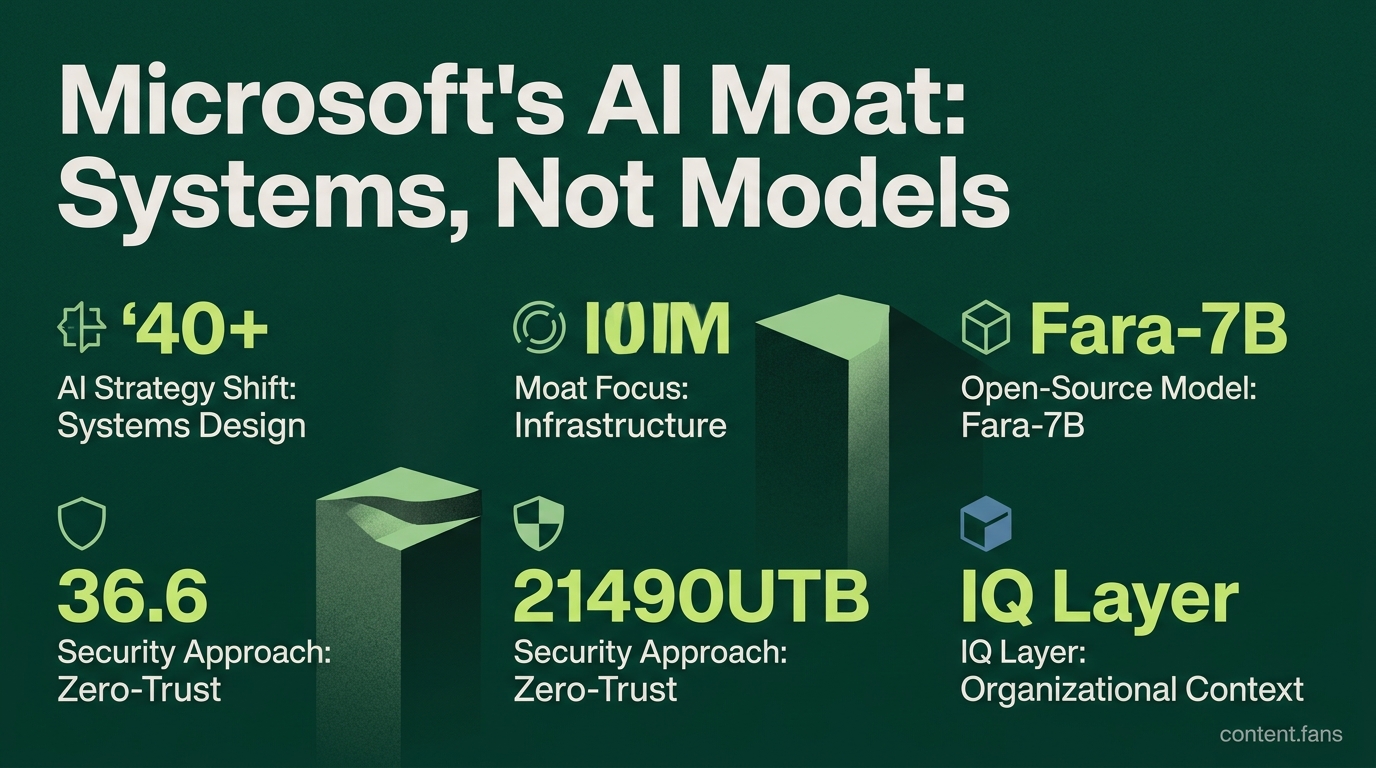
Microsoft's enterprise AI stack includes Azure AI Foundry, Windows Copilot, and Microsoft 365 Copilot. Microsoft IQ is an intelligence layer that grounds AI agents in organizational context (Work IQ, Foundry IQ, Web IQ). Microsoft's security approach involves zero-trust principles and secure execution environments, providing design-time governance for AI systems. Key investment areas include:
- Shared business context pipelines to feed agents real-time, proprietary data.
- Orchestration of specialized agents through ensembles like MDASH.
- Evaluation and verification harnesses to validate agent outputs.
- UX and trust layers that are secured by design.
Data pipelines in practice - synthetic data generation
Microsoft's approach to synthetic data generation demonstrates how data pipelines can become strategic assets. Microsoft has developed models like MAI (Microsoft AI) and uses synthetic data for training purposes. The company has open-sourced Fara-7B under an MIT license, along with detailed descriptions of its data generation pipeline in research papers.
By open-sourcing both the model and providing detailed pipeline documentation, Microsoft demonstrates its commitment to advancing the field while maintaining competitive advantage through operational expertise and integration capabilities. This approach allows smaller, more efficient models to perform complex agentic work by leveraging high-quality, task-specific training data - a capability enabled by the surrounding architecture, not raw model scale.
Competitive dynamics and the open-source question
As the performance gap between leading open-source and proprietary models continues to narrow, the strategic focus shifts to orchestration and control. This convergence elevates the importance of the systems that manage the agents.
Proprietary agent SDKs can increase switching costs and create vendor lock-in. In response, many enterprises are adopting a hybrid, "rent the engine, own the car" strategy: they license intelligence from vendors but manage orchestration through open frameworks to maintain control. Standards like the Model Context Protocol (MCP), introduced by Anthropic in November 2024, aim to standardize AI integration with external tools, ensuring workflow portability and vendor-neutral governance, pushing the competitive moat further toward integration standards and compliance tooling.
Why scale still matters - but differently
While Microsoft's focus has shifted to systems, model scale remains relevant, just not as the primary moat. The company continues to train frontier models, but its platform strategy is increasingly model-agnostic. Microsoft has been integrating AI capabilities into Windows and positioning it as a platform capable of running various AI models and services.
This approach allows Microsoft to control the critical governance and orchestration layer, capturing value regardless of which model leads the benchmarks. In this architecture, scale funds the research and development of the surrounding systems - evaluation harnesses, synthetic data engines, and security containers. The value accrues as these assets are tightly coupled with enterprise context, widening the systems-based moat with each agent deployment.