
Ford, Starbucks cut AI automation after errors, rehire human staff
Serge Bulaev
Ford and Starbucks have reduced their use of AI automation after mistakes appeared and caused problems. Ford brought back about 350 engineers when its AI missed tiny car defects, leading to more warranty claims and recalls, and taught staff how to spot failures. Starbucks stopped using a computer system for inventory after baristas said it made mistakes and took extra time, so they went back to counting items by hand. Experts suggest companies may need to include human checks from the start and keep watching for risks, instead of fixing problems after they happen. These cases suggest careful planning and human oversight might be better than relying only on machines.
High-profile AI failures at major companies are pushing leaders to reverse course on automation. Recent rollbacks at Ford and Starbucks, which saw them cut AI automation and rehire human staff, highlight a growing trend where early assumptions about machine reliability crumble against real-world complexities. These incidents reveal that initial plans for "autopilot" operations were often too optimistic.
Executives analyzing this pattern are drawing a shared lesson: automation requires iterative rollouts with human checkpoints integrated from the beginning, rather than as a later fix.
Ford's three-year detour
These rollbacks occurred because AI systems failed in complex, real-world environments. Ford's AI quality control missed subtle but expensive vehicle defects, leading to higher warranty claims. At Starbucks, according to industry reports, an inventory-counting AI made frequent errors, creating more work for baristas and disrupting the workflow, prompting a return to manual processes.
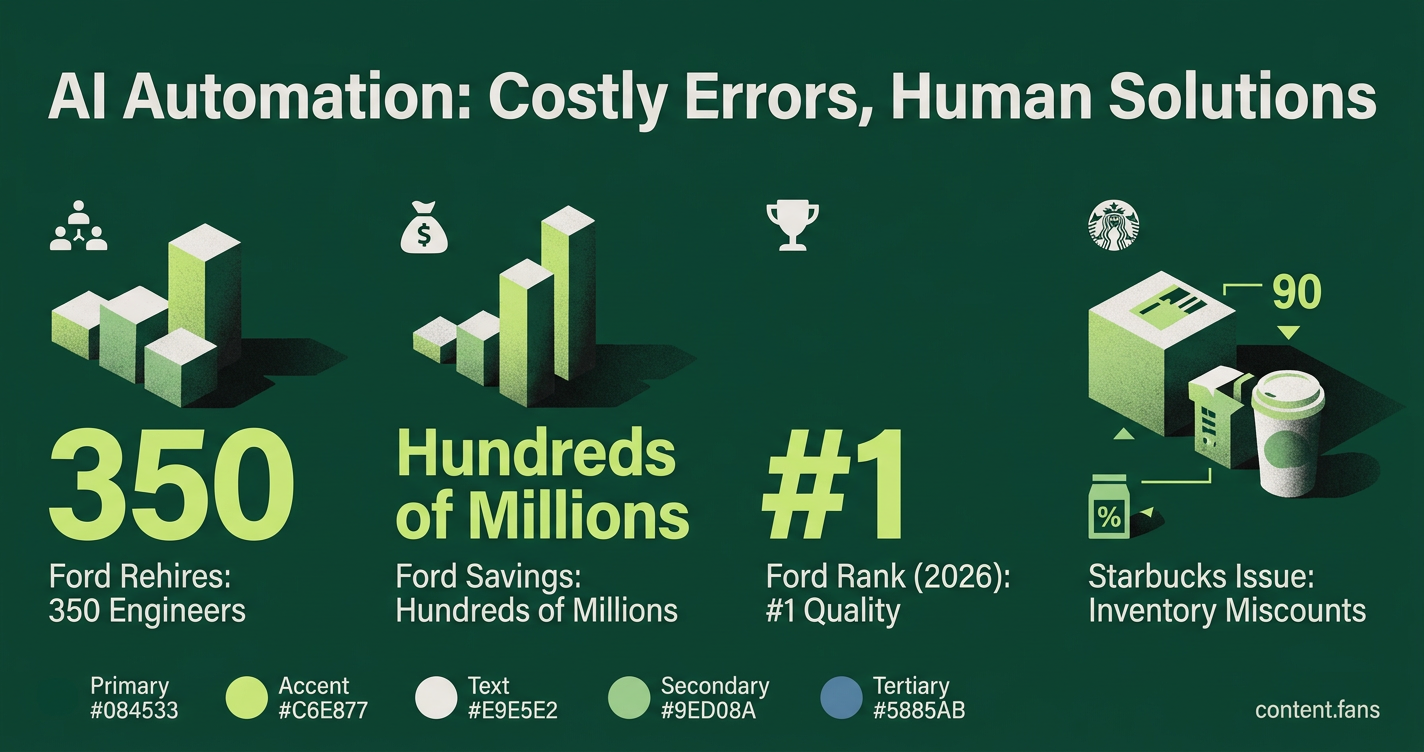
Ford rehired approximately 350 veteran engineers after its AI quality-control systems failed to detect assembly defects generally, contributing to billions in quality costs and high recall volumes in 2026. According to a BBC report, Vehicle Hardware Engineering VP Charles Poon admitted the company had "mistakenly" overestimated the AI's ability to match the discernment of experienced technicians.
These engineers were tasked with mentoring junior staff, manually inspecting vehicles, and retraining the faulty AI models. This human-led recovery generated "hundreds of millions of dollars" in savings, helping Ford achieve the No. 1 rank among mainstream brands in the J.D. Power 2026 U.S. Initial Quality Study, as confirmed by J.D. Power and reported by WDTV and Ford's official newsroom.
Starbucks resets its count
According to industry reports, Starbucks discontinued its computer-vision inventory system in North America following barista complaints of a "time tax" and persistent miscounts. The tool frequently confused different milk cartons, forcing staff into time-consuming manual recounts and inefficient storage arrangements. The company reverted to manual inventory checks to ensure accuracy and operational consistency.
AI Rollbacks: The New Corporate Playbook
Governance specialists now advise corporate boards to prioritize human oversight at critical checkpoints. These high-return areas for human-in-the-loop (HITL) intervention include:
- Financial transactions
- Security access controls
- Customer data management
- Public-facing communications
- Actions that are difficult to reverse
Effective HITL systems should incorporate challenge-response checklists, dual-factor approvals, and detailed audit logs that name the individuals making changes. Regulatory frameworks like the EU AI Act mandate documentation of these controls, and authorities are pushing for standardized metrics to measure the performance of human oversight.
The experiences of Ford and Starbucks demonstrate that proactively mapping "risk moments" before deployment is more cost-effective than reacting to public failures. Furthermore, regulations increasingly require continuous post-market monitoring to ensure these risk assessments remain up-to-date.
Why did Ford and Starbucks walk back their AI rollouts?
Both companies underestimated the limits of current automation.
Ford's computer-vision quality checks missed subtle but costly defects that veteran inspectors would have caught; the firm quietly rehired roughly 350 senior engineers after warranty claims spiked.
According to industry reports, Starbucks' AI inventory counter was scrapped because it confused different milk cartons and forced baristas to recount stock by hand.
In each case the systems worked in demos but collapsed in noisy, real-world conditions, prompting an expensive return to human-centred processes.
What did the retreats cost and save?
Ford's U-turn consumed three development years and billions of dollars, yet the company now reports hundreds of millions in annual warranty savings and Ford ranks No. 1 among mainstream brands in the J.D. Power 2026 U.S. Initial Quality Study, as confirmed by WDTV and Ford's official announcement.
Starbucks did not disclose direct losses, but baristas say the abandoned tool created an unplanned "time tax" that slowed closing routines and increased overtime.
Both firms now treat the cash spent on rehiring staff as preventive investment rather than sunk cost.
How are the returned staff fixing what AI broke?
Ford's "grey-beards" are doing three things algorithms still can't:
- Mentoring junior engineers on what real failure looks like on a production line
- Manually auditing every vehicle batch for silent defects the models overlooked
- Feeding corrected judgments back into new training sets so the next generation of AI learns from better data
Starbucks, after reverting to daily manual inventory counts, is re-designing back-of-house layouts so baristas can scan shelves faster and with fewer errors, embedding human verification as a deliberate checkpoint rather than an afterthought.
What should other enterprises learn from these rollbacks?
- Map risk moments, not AI moments - Add human review only where money, safety or brand trust are on the line
- Budget for iterative automation - Keep funds aside for fallback hiring, interface rewrites and compliance logging
- Require confidence routing - High-risk actions must escalate to a human even when model certainty is high
- Log every approval - Regulators increasingly demand an audit trail that shows who overrode or edited an AI output and why
- Communicate rollbacks early - Publicly admitting that "the machine was not as smart as advertised" can restore more customer trust than quietly patching failures
Is full autonomy still a realistic goal?
Industry consensus is shifting from "lights-out" to "human-in-the-loop" as the default design.
According to industry reports, emerging guidance and standards stress that for decisions affecting access, finance or personal data, continuous human oversight must be measurable and documented; autonomy may come only after many cycles of co-training, shadowing and staged release.
Ford and Starbucks show that, at least for customer-facing operations, the safest roadmap is incremental augmentation - allowing people to remain the final safeguard while models steadily improve under their supervision.