
OpenAI Generated Nearly $6 Billion in Q1 2026 Revenue, Ahead of Anthropic
Serge Bulaev
OpenAI generated nearly $6 billion in revenue in the first quarter of 2026, which appears to put it ahead of Anthropic for that period. Most of OpenAI's money seems to come from consumer subscriptions, enterprise contracts, and developer access, with Codex playing a key role. Reports suggest enterprise contracts make up about 40 percent, while Microsoft licensing is a smaller part. Even with this revenue, OpenAI still depends on bigger cloud providers and faces questions about keeping costs low and staying competitive. The company's future position may change if rivals improve or if customers start using more than one AI platform.

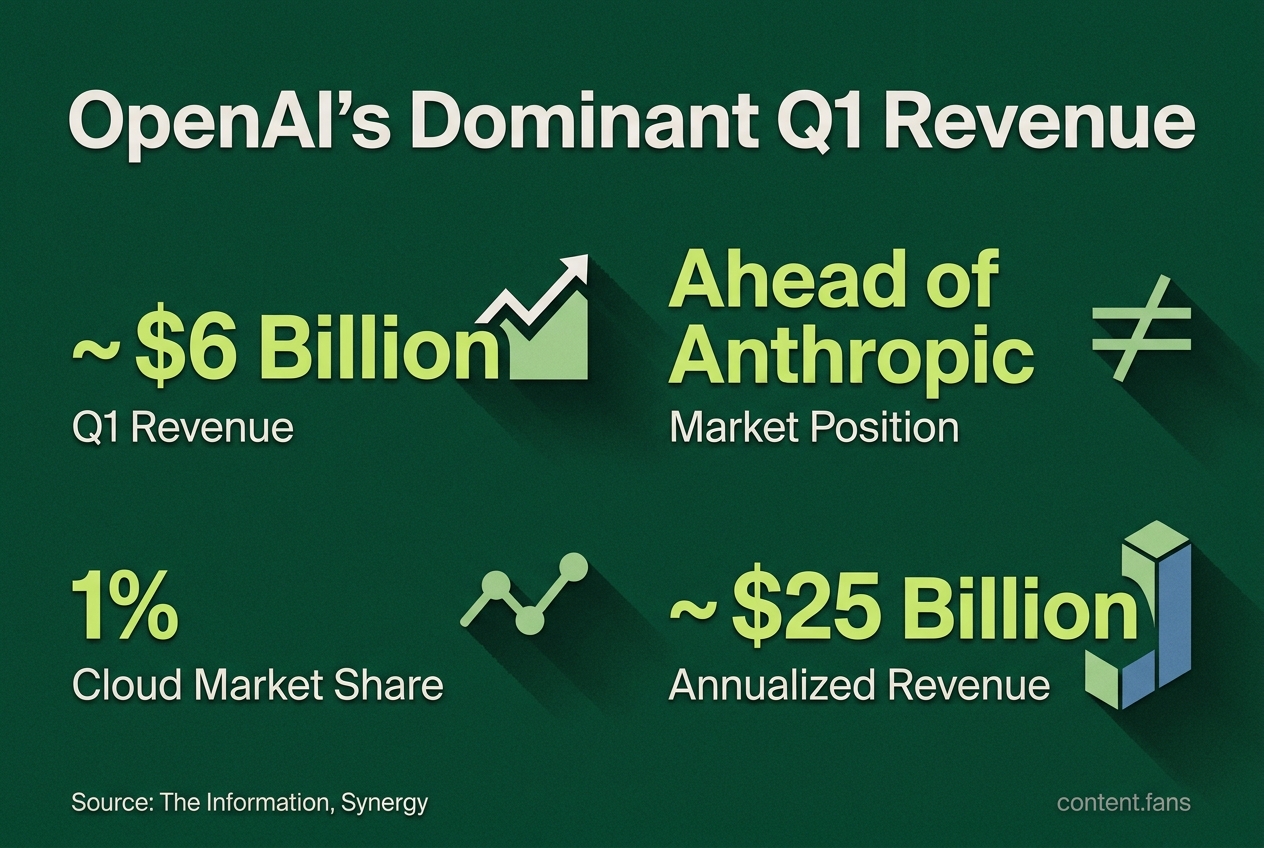
OpenAI generated nearly $6 billion in revenue during the first quarter of 2026, a milestone that positions the AI leader significantly ahead of rival Anthropic. This impressive figure, driven primarily by enterprise contracts, consumer subscriptions, and developer access to models like Codex, highlights the company's rapid conversion of research breakthroughs into substantial cash flow.
Understanding OpenAI's Revenue Streams
OpenAI's revenue is sourced from a mix of channels, led by paid consumer subscriptions and rapidly scaling enterprise contracts. Developer API services represent a smaller but fast-growing segment, while direct licensing to partners like Microsoft constitutes a distinct, comparatively smaller stream of income.
While OpenAI has not published an exact product-level breakdown, the headline figure was reported by The Information, citing sources with knowledge of the company's financials. Industry reports and analyst notes offer further insight into how this revenue is distributed across its main channels.
- ChatGPT Consumer Subscriptions: Remain the largest single source of revenue, although its overall share is decreasing as enterprise adoption accelerates.
- Enterprise Contracts: Contribute a significant portion of total revenue. The sources support ChatGPT subscriptions and API/licensing as major revenue components driving enterprise demand.
- API and Developer Services: Show the fastest percentage growth, expanding quickly from a smaller initial base.
- Microsoft Licensing: Handled as a separate commercial agreement, this stream is estimated to be smaller than the others.
This revenue structure suggests that income from Codex is integrated into the enterprise category rather than being tracked separately. The description of customers upgrading "from just ChatGPT to Codex into truly an agentic platform" points to significant upsell opportunities without clarifying specific product margins.
Competitive Landscape and Market Position
According to industry reports, OpenAI's quarterly revenue firmly places it ahead of its closest model-building rival, Anthropic. However, broader cloud infrastructure data underscores the AI sector's reliance on hyperscale providers. In Q1 2026, Synergy reported AWS 28%, Microsoft 21%, and Google Cloud 14% of the global cloud infrastructure services market; OpenAI and Anthropic were each listed at 1% in an earlier Synergy market snapshot, indicating their dependence on larger partners for delivering model inference at scale.
The enterprise AI platform market was estimated at $14.8 billion at end-2025, while OpenAI was estimated at about $25 billion in annualized revenue in February 2026. However, this leadership position is not guaranteed. Industry observers note that its market share could be challenged by two key factors: advances in model quality from competitors and a growing preference among large customers for multi-model strategies to mitigate risk and control costs.
Sustainability and Long-Term Viability
This impressive financial scale does not erase fundamental questions about OpenAI's cost structure and long-term profitability. Reports continue to highlight the immense capital required for training new model generations. Simultaneously, enterprise customers are exerting pressure for lower inference prices and transparent carbon accounting, creating a difficult balance for maintaining healthy margins. OpenAI's success may hinge on balancing premium subscription tiers and high-value services, like Codex-based agents, with its reliance on cloud credits from strategic partners.
For enterprise buyers and investors evaluating the company's long-term trajectory, three key metrics will be critical to watch:
- The share of enterprise revenue derived from specialized, workflow-specific agentic systems.
- The cost-per-token trend for complex tasks like code generation.
- The rate of customer adoption for multi-vendor AI tools, which could reduce platform lock-in.
Any significant movement in these metrics throughout 2026 could alter the competitive dynamics among leading AI labs.
What drove OpenAI's strong Q1 2026 revenue performance?
According to industry reports, a significant portion came from enterprise contracts, with coding agents representing a fast-growing segment. Paid ChatGPT subscriptions still supplied the single largest share, but their portion is shrinking as business accounts scale.
How does OpenAI's quarterly revenue compare with Anthropic's?
The Information puts OpenAI's Q1 top line at about $5.7 billion, giving the company an estimated $1 billion lead over Anthropic for the quarter. No public filing breaks out Anthropic's exact figure, so the gap is directional rather than audited.
Is Codex a separate revenue line item?
No. Codex is bundled inside the enterprise bucket; OpenAI does not disclose a standalone Codex number. Enterprise customers buy seat licenses or usage credits that can be spent on ChatGPT, Codex, or future agent tools, so the coding model's exact dollar contribution is blended.
What does the Q1 result signal about enterprise AI demand?
According to industry reports, the strong quarterly performance implies that large companies are moving from pilot to production much faster than many budgets predicted. Industry sources suggest the enterprise segment is on track to reach a significant portion of total revenue by year-end.
Are margins keeping pace with revenue growth?
OpenAI has not released a Q1 profit figure, but earlier internal documents reportedly forecast a negative operating margin for 2026 as the firm keeps GPU clusters and staff hiring on aggressive expansion paths. High revenue is not yet matched by high profitability, a tension investors are watching closely.