
OpenAI Finds 18 New Diagnoses in Rare Childhood Disease Cases
Serge Bulaev
OpenAI helped review 376 rare childhood disease cases and found 18 new diagnoses, according to a June 2026 study. The study suggests that focusing on patient-level results may be more helpful than just looking at performance scores. Researchers used AI to quickly scan patient data and notes, but doctors made the final diagnosis decisions. Another report says Google's AMIE system might help doctors manage long-term care, with plans rated as good as those from regular doctors. Experts note that hospitals and regulators may now look at real-world results, like fewer misdiagnoses and readmissions, instead of only accuracy numbers.
A new study reveals how OpenAI helped find 18 new diagnoses in rare childhood disease cases by reanalyzing 376 unsolved medical files. The report, a collaboration with Boston Children's Hospital and Harvard, represents a growing focus on real-world patient outcomes in AI evaluation.
How AI Helped Revisit 376 Unsolved Cases
Researchers used an OpenAI model to re-examine genomic data and clinical notes from 376 children with undiagnosed disorders. The AI rapidly identified potential leads that human specialists had missed, allowing physicians to conduct targeted follow-up tests and confirm 18 new diagnoses in a fraction of the time.
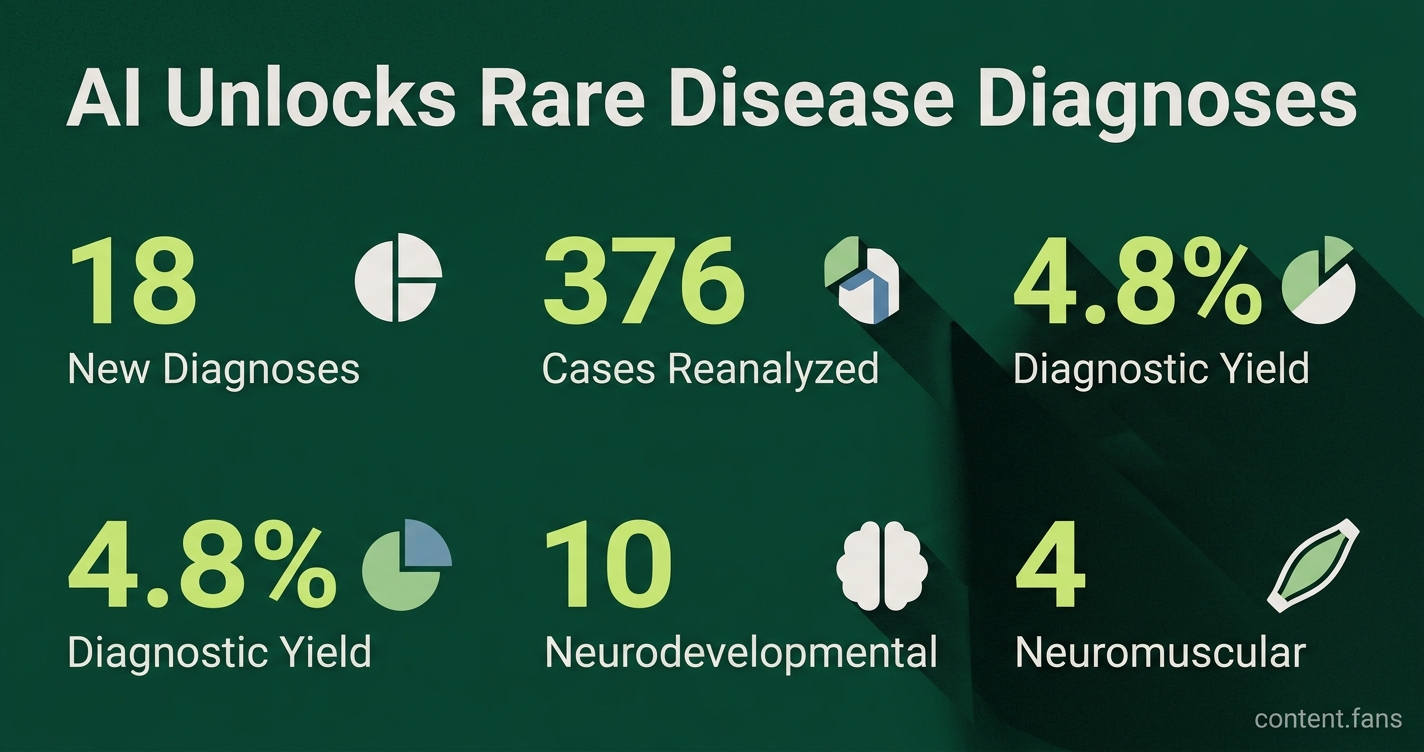
The study, published in NEJM AI, details how this workflow achieved a 4.8 percent diagnostic yield on cases previously deemed unsolvable, surfacing leads for the 18 new diagnoses (OpenAI). The AI acted as "an extra set of eyes," enabling clinical teams to review each complex case efficiently (NBC News). Investigators stress that human clinicians made all final diagnostic decisions after conducting follow-up tests.
The newly diagnosed conditions included:
- 10 with neurodevelopmental conditions
- 4 with neuromuscular disorders
- 2 sudden unexplained deaths reevaluated post-mortem
- 2 early childhood psychosis presentations
Google's AMIE Extends AI to Long-Term Patient Care
In a related development, Google announced its AMIE system can now manage long-term patient care. A study in Nature found that AMIE-generated management plans were comparable to those from primary-care physicians. According to a Google Research blog post, blinded specialists rated AMIE's plans higher for treatment precision and adherence to medical guidelines.
A New Focus on Real-World Outcomes Over Benchmarks
These studies reflect a broader industry trend among healthcare providers who are increasingly demanding real-world evidence of AI's impact. Instead of focusing solely on lab-based accuracy scores, there is a growing shift toward patient-centric metrics.
Key performance indicators now being tracked in clinical AI studies include:
- Misdiagnosis reduction percentages
- After-hours charting minutes saved
- Readmission or revisit counts within 30 days
This shift to an outcome-based evidence model will likely define how hospitals and insurers evaluate and adopt clinical AI technologies in the future.
What exactly did OpenAI do in the Boston Children's Hospital study?
OpenAI's o3 Deep Research model acted as an AI "second reader." Physicians fed it the full genomic and clinical charts of 376 children whose diseases had stumped multiple specialist teams. The model flagged plausible explanations, and confirmatory lab or imaging tests then verified 18 new diagnoses (a 4.8 % hit-rate).
Which families saw a turnaround?
The NEJM AI paper reported the first 18 confirmed cases:
- 10 children with neurodevelopmental delay
- 4 with severe neuromuscular weakness
- 2 who had survived near-miss sudden-cardiac events
- 2 with early-childhood psychosis
All had waited > 3 years on average before the AI re-analysis.
Why is the 4.8 % yield considered a win?
Experts point out that these cases had already been through multiple specialist rounds and costly gene panels, so any extra diagnostic yield is clinically meaningful. Boston Children's reported about 60,000 hours in time savings across more than 50 automations, equivalent to more than $7 million in redeployed labor.
How does this compare with Google AMIE moving into chronic-care?
Google AMIE has now left the "single-consult" stage. A Nature paper shows AMIE matching primary-care attendings on longitudinal management plans - tracking meds, investigations, and guideline adherence across repeat visits. While OpenAI's study focuses on rare-disease diagnosis, AMIE's push illustrates AI covering the full care arc.
What does the timing tell us about medical-AI reporting?
These developments reflect a growing trend where media and journals increasingly highlight patient-level outcomes (diagnoses rendered, hours saved, readmissions avoided) rather than benchmark leader-boards alone.