
OpenAI files confidential S-1 for IPO, targets enterprise superapp growth
Serge Bulaev
OpenAI has filed a confidential S-1 to prepare for a possible IPO, with reports suggesting the company could be valued above $300 billion, though some private estimates are even higher and not confirmed. The timing of the filing comes just after OpenAI announced plans for a desktop 'superapp' that may combine several AI tools and focus on business users, aiming to increase the share of revenue from enterprise customers. Leadership roles appear to be shifting, with Greg Brockman now handling product strategy, while Fidji Simo's current status is unclear. Because the filing is confidential, important details like finances and exact valuation are not yet public. Observers suggest the company may be waiting to see how the market responds before making more decisions.

OpenAI has officially initiated its path toward a public offering, confirming that it filed a confidential S-1 for its IPO. While the company has not provided specific timing details, this move prepares for a potential stock market debut. Due to SEC confidentiality rules, crucial details like financials, share price, and an official valuation are not yet public. Industry reports suggest significant valuations, but these figures remain speculative until a public prospectus is released.
Why the Filing Coincides with a Product Overhaul
The S-1 filing's timing is strategic, arriving just after OpenAI unveiled its new desktop 'superapp.' This product overhaul is central to the company's plan to significantly boost enterprise revenue, signaling to potential investors a clear strategy for converting its massive user base into sustainable, high-value subscriptions.
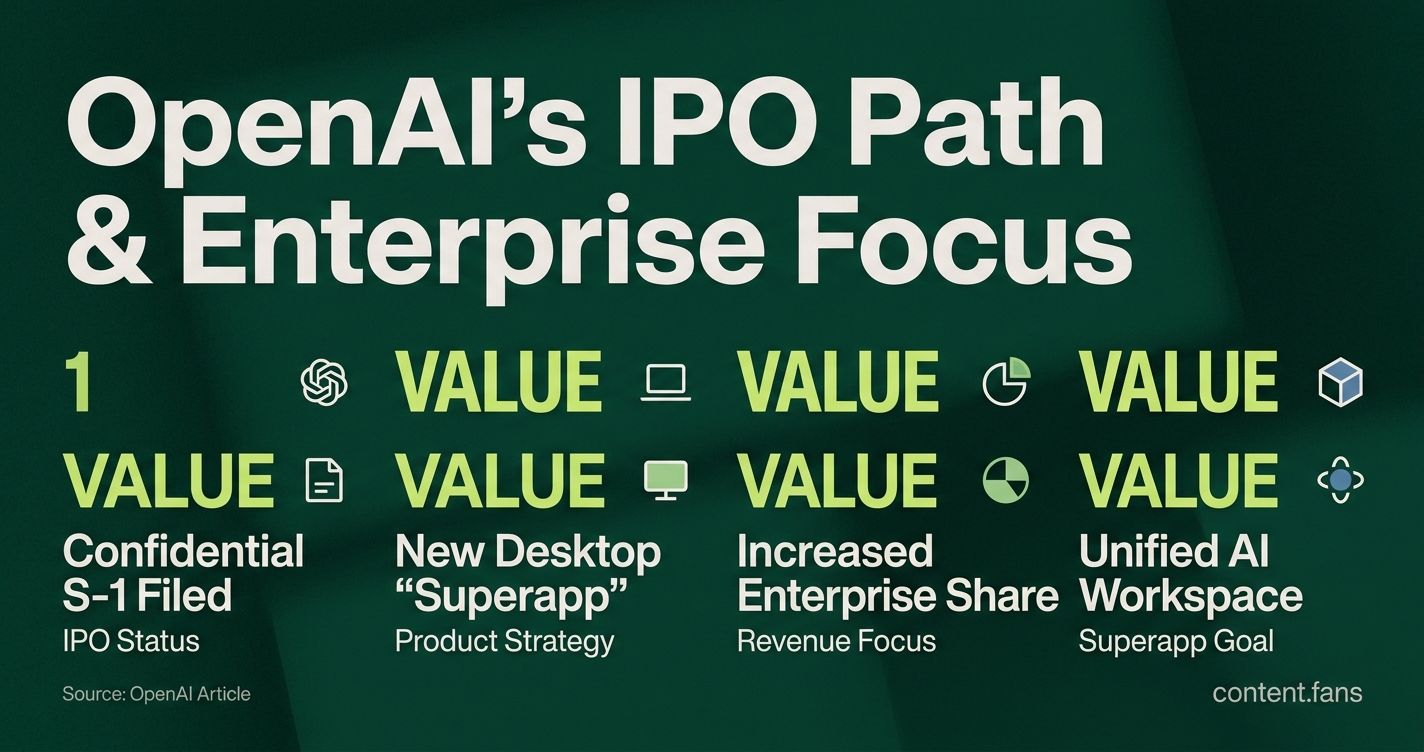
The confidential submission closely follows the announcement of a new desktop "superapp" designed to integrate ChatGPT, Codex, and browser tools into a single workspace. According to company sources cited by Bloomberg, this unified platform is intended to guide professional users toward paid, high-compute services. OpenAI's strategy aims to create "a unified AI superapp as the primary experience where employees get things done."
This product pivot is directly linked to a new revenue focus. With enterprise clients representing a significant portion of revenue from a growing number of businesses, OpenAI aims to increase that share before an IPO. The new superapp is a key tool for accelerating the conversion of free users to paid enterprise accounts.
- Enterprise Customers: Growing number of businesses
- Current Enterprise Revenue Share: Significant portion
- Pre-IPO Revenue Goal: Increased enterprise focus
Leadership Roles Behind the Strategy
According to supported reporting, OpenAI's CFO Sarah Friar and CRO Denise Dresser have been speaking about enterprise strategy. This new structure organizes development into four main pillars: core platform, enterprise, consumer, and infrastructure, all of which will support the new unified superapp. While Fidji Simo, described as CEO for AGI deployment, has been central to the commercial strategy, her current role is unconfirmed by the company after she took medical leave. Her status remains based on press reports rather than official company statements.
What the Confidential S-1 Reveals - And What It Hides
Filing a confidential S-1 allows OpenAI to prepare for an IPO without the immediate public disclosure required by a full, public filing. This provides limited visibility into the company's health; key information like executive compensation, detailed risk factors, and audited revenue figures will only become public if OpenAI proceeds with the IPO. For now, valuation discussions are based on unverified secondary market activity, not official data.
This strategy gives OpenAI tactical flexibility, allowing it to go public quickly in favorable market conditions or delay if the market is weak. Announcing the superapp alongside the S-1 filing sends a clear message to investors: the company is focused on securing stable, recurring revenue through deeper enterprise market penetration.
Key indicators to watch next include any SEC comments on the filing, the beta release of the new desktop client, and updated metrics on enterprise subscription growth. These developments will offer the first real tests of whether OpenAI can meet its lofty valuation goals.
What does OpenAI's confidential S-1 filing mean for its IPO timeline?
The move marks the first official step toward a U.S. public listing. OpenAI has submitted the confidential filing, though specific timing details have not been disclosed publicly. The document remains confidential, so no pricing, share count, or valuation is disclosed to the public at this stage.
Are the rumored high valuations accurate?
Available reporting is mixed. While some outlets cite significant private-market valuations, the confidential S-1 itself has not confirmed any figure. Until the SEC filing is made public, valuation figures remain speculative.
How will the new 'superapp' strategy drive enterprise revenue?
OpenAI is merging ChatGPT, Codex, and Atlas into a single desktop experience. The goal is to significantly increase enterprise revenue share. A unified interface is expected to steer users toward paid developer tools and partner integrations, boosting per-customer spend.
Who is leading the product and commercial overhaul?
- Sarah Friar (CFO) and Denise Dresser (CRO) have been speaking about enterprise strategy.
- Nick Turley now heads Enterprise, Ashley Alexander leads Consumer, and Thibault Sottiaux drives Core Product/Platform.
- Brad Lightcap, as COO, continues to expand the commercial push, while Fidji Simo (on medical leave) is still involved in strategic planning.
Will existing mobile or consumer services be discontinued?
No. The mobile ChatGPT app and free consumer tier remain unchanged. The desktop-first superapp is aimed squarely at professionals and businesses, reflecting OpenAI's strategic shift toward higher-value, enterprise-focused revenue streams ahead of a potential public debut.