
OpenAI expects $50 billion compute spend in 2026 amid scarcity
Serge Bulaev
OpenAI expects to spend about $50 billion on computing power in 2026, which may be difficult due to limited supply. Most AI computing is controlled by a few big tech companies, making it hard for smaller groups to compete. This concentration of resources appears to affect innovation, as teams must carefully choose which projects get access to computing. Companies are using different strategies to secure enough computing power, but delays and energy needs make this challenging. Some experts suggest that the rules and policies about who owns and controls computing power could change as governments and regulators get more involved.

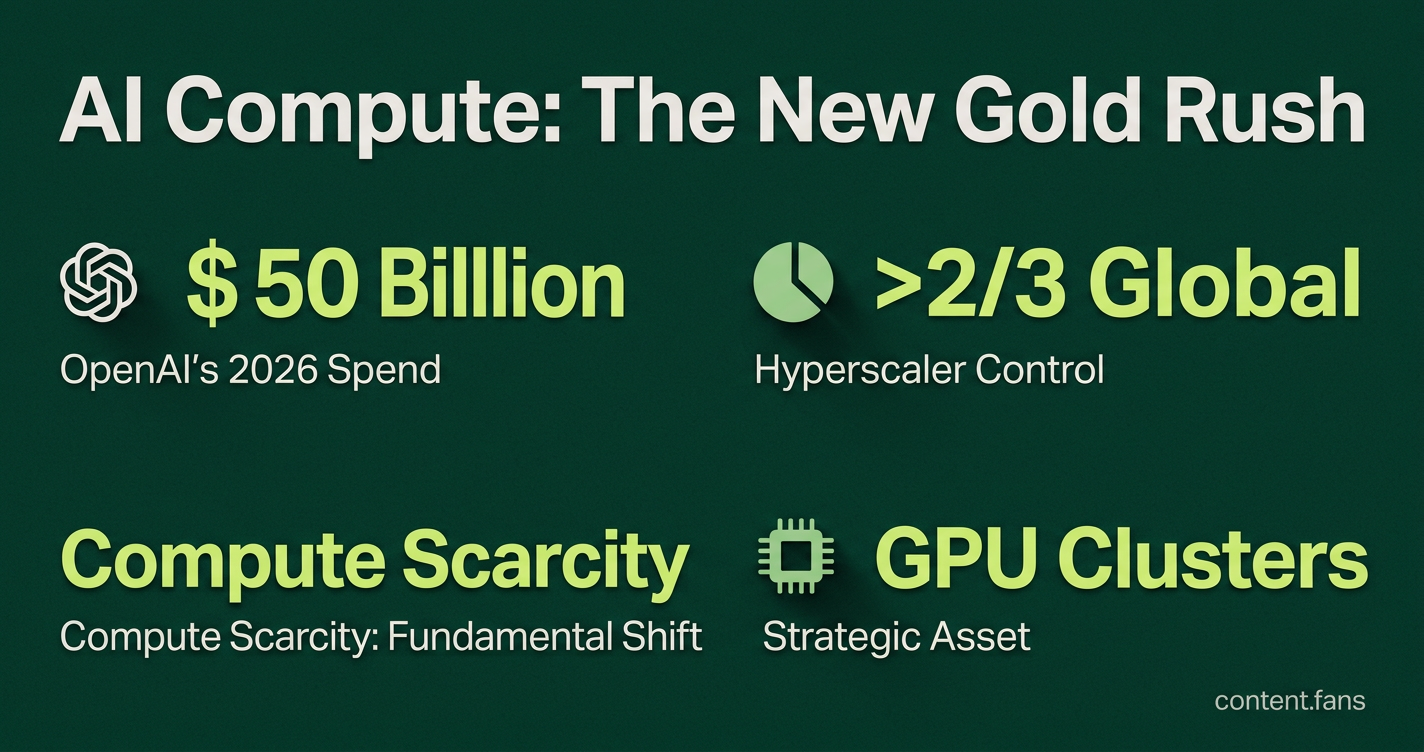
The scale of OpenAI's expected compute spend - projected at $50 billion for 2026 - signals a fundamental shift where raw processing power is the scarcest resource in AI. Brockman said OpenAI expects to spend $50 billion on computing power in 2026 during court testimony, according to Bloomberg and Reuters-style reporting. This scarcity redefines the competitive landscape, determining who can build, launch, and scale frontier AI models.
Treating compute like prime real estate fundamentally alters market structure, innovation tempo, and policy debates. Those who own or secure access to large-scale GPU clusters can effectively decide which AI projects scale and which ones stall.
Why concentration matters
The concentration of AI compute resources among a few tech giants creates significant barriers to entry for smaller firms. It drives up costs, forces long-term infrastructure commitments before development begins, and positions GPU clusters as strategic assets, limiting broad access and potentially slowing independent innovation.
Epoch AI estimates that Google, Microsoft, Meta, Amazon, and Oracle collectively control more than two-thirds of global AI compute (link). This concentration means:
- Prices for training and inference often track the capacity decisions of a handful of hyperscalers.
- Smaller labs must negotiate multi-year cloud contracts before they write the first line of model code.
- Governments increasingly view GPU clusters as strategic infrastructure rather than a private commodity.
OpenAI's anticipated $50 billion compute spend for 2026 represents a massive investment that signals competitive advantage in AI now depends as much on financing and facility build-outs as it does on algorithmic breakthroughs.
Impact on innovation pipelines
Within organizations, compute scarcity has a cascading effect. Brockman described internal GPU allocation as an exercise in "pain and suffering," compelling teams to prioritize projects based on projected revenue and latency needs. This pressure is causing a strategic shift away from broad, exploratory research toward narrower, milestone-driven roadmaps tied to pre-booked cluster time.
Furthermore, industry reports indicate that post-training enhancements - like larger context windows or denser retrieval - also demand significant compute cycles. This suggests that firms with secure, steady inference capacity can iterate and improve features faster, while competitors on volatile spot markets may be forced to throttle usage or prematurely distill models.
Competitive responses
To counter the dominance of hyperscalers, other companies are adopting three primary strategies:
- Strategic Partnerships: Exchanging equity or exclusive content for guaranteed, long-term GPU time.
- Hybrid Infrastructure: Using public clouds for bursty training workloads while moving predictable inference tasks to on-premise hardware located near affordable power sources.
- Policy Advocacy: Engaging with governments to secure subsidies, fast-track data center permits, or establish sovereign compute initiatives.
These tactics demonstrate a shift toward treating compute as a portfolio management challenge, balancing affordability, access, and resilience. However, experts warn that the success of any strategy depends heavily on energy availability, as power grid and cooling limitations are already causing cluster delivery delays of up to 24 months in some regions.
Policy cross-currents
The issue of compute scarcity creates a central tension for policymakers. Regulators considering antitrust action may view concentrated compute as an essential facility, justifying rules for interoperability or capacity disclosure. Conversely, national security interests are driving investment in domestic mega-clusters to reduce reliance on foreign-owned clouds. Industry reports indicate that many countries have announced public funding for high-performance AI infrastructure.
In the near term, the most likely battleground is cloud pricing transparency. With a few providers controlling both supply and spot prices, rival labs may argue that preferential access for internal teams constitutes anti-competitive self-preferencing. It remains an open question whether antitrust authorities will classify GPUs and high-speed interconnects as a distinct market subject to regulation.
The debate over compute as a competitive moat connects capital investment, energy infrastructure, and antitrust law. This complex intersection ensures that it will remain a critical focus for engineers, policymakers, and corporate strategists alike.
What is OpenAI's planned compute spend for 2026 and why is it so high?
OpenAI expects to spend about $50 billion on computing power in 2026; Bloomberg attributes this to Greg Brockman and says costs have surged as OpenAI develops more advanced models and serves a wider audience. This level of spend reflects OpenAI's view that compute is now the central limiting factor for product launches, research velocity, and competitive position. Brockman has explicitly said the company "cannot build compute fast enough to keep up with demand," forcing it to prioritize only the highest-impact use cases and delay or cancel others.
How does compute scarcity shape competitive dynamics in AI?
Compute scarcity is turning the AI race into an infrastructure race. Brockman notes that whoever secures the most reliable access to GPUs, power, and data-center capacity can launch more products, serve more users, and iterate faster. A significant portion of global AI compute is now controlled by major hyperscalers, meaning start-ups and smaller labs must buy access through cloud contracts, making cloud pricing and GPU availability pivotal competitive bottlenecks.
Which companies currently dominate global AI compute?
According to industry reports, Google, Microsoft, Meta, Amazon, and Oracle jointly control a significant portion of global AI compute. This concentration gives these firms outsized bargaining power and the ability to absorb the multi-billion-dollar capital costs of training frontier models, while other players face scarcity-driven delays.
What practical steps can companies take to mitigate their own compute shortages?
Firms can adopt a three-part playbook:
- Partnerships: Negotiate multi-year reserved-capacity deals with cloud and chip providers to lock in priority allocation and reduce single-vendor risk.
- Hybrid cloud: Run training and experiments on elastic public cloud, keep steady-state inference on private or reserved infrastructure, and push latency-sensitive workloads to edge or on-prem systems.
- Policy engagement: Work early with utilities and regulators on power availability, grid upgrades, and permitting timelines to secure regional capacity.
Why is compute becoming a strategic policy issue?
Governments are beginning to treat compute as critical infrastructure, comparable to energy or telecom networks. Industry reports highlight efforts by many countries to reduce dependency on foreign cloud providers for sensitive workloads. The outcome is a policy tension: regulators want open access and competition, while states and large firms are building national-scale AI infrastructure that could deepen concentration.