
OpenAI Expands Enterprise Sales to 500, Boosts Recurring Revenue Push
Serge Bulaev
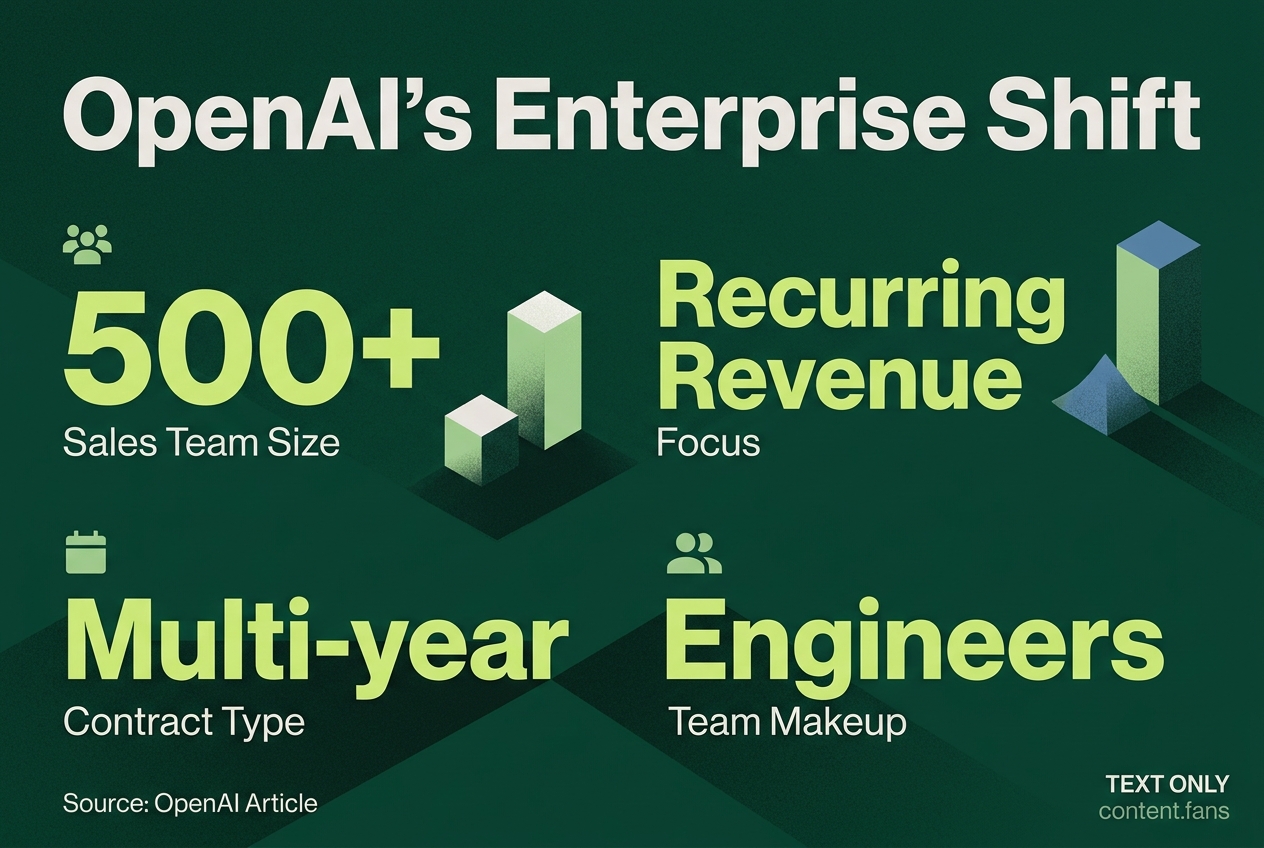
OpenAI has grown its enterprise sales team to over 500 people, which may signal a move toward larger and more regular contracts with big companies. The company appears to be shifting from simple API usage to more complicated, multi-year deals, and enterprises may soon see new pricing structures and rules. OpenAI's offers for big buyers include different types of contracts, such as seats for each user, usage by tokens, and custom solutions. Sources suggest that new contracts now require higher service availability, better data controls, and stronger security standards. Experts recommend that companies set clear rules and checks before buying AI, since deals are getting more complex and might involve several pricing models.

OpenAI has significantly expanded its enterprise sales team, signaling a major push for recurring revenue. This pivot away from simple API usage means enterprise customers will increasingly face structured, multi-year contracts. The move is driven by heavy infrastructure spending and the need to generate more predictable revenue streams, fundamentally changing how large companies will procure and govern AI solutions.
What Is Driving OpenAI's Enterprise Sales Expansion?
OpenAI has substantially expanded its enterprise sales team under COO Brad Lightcap in 2024-2025. This surge follows the company's need to generate more predictable revenue streams, signaling a deliberate pivot toward multi-year, recurring revenue from large-scale customers. According to CNBC coverage, the team is staffed heavily with engineers who act as solutions experts, not traditional sales reps, to guide technical validation with buyers.
For enterprise buyers, this strategic shift means moving from experimental, usage-based API access to formal procurement cycles. Companies should prepare for complex negotiations around pricing tiers, security guarantees, data governance, and long-term service level agreements, requiring more rigorous vendor diligence than ever before.
What New Contract Types and Pricing Models Can Enterprises Expect?
OpenAI is moving away from simple, opportunistic API consumption toward a mixed go-to-market motion that combines product-led growth with targeted enterprise outreach. As documented in analyst briefings (Saastr scaling story), this strategy introduces several hybrid commercial models designed to balance predictability with elasticity.
| Typical Structure | What It Delivers | Buyer Impact |
|---|---|---|
| Seat-based Enterprise subscriptions | Guaranteed user licenses plus admin controls | Predictable budget line items |
| Usage-based API contracts | Pay-as-you-go tokens for product teams | Direct cost-to-value linkage |
| Custom enterprise deployments | Tailored security, data residency, fine-tuning | Higher switching costs, deeper lock-in |
| Hybrid seats + usage | Baseline seats plus measured API spend | Balances predictability and elasticity |
| Outcome-oriented deals | Pricing linked to business-process KPIs | Shared risk / shared upside |
This shift toward structured deals is a core part of the company's evolving commercial strategy, as noted in reports on its enterprise approach (OpenAI's Enterprise AI Strategy in a Nutshell).
How Should Enterprises Prepare Their AI Procurement and Governance?
Advisory bodies like ISACA and the World Economic Forum recommend treating AI sourcing as a formal program, not a one-off tool purchase. To prepare, procurement, legal, and risk teams should implement a six-step program based on established frameworks (WEF procurement guidelines):
- Define measurable outcomes before any vendor conversation.
- Audit data readiness, as fragmented or low-quality data undermines ROI.
- Require transparency packs, including model cards and training data disclosures.
- Lock down IP and data rights with explicit "no-training-on-customer-data" clauses.
- Run pilots under governance with a limited scope, success gates, and rollback plans.
- Establish cross-functional oversight with executive co-sponsors and a security review board.
What SLA, Security, and Pricing Baselines Should Buyers Demand?
As the AI market matures, enterprise-grade standards are solidifying. Across leading vendors, high uptime guarantees are becoming standard expectations, backed by service credits. Key security expectations now include SOC 2 Type II compliance, zero data retention options, full data encryption, and explicit no-training guarantees. For financial predictability, buyers should push for hybrid base-plus-usage contracts or committed spend tiers to avoid the volatility of pure token-based billing.
Enterprise Terms Considerations:
Public documentation indicates, for example, that Anthropic offers zero data retention by default for certain enterprise integrations, and cloud providers like AWS, Azure, and Google Cloud commonly offer committed-use or provisioned-throughput style pricing and IAM/KMS-based security integrations. However, exact SLA percentages and specific ranges vary by service, region, and tier and are not consistently documented across all these providers. Any accurate comparison should reference each vendor's current, product-specific SLA and security documentation rather than generalized assumptions.
How Can Procurement Teams Avoid Vendor Lock-in?
A three-layer defense against vendor lock-in is emerging as a best practice, as detailed in vendor-neutral procurement playbooks (Avoiding vendor lock-in guide). Enterprises are now building these requirements into their RFPs:
- Architecture Layer: Insist on open APIs, standardized data formats, and portable fine-tuning capabilities.
- Contract Layer: Negotiate clear export/deletion rights, model-versioning controls, and termination SLAs.
- Governance Layer: Schedule annual portability drills and dual-source critical workloads to ensure technical and operational freedom.
Key Signals for the Next Budgeting Cycle
These developments signal that procurement leaders must act proactively. It is essential to update cost models to account for hybrid pricing, involve security and legal teams much earlier in the process, and map out growth scenarios for both seat-based and API-driven consumption. This preparation enables an organization to negotiate with AI vendors from a position of clarity and strength, rather than urgency.