
OpenAI engineer arrested for planting listening device in executive meeting room
Serge Bulaev
A senior OpenAI engineer, Abdulrahman Alfozan, was arrested after a hidden listening device was found in an executive meeting room. Federal charges allege he planted the recorder, raising questions about possible corporate espionage, but there is currently no indication that important data was stolen. OpenAI says its internal tools helped find the source of the device and that it is working with investigators. This incident appears to highlight growing concerns about spying risks at AI labs and suggests that companies may need to take new security steps. OpenAI also appears to use both human checks and advanced AI tools to protect its secrets.

An OpenAI engineer was arrested for planting a listening device in a San Francisco executive conference room, prompting federal charges and raising alarms about corporate espionage at top AI labs. The FBI took Abdulrahman Alfozan, a senior software engineer, into custody after security staff found the hidden recorder during a routine sweep.
Federal Charge Details
The engineer, Abdulrahman Alfozan, faces a federal charge for using an electronic device to intercept oral communications. This felony count was filed in the Northern District of California after OpenAI security discovered the bug and alerted the FBI.
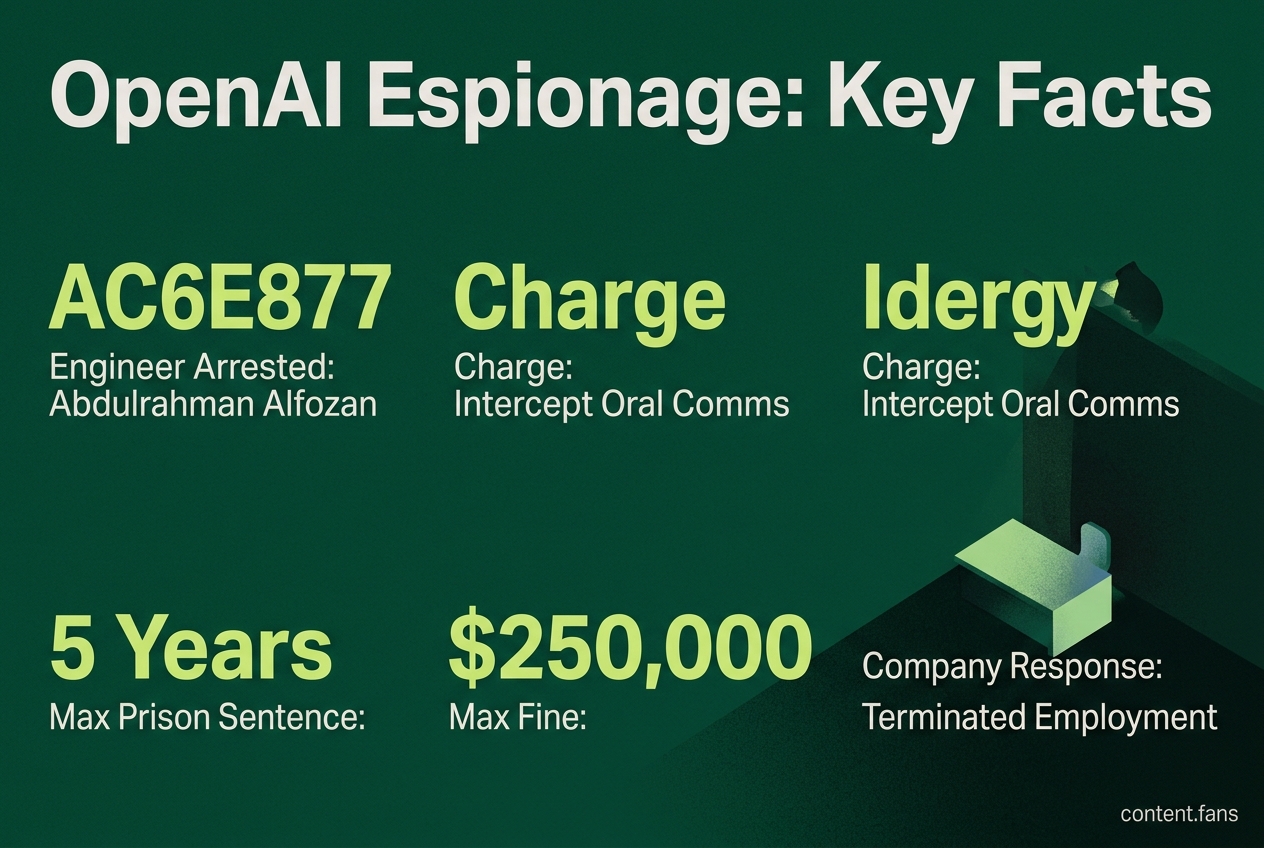
Federal filings allege Alfozan planted the device in a room used for confidential technical and strategy sessions. According to prosecutors, he was charged with one count of intercepting oral communications, which carries a maximum sentence of five years in prison and a $250,000 fine.
OpenAI has since terminated Alfozan's employment and is cooperating with the investigation. The company reported that its internal security tools helped identify the device and that it has "no current indication" that sensitive data like model weights or source code were stolen.
Rising Security Stakes for AI Labs
The incident highlights the growing physical and digital security risks facing AI research labs. With valuable assets like unreleased model weights at stake, the threat of corporate espionage has become a critical priority for many companies in the sector.
In response, industry experts recommend enhanced security protocols:
- Physical Sweeps: Regularly check conference rooms for hidden audio or video hardware.
- Access Control: Implement stricter background checks and access controls for personnel handling proprietary models.
- Employee Training: Educate staff to identify eavesdropping devices and social engineering attempts.
- Secure Communication: Enforce policies that limit sensitive discussions to secure locations.
- Network Monitoring: Continuously monitor for unusual data transfers from internal networks.
Inside OpenAI's Response Toolkit
A key aspect of OpenAI's response was its use of internal security analysis tools to examine the device. The company employed advanced technical capabilities to assess the hardware and identify potential security implications.
This combination of human security sweeps, technical forensics, and collaboration with law enforcement represents an emerging approach for how AI labs can protect their intellectual property against sophisticated threats.
This incident has intensified scrutiny of corporate espionage risks facing AI companies and prompted broader industry discussion about strengthening physical security measures. Below are answers to key questions about what happened, who was involved, and what it means for the sector.
Who was arrested and what are the charges?
Abdulrahman Alfozan, a Saudi national, was arrested and charged in federal court in the Northern District of California with "using or endeavoring to use an electronic, mechanical, or other device to intercept oral communications." If convicted, Alfozan faces up to 5 years in prison and a $250,000 fine, plus supervised release.
What exactly did OpenAI discover?
OpenAI discovered a hidden listening device planted in an executive conference room at its San Francisco office - a space used for confidential technical and strategic meetings. The company notified the FBI, which led to Alfozan's arrest. OpenAI has stated it has no current indication that model weights, source code, or customer data were exfiltrated.
How did OpenAI investigate the device?
OpenAI terminated Alfozan following the discovery and is cooperating with federal authorities. The company used its internal technical capabilities to analyze the device and assess its provenance, applying advanced security analysis tools in this forensic context.
What does this reveal about security risks for AI companies?
The incident illustrates that corporate espionage threats against AI companies are both cyber and physical. Intelligence reports have identified compromised insiders and exploitation of cybersecurity vulnerabilities as significant threat vectors for exfiltrating AI lab intellectual property. Many organizations now rank data leaks associated with generative AI as a leading concern, with growing numbers citing advancing adversarial capabilities.
Following this case, major AI companies have reportedly tightened security protocols amid heightened awareness of espionage risks.
How does this compare to previous espionage cases?
The incident has drawn comparison to previous espionage cases involving foreign nationals, including cases where employees were charged with accessing private data for foreign governments. These cases highlight concerns about employees with access to sensitive technologies and the potential for state-aligned intelligence collection targeting U.S. tech companies.
Physical security protocols now recommended for AI companies include regular conference room sweeps for hidden devices, restrictions on sensitive conversations in unsecured areas, enhanced employee vetting, and training to detect eavesdropping and social engineering attempts.