
OpenAI cuts Cursor access after SpaceX acquisition, citing trust
Serge Bulaev
OpenAI said it will stop providing its models to Cursor after SpaceX acquired the company, mainly because it does not fully trust companies linked to Elon Musk to follow OpenAI's rules. Cursor will lose access to GPT models on November 12, but the IDE will stay online and users might need to find new ways to keep some features working. Cursor users can still use OpenAI models if they add their own API key, but some advanced features may not work as before. OpenAI's contract may allow this cutoff after a change in company ownership, though it does not directly mention mergers. This kind of service stop appears to be happening more often in the industry when companies change ownership or there are worries about competition or rules.

OpenAI is set to cut Cursor's access to its AI models on November 12, a move that follows the code editor's acquisition by SpaceX. This decision to cut Cursor access stems from OpenAI's stated lack of trust in companies linked to Elon Musk to comply with its usage policies. While the Cursor IDE remains operational, the change disrupts core AI features that have relied on GPT models for chat and code refactoring since 2024.
The Rationale: Contract Clauses and Trust Issues
OpenAI is terminating access because its enterprise agreement allows for cancellation after a "change of control," which was triggered by SpaceX's acquisition of Cursor. The company cited a lack of trust, stating it cannot be certain that companies linked to Elon Musk will honor contractual bans on reverse-engineering or training competing models.
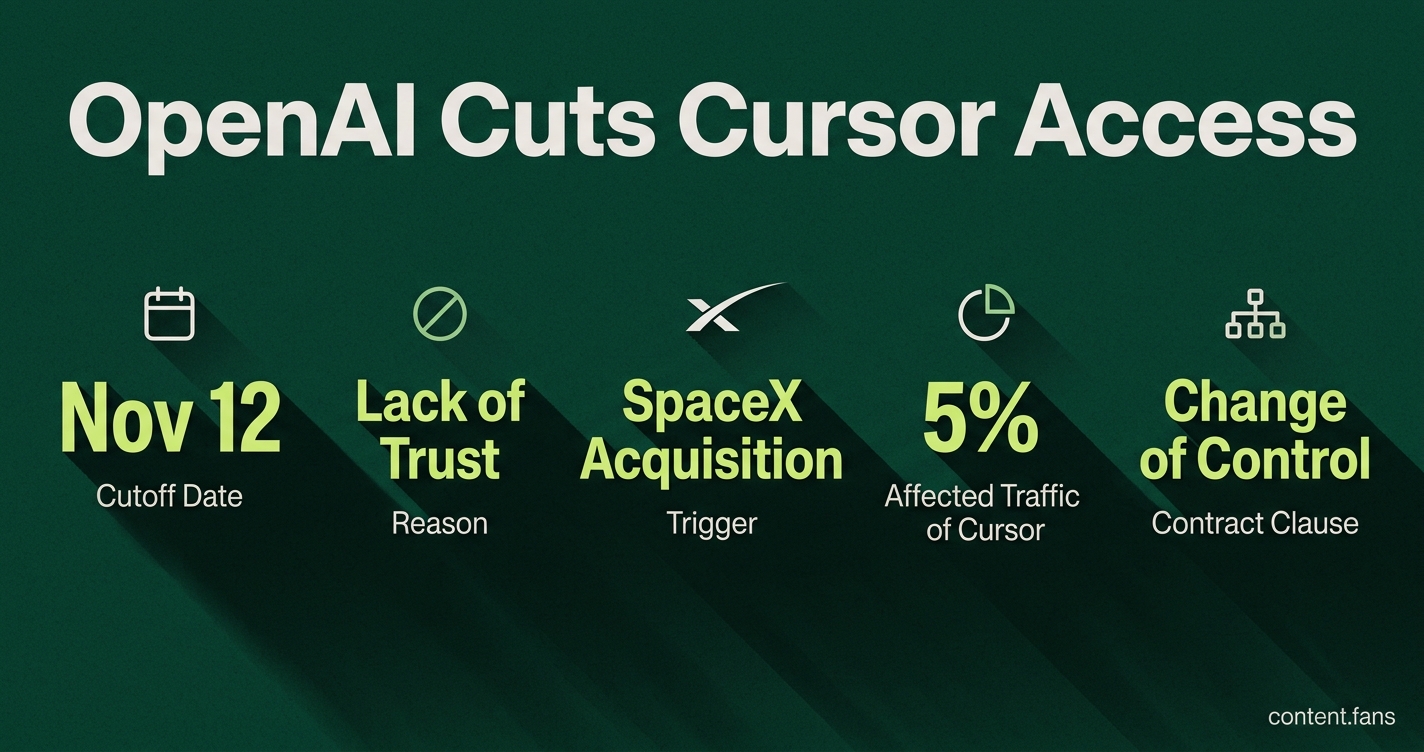
The termination is reportedly based on a "change of control" clause within a negotiated enterprise contract, a provision not explicitly detailed in OpenAI's public Services Agreement. This clause was activated by the SpaceX acquisition, and OpenAI is providing the maximum contractual notice period before the cutoff. Officially, OpenAI attributes the decision to "reduced trust," emphasizing that it "cannot trust Musk's companies to adhere" to its terms of service, which prohibit using model outputs to train competing models, according to Reuters.
What Cursor Users Lose and Keep
According to Cursor CEO Michael Truell, OpenAI models handle only about 5% of the platform's traffic, suggesting a limited immediate impact for the broader user base. The loss will be most felt in background features that automatically use provider-hosted GPTs. Users can still access OpenAI models for manual chat by providing their own API key, but this bypasses Cursor's native routing and orchestration.
Migration paths discussed by the company and community include:
- Plugging a personal OpenAI key into Cursor settings
- Switching to OpenAI's standalone Codex IDE extension
- Pointing Cursor at compatible OpenRouter gateways
- Evaluating self-hosted or open-weight code models (e.g., Starcoder2)
While these options preserve some functionality, they leave advanced automations partially degraded.
Industry Precedent
While terminating API access due to a change in ownership is rare, it is not without precedent. In a similar 2025 case, Anthropic revoked access to its Claude models for the startup Windsurf amid reports of a potential acquisition by OpenAI. Other instances of access restriction due to competitive or regulatory pressures include Reuters reporting on June 28, 2026 that Google had put limits on Meta's use of its Gemini AI models, with another source indicating the issue stemmed from March 2026 capacity limits rather than a complete access cutoff, and Anthropic disabling a model line in June 2026 due to a US export-control order, as Reuters noted. The Cursor case fits this growing pattern of model vendors weighing competitive risk when deciding who can access their systems.
Next Steps Before November 12
OpenAI will maintain service for Cursor until the November 12 cutoff. In response, Cursor is developing multi-provider routing to help users transition smoothly. Customers who depend on Cursor's integration with GPT-4 and future models should use the coming weeks to explore and validate alternative solutions, as new OpenAI models will no longer be available through the IDE.