
OpenAI Confidentially Files S-1, Signals Potential $1 Trillion IPO
Serge Bulaev
OpenAI has confidentially filed an S-1 in June 2026, which may lead to an IPO that some analysts say could be valued close to $1 trillion. The filing keeps detailed financial information private and does not mean a public listing will happen soon. This step comes as OpenAI faces growing legal and regulatory issues, which may affect its future value. The company's real market value might be lower because of these risks, and investors will not see full details until a public prospectus is released.

OpenAI has confidentially filed its S-1 registration, a pivotal step toward a potential initial public offering (IPO) that analysts speculate could value the AI leader near $1 trillion. The recent submission to the U.S. Securities and Exchange Commission allows the company to prepare for public markets while keeping its detailed financials private. This move arrives as OpenAI navigates significant regulatory and legal challenges, forcing investors to weigh its immense growth potential against a complex risk landscape.
Understanding the Confidential S-1 Filing Process
A confidential S-1 filing allows a company to submit its IPO registration to the SEC for private review. This process enables management to address regulatory feedback and refine disclosures without public scrutiny until approximately 15 days before the investor roadshow begins, offering flexibility on the IPO's timing.
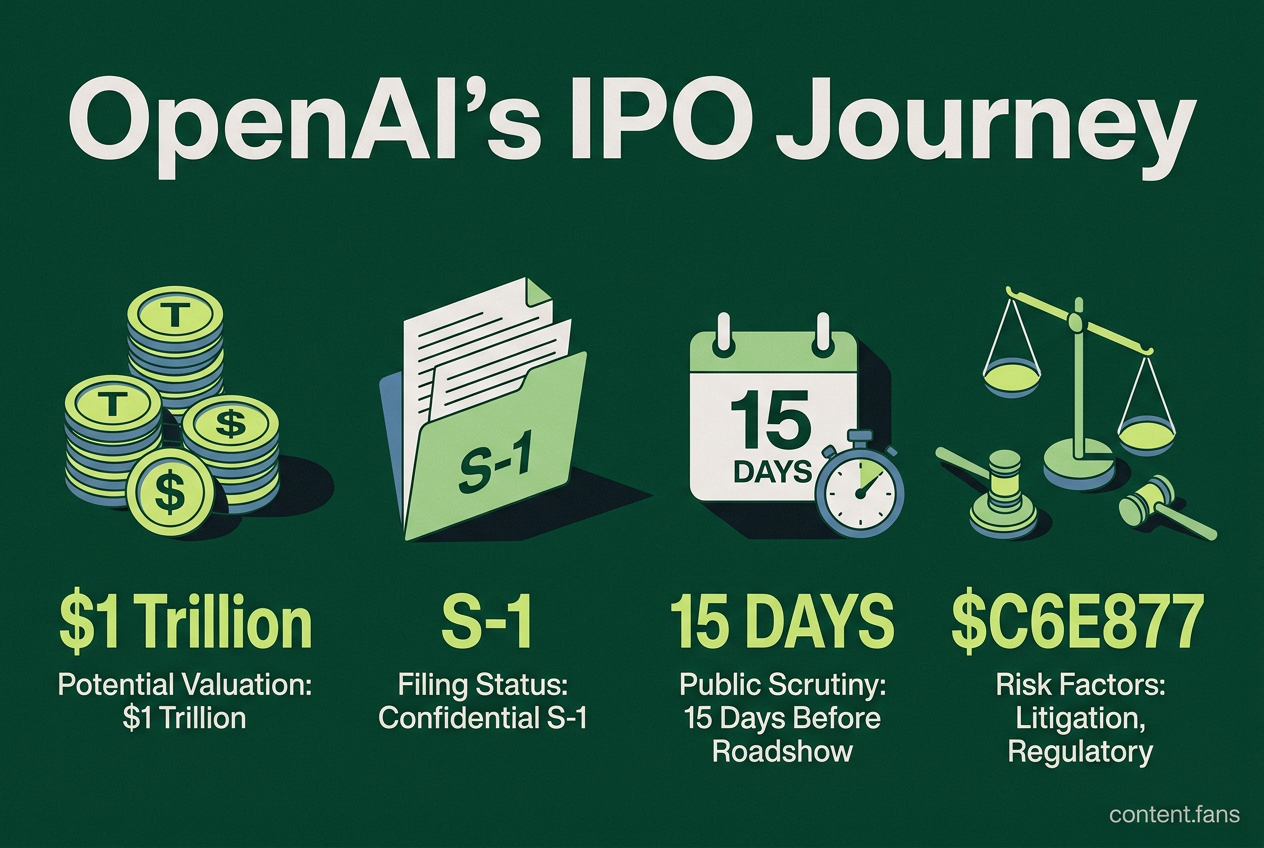
In a statement on its website, OpenAI confirmed it had "recently submitted a confidential S-1" but clarified it "has not decided on timing yet." Media outlets like CNBC characterized the move as a preparatory step, not a sign of an immediate listing (CNBC report).
The rumored trillion-dollar valuation stems from secondary market trades that have valued OpenAI at significant levels according to industry reports. However, public investors will likely demand a discount to compensate for significant litigation, governance, and execution risks, making the final IPO valuation uncertain.
Navigating Litigation and Regulatory Headwinds
OpenAI has already flagged significant risks to investors, including ongoing lawsuits and investigations that could impact future performance. According to industry reports, the company faces copyright and privacy claims, product liability suits, its critical reliance on Microsoft, and litigation with Elon Musk's xAI. These pressures intensified when, according to The New York Times, a group of state attorneys general issued subpoenas regarding user data and safety practices.
Key legal and regulatory challenges highlighted in recent reports include:
- Copyright and training-data disputes
- Product safety and wrongful-death suits
- State attorney general investigations on privacy and youth protection
- Contract and employment claims tied to rapid hiring
- Governance challenges linked to nonprofit oversight
Each of these issues could result in substantial fines, costly settlements, or operational restrictions. Analysts warn that the cumulative effect of these actions creates a higher risk premium, which could translate to a lower valuation multiple, even if each case is managed individually.
The Market for Mega-Cap AI IPOs
Following a significant rebound in IPO activity, advisory firms anticipate a growing wave of AI offerings. Current market sentiment favors infrastructure and enterprise platforms with visible revenue streams, a trend that supports OpenAI's API-driven business model. However, analysis from PwC and EY indicates that investors are increasingly selective, demanding clear paths to profitability before awarding high valuations.
Compared to its peers, OpenAI's potential valuation is in a class of its own. Industry estimates suggest competitors like Anthropic and Databricks are valued at substantially lower levels. While this positions OpenAI to potentially create a new trillion-dollar tier, achieving that milestone is far from guaranteed as long as major legal and regulatory questions persist.
OpenAI has issued the standard legal disclaimer that the confidential filing "does not constitute an offer to sell or a solicitation of an offer to buy" securities. Until the S-1 is made public, key details like revenue figures, share structure, and pricing will remain confidential. The market must wait for the public prospectus to see if the trillion-dollar valuation can hold up under scrutiny.