
OpenAI burned $3.7 billion in Q1 2026, raising sustainability questions
Serge Bulaev
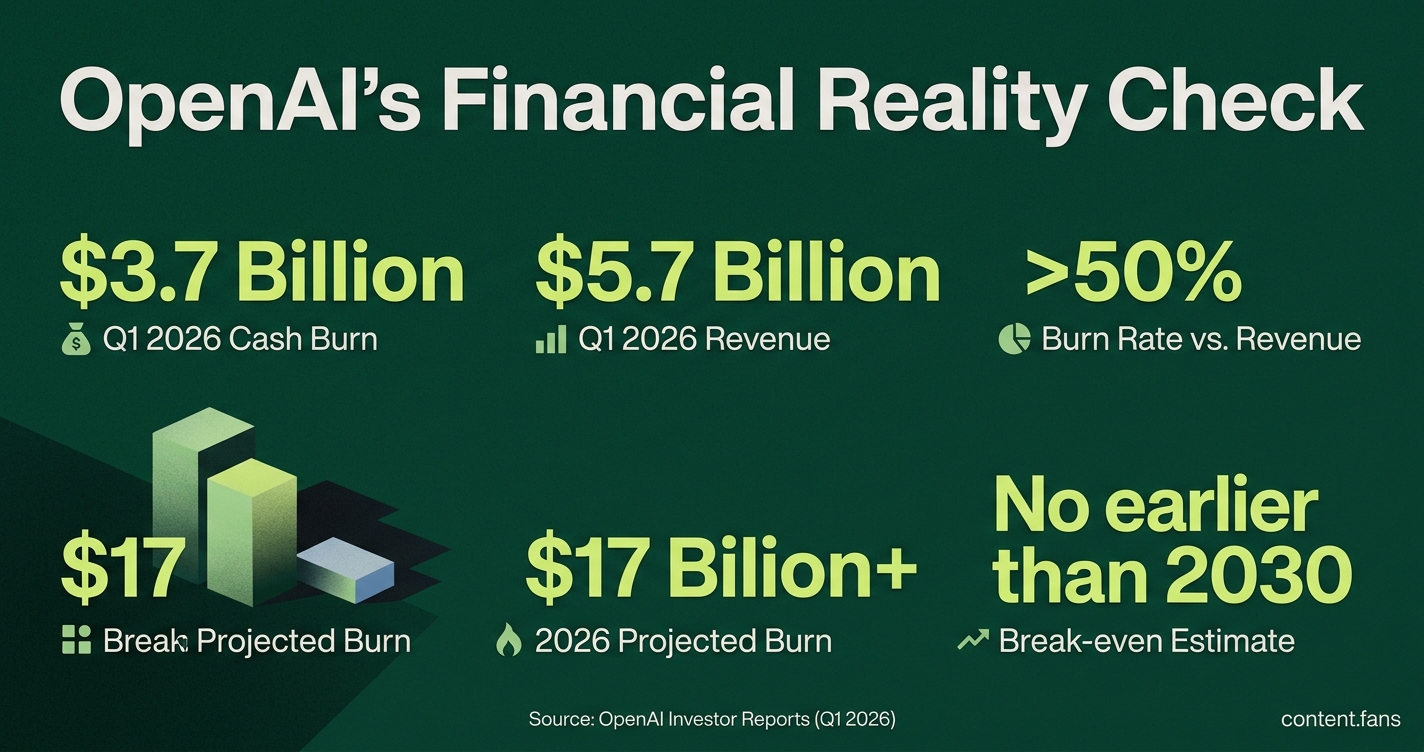
OpenAI reportedly spent $3.7 billion in the first quarter of 2026, which is over half of its $5.7 billion in revenue. Most of this spending appears to go toward running and training large AI models, with compute being the biggest cost. Although OpenAI has over $73 billion in cash, there are concerns about whether current spending can keep up with revenue growth. Some estimates suggest OpenAI's yearly cash burn could reach $27 billion, and break-even may not happen before 2030. These figures highlight the high costs and uncertainty around the sustainability of advanced AI development.

OpenAI's Q1 2026 cash burn of $3.7 billion, a figure exceeding half its $5.7 billion revenue for the period, highlights the immense capital required for large-scale AI development. According to figures reportedly shared with investors, this burn rate raises critical questions about the long-term financial sustainability and business models for even the most well-funded AI labs.
Key Drivers of the Cash Burn
The company's substantial spending is primarily driven by massive compute costs for training and running its AI models, including long-term obligations for GPUs and data centers. Significant investment in enterprise sales, strategic hiring, and the development of new models also contribute heavily to the quarterly cash burn.
Reports citing internal materials indicate substantial long-term GPU and data center obligations, making compute the single largest cost. Further expenses include an aggressive expansion of enterprise sales, robust hiring, and new model R&D. The company's gross margin is considered insufficient by analysts to offset such high growth-stage operating costs.
Balance Sheet and Financial Runway
Despite the significant cash burn, OpenAI remains well-capitalized, finishing the quarter with a substantial cash and marketable securities position. This provides the company with operational freedom to scale its revenue and refine its model. However, it does not alleviate the pressure to improve unit economics. While the figures were widely reported, multiple outlets noted they could not independently verify numbers from the original shareholder documents.
Strategies for Financial Sustainability
Analysts identify three primary levers for OpenAI to narrow its losses. First, revenue growth must consistently outpace cost increases, as the company currently spends a significant portion of every dollar earned. Second, gross margins must improve through higher-value enterprise products or more efficient model inference. Third, future infrastructure commitments may need to be moderated to align cash outlays with realized market demand.
Projections for 2026 and Beyond
OpenAI's 2026 cash burn was reported as more than $17 billion, with some reporting putting 2026 losses at about $14 billion, with most estimates placing operational break-even no earlier than 2030. These speculative projections underscore the immense investment required if current spending trends continue. Furthermore, competitive pressures to lower token prices could further compress margins and delay profitability.
Broader Industry Implications
OpenAI's situation is not unique. The entire AI sector is facing staggering costs, with industry reports suggesting massive hyperscaler AI capital expenditures. This spending is squeezing free cash flow at major cloud providers like Microsoft and Alphabet. For instance, according to industry reports, Amazon Web Services could face significant negative free cash flow this year, driven largely by GPU acquisitions and data center expansion as AI inference loads escalate.
Key Metrics to Watch
- The quarterly trend of gross margin relative to compute spending.
- Adoption rates of higher-margin enterprise offerings.
- Any renegotiation of long-term GPU supply or data center power contracts.
While OpenAI's substantial cash reserve provides significant flexibility, its long-term success hinges on bending the cost curve. Future financial reports will be scrutinized for evidence that revenue growth, efficiency gains, and strategic partnerships can create a sustainable path to profitability. For now, the substantial Q1 burn serves as a stark benchmark for the financial realities of developing frontier AI.
How much cash did OpenAI burn in Q1 2026 and how does it compare to revenue?
The company reportedly burned substantial amounts in the first quarter of 2026, a figure first published by The Information based on shareholder documents. This expenditure represents more than half of its revenue for the same period, meaning it spent a significant portion of every dollar it earned.
What are the two biggest drivers behind this substantial spend?
The two largest cost drivers are:
- Compute Commitments: The immense cost of GPUs and data centers for training models and serving inference requests.
- Growth Investments: Aggressive spending on talent acquisition, enterprise sales force expansion, and new infrastructure deployment.
Does OpenAI have enough liquidity to keep operating at this pace?
Yes. The company reportedly has a strong liquidity position, ending the quarter with substantial cash and marketable securities following a recent funding round. This provides a multi-year runway at the current burn rate, mitigating immediate financial risk.
When is OpenAI expected to become profitable?
While projections are speculative, according to industry reports, OpenAI may reach cash-flow positivity in the coming years. The company is expected to continue its high burn rate, making revenue growth and cost control critical to hitting profitability targets.
Could this level of spending pressure other Big Tech or AI labs?
Yes. The massive capital expenditures required for AI are a sector-wide issue. According to industry reports, combined hyperscaler AI capex continues to grow substantially. This trend is expected to cause margin compression and negative free cash flow across the industry, with analysts forecasting major cloud providers could see significant negative free cash flow due to similar AI infrastructure investments.