
OpenAI Ads Manager Expands Self-Serve, Targets Small Businesses with CPC Bidding
Serge Bulaev
OpenAI Ads Manager became available for all U.S. businesses on May 5, 2026, allowing small and medium companies to run ads on ChatGPT with no big spending minimum. Early reports say ads are sold by cost-per-click, usually around $3-5 per click, and only show to free and Go users, not those with paid accounts. Average click rates appear to be about 0.68 percent, but some brands may see higher results. Analysts suggest this change could be important for OpenAI's goal to make more money from ads, but it remains unclear if this approach can compete with Google and Microsoft. OpenAI is adding more tools for advertisers while keeping user privacy strong.
OpenAI began rolling out a beta self-serve Ads Manager on May 5, 2026, available to U.S. advertisers, rather than announcing a fully expanded launch to all U.S. businesses. This strategic shift opens the conversational ad platform to companies of any size by introducing CPC bidding (PPC Land) and removing the previous high spending minimums.
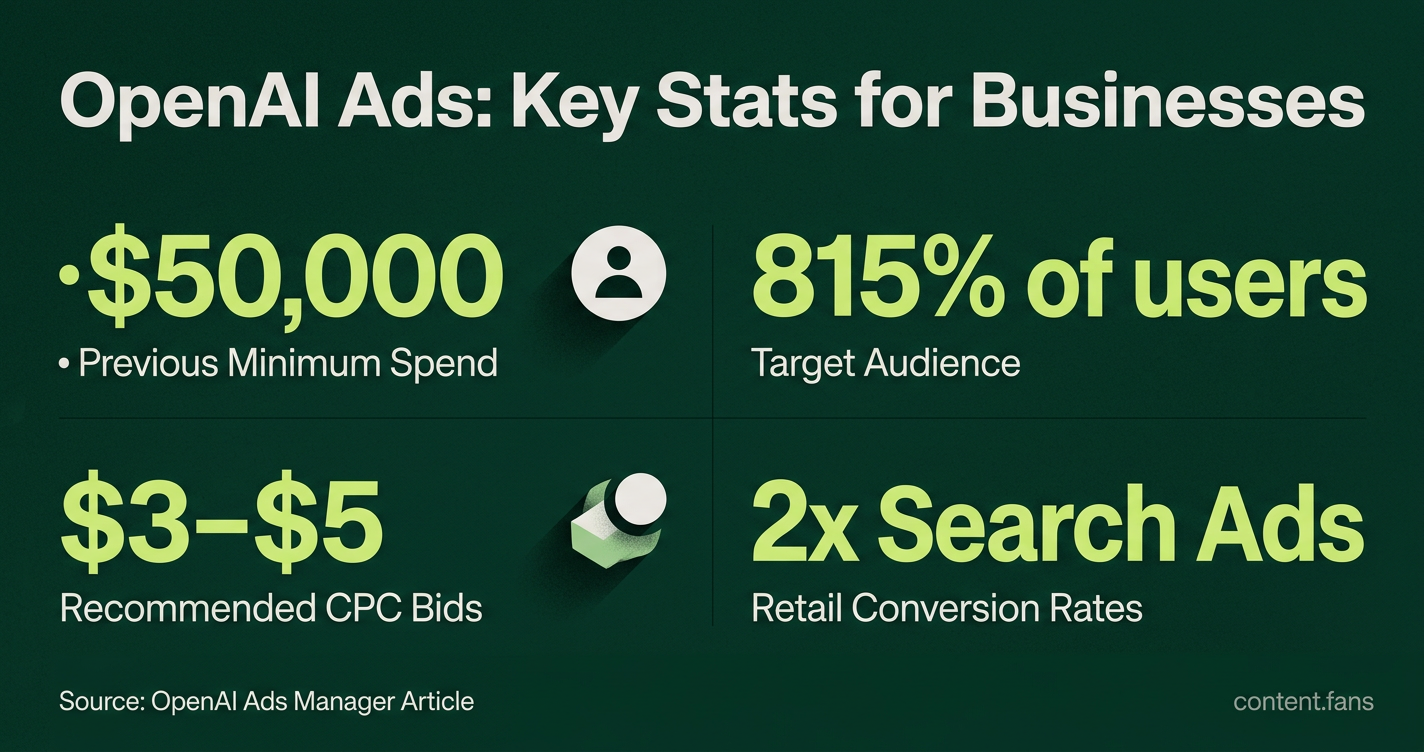
By eliminating the previous $50,000 minimum spend, OpenAI now provides a direct advertising path for small and medium-sized businesses to reach the platform's free and Go users. According to Reuters, this audience constitutes about 85 percent of the service's user base. Paid Pro, Business, and Enterprise accounts will continue to be ad-free.
This guide details the key product changes, early performance data for advertisers, and the competitive landscape for conversational ads.
OpenAI Ads Manager: Key Product Details
The OpenAI Ads Manager self-serve platform allows U.S. businesses to run cost-per-click (CPC) ads within ChatGPT conversations. By removing its previous minimum spend, OpenAI has made the platform accessible to small and medium-sized businesses, who can now target the platform's free and Go-tier users.
- Auction Model: CPC auction with recommended starting bids of $3-$5. Legacy $60 CPM inventory remains available.
- Measurement: The platform provides an OpenAI Pixel and a server-side Conversions API to track results. Advertisers can download aggregated reports with metrics like impressions, clicks, CTR, CPC, and conversions (OpenAI Help Center).
- Ad Placement: Ads are shown exclusively to users on the free and Go tiers. They do not appear in paid Pro, Business, or Enterprise accounts.
- Agency Access: Early access partnerships have been confirmed with major agencies including Dentsu, Omnicom, Publicis, and WPP.
First-Year Performance Snapshot
The platform's interface is maturing, with Search Engine Land noting the addition of budgeting and geo-targeting controls. While advertisers can see total impressions, clicks, and spend, all data remains aggregated to protect user privacy; individual conversation logs are not accessible.
Industry reports suggest that many brands are seeing promising performance metrics, with some campaigns achieving strong click-through rates. Furthermore, some industry reports suggest conversion rates in retail can be nearly double those of traditional search ads, though these are external benchmarks, not official OpenAI case studies.
The Competitive Landscape for Conversational Ads
- Google is testing ad placements in Gemini and AI Overviews, integrating them with its powerful search marketplace.
- Microsoft leverages its existing ad stack to display Sponsored Answers within the Bing-powered Copilot chat.
- Perplexity has experimented with native ads and affiliate links, with industry reports suggesting varying approaches to monetization across the conversational AI space.
- Anthropic is positioning its AI assistant, Claude, as a trust-focused, ad-free alternative.
This expansion is seen by analysts as critical for OpenAI to meet its ambitious revenue goals. This change could be important for OpenAI's goal to make more money from ads. Industry reports suggest strong early demand for the platform's advertising inventory.
Looking ahead, OpenAI's roadmap prioritizes enhancing its performance tools while maintaining user privacy through data aggregation. Whether this strategy can effectively compete with the granular targeting of Google and Microsoft remains an open question, but the launch of self-serve access has undeniably shifted the focus of digital advertising from keywords to conversations.
What exactly changed on May 5, and how does this affect small businesses?
OpenAI quietly dropped the $50,000 minimum spend that once walled off its ChatGPT Ads Manager. Any U.S. business that can pay with a credit card can now open an account at https://ads.openai.com and start buying impressions inside the ChatGPT conversation stream. The shift replaces a gated, invite-only model with a true self-serve checkout, making the inventory as accessible as Google Ads or Meta Ads for the first time.
How does the new CPC bidding model work, and what should I budget?
Instead of the flat $60 CPM pilot model, advertisers bid cost-per-click. Early observers report starting bids between $3 and $5 for competitive verticals, but you can set a custom max CPC and daily cap inside the dashboard. Budgets can be as low as a few dollars a day; there is no platform-imposed floor. Payment is post-pay: you are charged after the clicks are delivered, so cash-flow risk for small campaigns is minimal.
Which users will see my ads, and which will not?
Free users and ChatGPT Go-tier users will see ads after certain prompts when the system detects commercial intent. ChatGPT Pro, Business, and Enterprise plans remain ad-free, so your impressions do not reach paying power users. Roughly 85 percent of the total ChatGPT audience is addressable, although frequency is capped to preserve user experience.
How do I measure results, and what metrics are available?
OpenAI gives every advertiser the OpenAI Pixel (JavaScript snippet) and a server-side Conversions API. Once either is installed, the Ads Manager dashboard surfaces:
- Impressions, clicks, spend
- CTR, average CPC, average CPM
- Conversions (purchase, lead, sign-up, booking) attributed to the click
Important limitation: all data are aggregated; you will not see individual conversations or user-level paths. For deeper funnel analysis, pipe the Conversions API into your own BI stack.
How big could this channel become for my business and for OpenAI itself?
Industry reports suggest strong early adoption and revenue growth for the pilot program. Analyst models suggest that if OpenAI monetizes even half of its 800 million monthly active users at Meta-like revenue-per-user levels, the platform could generate significant annual revenue. Industry reports suggest ambitious revenue targets for OpenAI's advertising business in the coming years. The wildcard is scale from small and medium-sized advertisers now entering the market for the first time without minimum spend hurdles.