
OpenAI: 99.8% of output tokens come from agents by 2026
Serge Bulaev
A study suggests that by 2026, almost all work done by OpenAI employees may go through automated agents, with 99.8% of output tokens coming from these systems. The use of agents started with engineers, but quickly spread to other departments like legal and finance, where most output now also comes from agents. Employees appear to trust agents with complex and lengthy tasks, and many run several agents at once. The study notes that knowing the business is more important for using agents well than knowing how to code. However, there may be concerns about data security and system complexity as agent use increases.

The adoption of AI agents at OpenAI has accelerated dramatically, with a joint study projecting that 99.8% of weekly output tokens generated inside OpenAI come from the Codex agent platform as of June 2026. Researchers from OpenAI and academic institutions tracked internal use of the Codex agent platform, revealing a fundamental shift in the company's operating model. Data shows nearly all employees now rely on agents for daily work, with 97.9% of staff using Codex and routing tasks through it instead of conventional software openai.com/index/how-agents-are-transforming-work.
How usage spread beyond engineering
While engineers were early adopters, AI agent usage grew fastest in non-technical departments. Teams with heavy documentation and compliance needs, such as Legal, Recruiting, and Finance, quickly integrated agents into their workflows, driving the platform's widespread adoption across the organization and signaling a cross-functional operational shift.
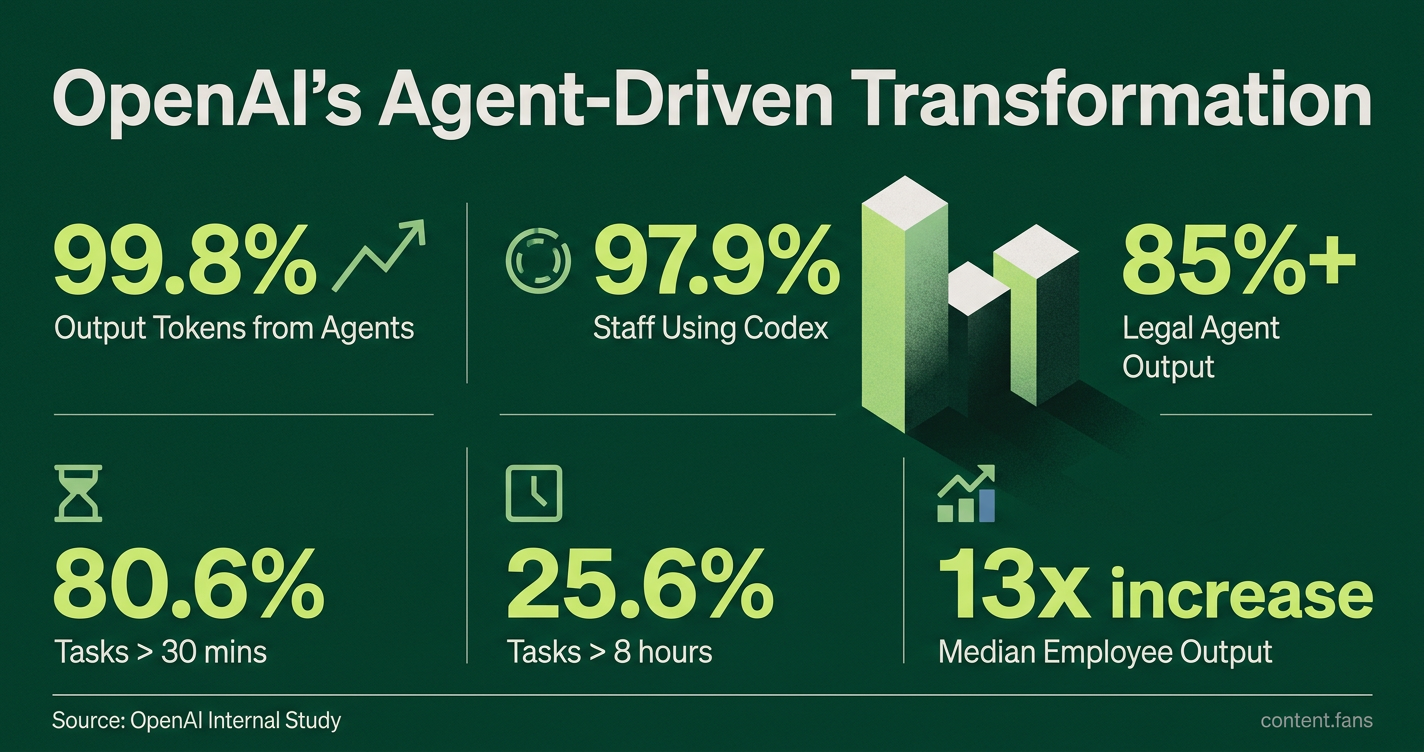
Although engineers were the initial users, the most rapid growth occurred in departments with significant document and compliance responsibilities. By June 2026, Legal and Recruiting teams crossed the majority-use threshold, with lawyers generating over 85% of their output tokens via agents investing.com/news/stock-market-news/openais-agent-tool-sees-rapid-adoption-across-departments-93CH-4761326. Finance teams adopted the technology shortly after, utilizing Codex for automated dashboard creation and recurring analysis.
The study also measured a significant increase in the complexity and duration of tasks delegated to agents, indicating a high level of employee trust in the systems:
- 80.6% of users initiated requests that would take a human more than 30 minutes to complete.
- 25.6% of users delegated tasks estimated at eight hours or longer.
This data shows employees are using agents for complex, multi-step projects rather than just simple, quick prompts.
Heavy concurrent usage inside the company
Data reveals that OpenAI employees frequently run multiple agents in parallel, developing a new skill set focused on orchestrating automated workflows. More than 10% of users manage three or more concurrent Codex agents, with 26.6% using skills for complex workflows. The data shows 25.6% of users made requests estimated above eight hours in duration.
This trend from ad-hoc prompts to long-running job orchestration is supported by token data. Codex agents account for 99.8% of weekly output tokens as of June 2026, with output tokens increasing 13x for median employees compared to November 2025. Researchers attribute this explosion in usage to employees providing agents with existing reference materials like policy documents and meeting notes, enabling complex delegation without coding.
Cross-functional examples
The study highlights several powerful cross-functional use cases:
- Legal: Operations teams automated contract assembly and case file transformation, with significant improvements in first-draft preparation time according to industry reports.
- Finance: Analysts used natural language to query internal data sets, eliminating the need for specialized SQL knowledge.
- Customer Support: Non-developer usage rose 137x for individuals and 189x for organizational users, automating routine ticket routing and allowing human staff to focus on complex escalations.
Why domain knowledge matters
A key finding from the research, corroborated by a related Anthropic study, is that domain expertise is more critical for success with agents than programming ability. Non-engineers with deep knowledge of their business processes were often more effective at steering agents than coders with less contextual understanding. Consequently, internal training has shifted to focus on teaching employees how to articulate precise task descriptions and verify agent outputs, rather than on traditional coding.
While the report does not prescribe specific governance models, its authors caution that such rapid, widespread adoption introduces significant challenges. Key concerns include data security, maintaining trust in automated systems, and accurately measuring productivity gains. These findings are echoed by external surveys from firms like PwC and IBM, where enterprise leaders identify data handling and system complexity as primary barriers to adoption.