
OECD: Global Fertility Halves to 2.2, Reshaping Labor and Pensions
Serge Bulaev
The global fertility rate has dropped from about 5.0 children per woman in the 1960s to around 2.2 today, and OECD countries now average just 1.5. Experts suggest that this trend may reshape labor markets and public finances, as fewer babies mean more older people compared to workers. Reasons for lower fertility include higher education and work opportunities for women, later childbirth, high costs of housing and childcare, more birth control, and changing attitudes toward family. No single cause explains this change everywhere, but the effects may already be visible in pensions, economic growth, and regional differences.

A dramatic drop in global fertility rates, a trend highlighted by the OECD, is poised to fundamentally reshape labor markets and public pensions. While discussions of falling birth rates can seem abstract, analysis like The Great Depopulation - Derek Thompson on global birth-rate decline confirms a clear reality: nearly every country is experiencing a decline in births.
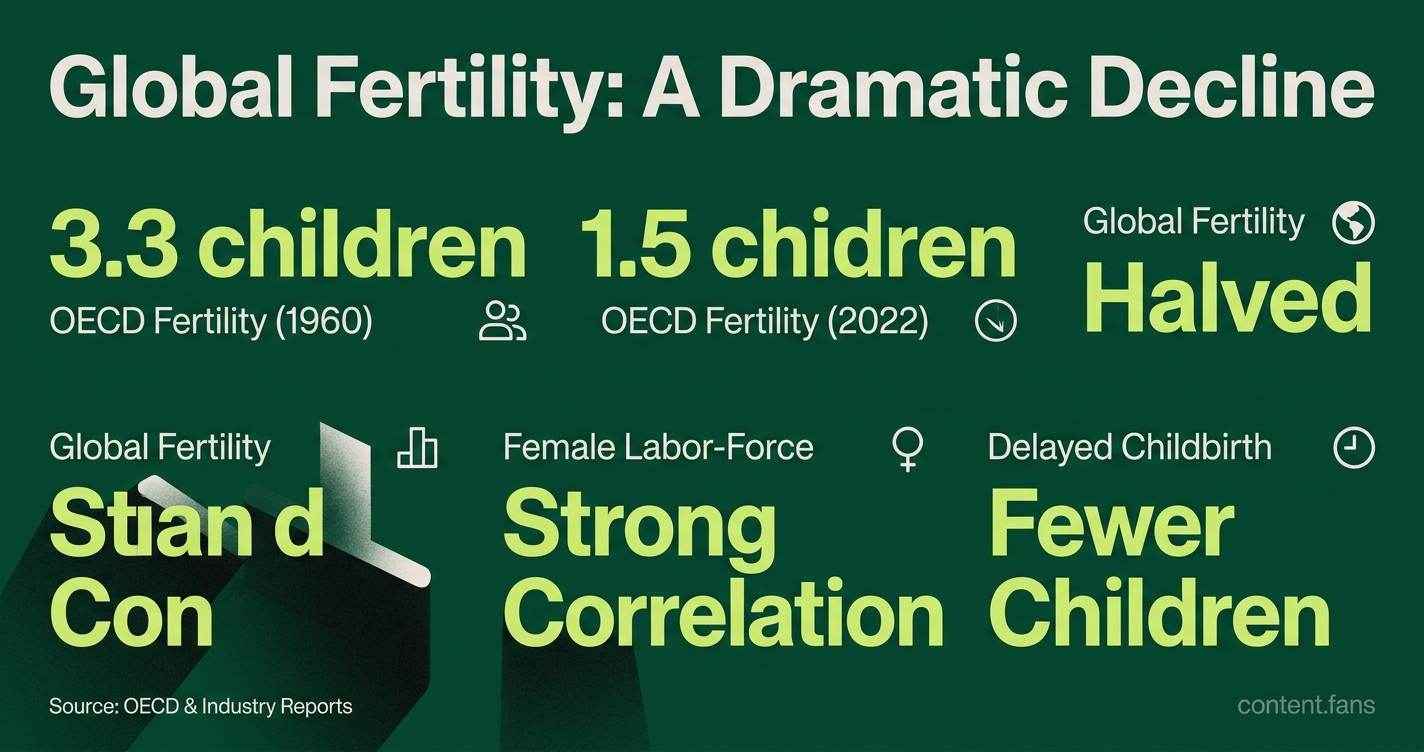
This trend represents a long-term demographic slide. The OECD reports its member average fell from 3.3 children per woman in 1960 to just 1.5 in 2022. On a global scale, industry reports indicate fertility rates have declined significantly from levels seen in the 1960s. While no single cause applies universally, the pattern is strong enough to alter economic forecasts and social structures worldwide.
Policymakers, employers, and investors are now closely tracking how smaller generations will raise dependency ratios and pressure public finances. Concurrently, researchers are examining the complex interplay of personal choice, economic costs, and policy design that continues to drive fertility rates lower.
Key Drivers of Global Fertility Decline
Economists point to a convergence of factors driving lower global fertility. Key drivers include greater educational and career opportunities for women, the trend of delaying childbirth, rising housing and childcare costs, and wider access to contraception, all of which combine to shift personal choices and societal norms.
Economists group the causes into several overlapping categories:
- Education and Career Opportunities: Analysis from Our World in Data shows a strong correlation between rising female labor-force participation and lower fertility, as the opportunity costs of parenthood increase.
- Delayed Childbirth: Medical research published in PMC confirms that delaying first births, a growing trend, often results in fewer total children due to a narrowing biological window for fertility.
- High Cost of Living: OECD analysts identify expensive urban housing and direct childcare expenses as significant financial barriers to starting or expanding a family.
- Reproductive Autonomy: UN sources say contraception reduces unintended pregnancies and can help people space or limit births, contributing to family planning decisions.
- Shifting Cultural Norms: Surveys highlighted by the Economics Observatory reveal changing attitudes toward marriage and ideal family size, particularly within high-income countries.
The OECD emphasizes that these drivers are not isolated; they interact and compound over an individual's life, shaping decisions about family formation.
The Economic and Social Consequences of Falling Birth Rates
- Shrinking Labor Supply: The Congressional Budget Office projects that without immigration, the U.S. population would face significant demographic challenges in the coming decades, leading to a smaller pool of new workers entering the economy.
- Pension System Strain: Government reports indicate Social Security faces projected funding challenges linked to slower workforce growth and increased longevity, with significant implications for future benefit coverage.
- Slower Economic Growth: The IMF supports that aging populations can reduce labor contribution and slow growth, with countries experiencing rapid fertility declines facing substantial demographic shifts that could impact per-capita economic output.
- Regional Divergence: While sub-replacement fertility is now the norm across the OECD, fertility rates in parts of sub-Saharan Africa remain above 3.5, highlighting a significant global demographic divergence.
Policy Responses to Demographic Change
While pronatalist cash grants often generate headlines, evidence from the OECD indicates that policies addressing the practical costs of raising children are more effective. Successful strategies often bundle paid parental leave, universal early-childhood education, and childcare subsidies.
Immigration is another key component of policy discussions. As The Economics Observatory points out, attracting foreign workers can offset workforce decline, although it is not a complete solution to population aging.
Finally, retirement reform remains a central focus. Experts in Travelers Institute webinars highlight solutions like phased retirement, raising the retirement age, and investing in lifelong learning to extend the productive careers of older workers.
Key Fertility and Demographic Indicators: A Snapshot
| Indicator | 1960s value | Recent trends | Source |
|---|---|---|---|
| Global fertility rate | significantly higher | substantial decline reported | UN DESA |
| OECD fertility average | 3.3 | 1.5 | OECD 2024 |
| US Social Security outlook | - | funding challenges projected | Government reports |
Source data is from official publications from the cited institutions.
Ultimately, the interplay of lower fertility and population aging is a defining demographic shift of our time, with far-reaching effects on everything from interest rates to social infrastructure. The complex policy responses now under consideration reflect the profound and multifaceted nature of this global trend.
What does the OECD say about the global fertility decline and why does it matter?
The OECD reports that average fertility has fallen from 3.3 children per woman in 1960 to just 1.5 in 2022, and broader sources indicate global fertility rates have declined substantially from levels seen in the 1960s. This reshapes labor markets because each new generation entering the workforce is smaller than the one before it, shrinking the working-age share of the population. It also raises the old-age dependency ratio, which means fewer workers must finance pensions and social protection for more retirees in the decades ahead.
Which economic and social drivers are pushing birth rates lower?
Multiple studies converge on a similar set of causes:
- Higher female education and workforce participation raise the opportunity cost of having children.
- Delayed parenthood - often into the 30s - lowers lifetime fertility because fertility declines with age.
- Housing and childcare costs create financial insecurity for young families.
- Urban life, longer commutes, and weaker family-policy support further discourage childbearing.
Together these factors shift social norms and individual preferences away from larger families without any single lever being decisive.
How will labor markets and retirement systems feel the impact in coming decades?
Because today's babies do not enter the workforce for roughly two decades, birth-rate rebounds offer little relief for the near term. Instead:
- The U.S.-born working-age population is projected to shrink over the next decade, and immigration is expected to account for essentially all U.S. population growth through that period.
- Social Security faces significant funding challenges, with government reports indicating substantial gaps between projected revenues and scheduled benefits without additional reforms.
- Economic projections for low-fertility countries show substantial increases in the share of elderly populations, intensifying pressure on pensions and health-care budgets.
Why are pronatalist cash bonuses unlikely to be enough?
OECD evidence indicates that cash transfers alone have mixed results unless they are paired with practical supports such as affordable childcare, paid leave, and family-friendly workplaces. Countries achieving modest fertility rebounds - for example, France and the Nordic states - rely on a bundle of policies rather than one-off incentives. Even the best packages only nudge rates closer to replacement, so policy makers are cautioned not to view higher births as a near-term labor-supply solution.
What policy mix are experts recommending for the coming decades?
Given the slow feedback loop of fertility, analysts advocate a balanced approach:
- Later retirement ages and higher labor-force participation, especially among older workers and women.
- Targeted immigration to slow workforce shrinkage without eroding social cohesion.
- Pension and tax reforms to keep systems solvent as dependency ratios rise.
- Housing, childcare, and flexible work reforms to remove practical barriers to family formation.
Together these measures address both demographic reality today and long-term economic sustainability, offering a more reliable path than hoping for a sudden baby boom.