
Netwrix's 2026 Report: AI Agents Create a 43% Breach Gap
Serge Bulaev
Netwrix's 2026 report suggests that organizations using AI agents see a higher breach rate - 43 percent - compared to 11 percent for those without expanded AI access. This increase may be due more to weak identity management than flaws in the AI models themselves. Many companies reportedly do not fully monitor or control AI agents and service accounts, making it hard to tell agent activity from human actions. The report recommends better real-time monitoring and automated permission removal to keep up with fast-moving AI agents. Analysts believe that managing identity properly might help reduce risks from autonomous systems, but most companies have not yet put these practices in place.

According to the 2026 Netwrix Data and Identity Security Report, organizations where AI significantly expanded the number of identities requiring access faced a 43% breach rate, compared to 11% where AI had not materially changed access patterns (Netwrix press release). This fourfold "breach gap" is not caused by flawed AI models but by critical failures in identity governance, as security teams struggle to manage the explosive growth of non-human identities. These agents operate at machine speed, overwhelming legacy controls and creating a significant mismatch between static security policies and dynamic automation.
Why AI agents inflate identity inventories
AI agents dramatically increase risk by creating thousands of unmonitored non-human identities that operate with privileged access. These autonomous accounts move at machine speed, making them difficult to track with traditional security tools, which often cannot distinguish their activity from that of human users.
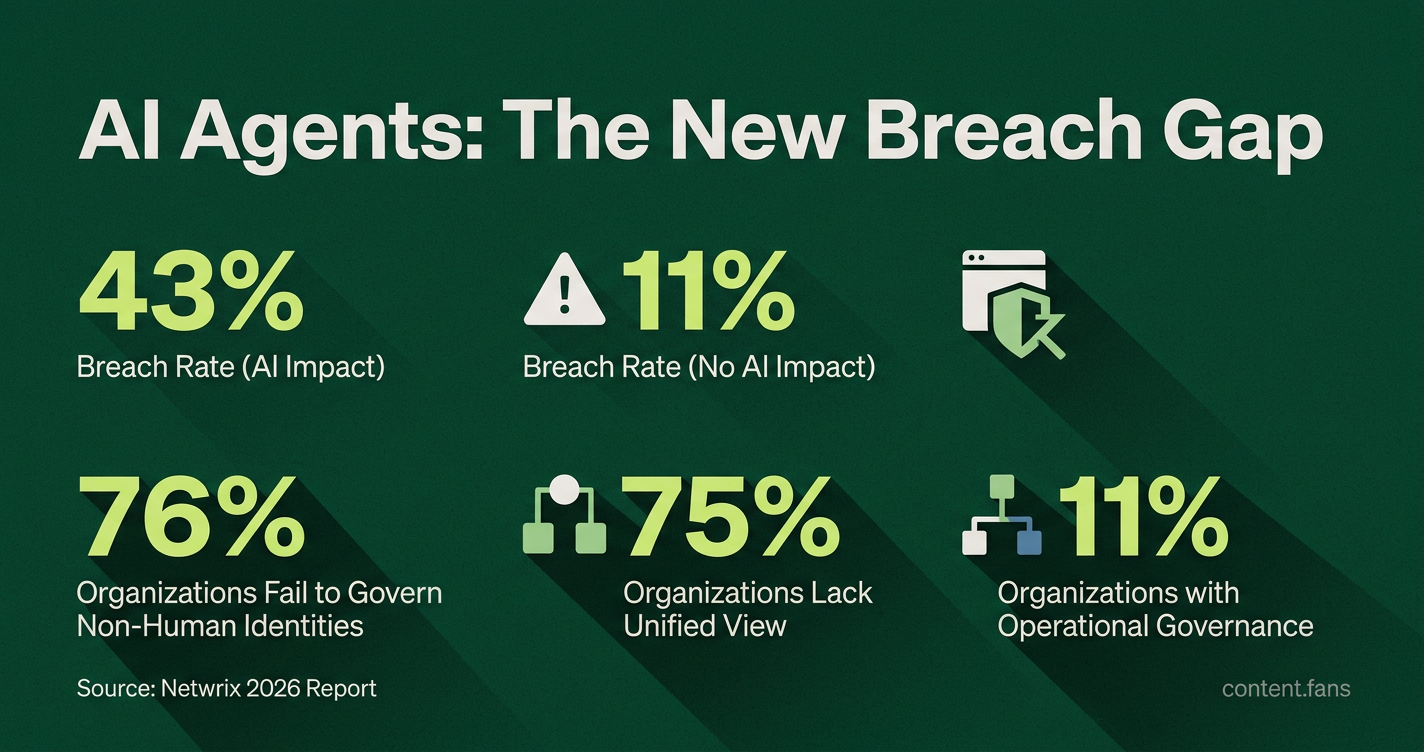
The Netwrix report highlights that 76% of organizations fail to fully govern or monitor non-human identities, and 75% lack a unified view connecting these identities to sensitive data. Since agents often authenticate through the same directories as people, each new workflow can create persistent credentials that outlast their purpose. Reinforcing this finding, industry reports indicate that many companies cannot distinguish agent activity from human logons in their core directories. This lack of visibility allows attackers to impersonate dormant agents, escalate privileges, and move laterally undetected.
Key governance gaps highlighted in the reports include:
- Unmonitored non-human identities that hold privileged tokens
- Slow revocation processes that leave standing access in place for days
- Blind spots created by siloed teams managing identity and data separately
- Shadow AI deployments launched without security review
What the 2026 report proposes
To counter this threat, Netwrix recommends a fundamental shift from periodic access reviews to a model of continuous enforcement. The report outlines three primary focus areas for organizations:
- Unified visibility - Integrate identity telemetry with data-access logs to expose misconfigurations in real time.
- Machine-speed revocation - Automate the removal of permissions to match the speed of agentic workflows.
- Non-human identity governance - Treat every agent, service account, and script as a first-class identity with a clear owner, purpose, and time-bound scope.
The report reveals a significant adoption hurdle: only 11% of surveyed organizations have operationalized such governance, indicating that most still treat identity as a secondary control rather than the primary defense layer for AI.
Early playbooks emerging across the industry
Industry practitioners are already developing pragmatic playbooks. According to security experts, organizations can take immediate steps without waiting for complete platform overhauls:
- Create a central registry of every AI agent, including shadow tools.
- Replace shared API keys with single-use, short-lived tokens issued through existing identity providers.
- Enforce just-in-time privilege grants instead of permanent roles.
- Instrument agents with tamper-evident logging and behavioral analytics.
- Align IAM, data security, and DevOps teams around a one-page AI identity policy.
While adopting these measures may not close the entire security gap, analysts believe they are critical for tightening the blast radius if an agent is hijacked. The collective research implies a definitive shift: identity governance, not just algorithmic safety, is becoming the central control plane for managing autonomous systems.