
Odyssey raises $310M Series B for AI world models
Serge Bulaev
Odyssey has raised $310 million in a Series B funding round, giving the company a reported valuation of $1.45 billion. This is one of the largest early growth rounds so far in 2026. The company has not shared clear product timelines, but the new money may be used to hire more people, buy more computing power, and build business partnerships. Investors appear confident, possibly because the founders have experience in self-driving technology. The large size of this round suggests strong investor interest in AI companies that are building big model platforms.

Odyssey has raised a significant Series B funding round for its AI world models, cementing its status as a major player in generative AI. This capital infusion represents a substantial early-growth deal, positioning the Palo Alto lab to accelerate the development and commercialization of its advanced simulation platform.
What does Odyssey build and why does it matter?
Odyssey is a Palo Alto-based AI lab developing world models, which are large-scale generative simulators capable of predicting how real-world environments evolve. Led by veterans from the self-driving car industry, the team applies its expertise in complex systems to a cloud platform for creating photorealistic, interactive environments on demand for industries like film, gaming, and robotics.
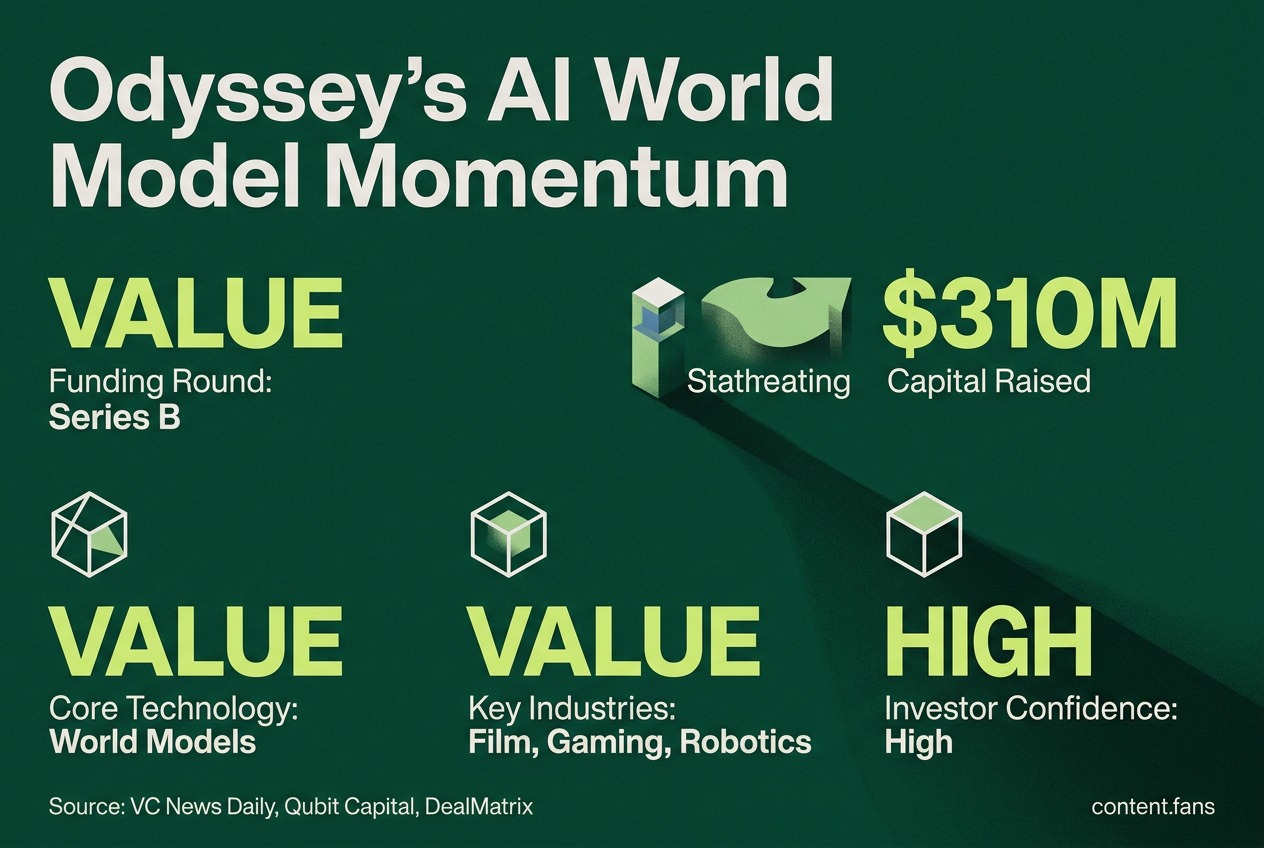
Odyssey secured substantial funding in a Series B financing round, achieving a significant post-money valuation. This places it among a growing number of AI companies to raise mega-rounds, signaling strong investor confidence in its world model platform.
How significant is the Series B in the current market?
The round is exceptionally large, even for the current AI funding landscape. According to industry reports, Odyssey's investment places it in an elite cohort of companies that have raised substantial amounts at the Series B stage. This group includes companies across various sectors:
- Valar Atomics - raised significant funding, per Qubit Capital's April 2026 roundup.
- Saviynt - substantial funding for AI-cybersecurity.
- Castelion - significant investment in aerospace-defense.
- Lovable - major funding for its "vibe-coding" platform, as listed by DealMatrix.
- Black Forest Labs - substantial funding at a significant valuation, according to the same DealMatrix data.
Securing this level of capital highlights investor conviction in the technology's scalability and the vast potential market.
Who is backing the round and why are they confident?
While the full syndicate remains undisclosed, the deal was reported by VC News Daily as a recent first-close, with more strategic partners expected to join. Investor confidence appears to be rooted in three key factors:
- Founder Pedigree: The leadership team has direct experience shipping production-grade world models for self-driving fleets, providing a significant advantage in data strategy and handling edge cases.
- Differentiated Data Flywheel: The platform is designed so that each customer's use feeds new, diverse scenarios back into the core model, progressively improving realism and reducing hallucinations.
- Large, Expandable Market: Successful pilots in Hollywood pre-visualization, AAA game development, robotics training, and ADAS simulation confirm strong cross-industry demand.
How will Odyssey use the new capital?
Following patterns of other large-scale AI infrastructure companies, the funding will likely be allocated to three core areas:
- Compute Expansion: Significantly increasing H100/H200 cluster capacity to train more powerful multi-modal foundation models that process video, LiDAR, radar, and text data.
- Go-to-Market Teams: Building out a global team of solution architects and partnership managers to scale the traction already seen in early Fortune 100 pilots.
- Vertical-Specific SDKs: Developing pre-packaged APIs for virtual production, synthetic data generation, and embodied agent training to reduce customer integration times from weeks to days.
This funding provides substantial runway, positioning Odyssey for potential future growth milestones or additional funding rounds if revenue growth accelerates.
What metrics will signal long-term success?
Beyond the initial funding announcement, several key performance indicators will signal whether Odyssey is translating its capital advantage into market leadership:
- Annual Recurring Revenue (ARR): Achieving significant ARR growth would validate the company's commercial strategy and put it on a clear path to substantial valuation increases.
- Simulation Accuracy: Publishing benchmarks that demonstrate meaningful improvement in key downstream tasks (like robot grasp success or ADAS collision avoidance) over existing simulators.
- Customer Diversification: Ensuring broad industry adoption across multiple verticals, which would prove the platform's horizontal applicability.