
Nvidia's Kumo AI buy means new lock-in risks for enterprise CIOs
Serge Bulaev
Nvidia's purchase of Kumo AI for at least $400 million may make it harder for companies to switch away from Nvidia products. Analysts suggest this deal could lead to more bundled hardware and software, quicker setups, but also higher costs and contract complexity for buyers. CIOs now face a choice between relying more on Nvidia or keeping options open with other vendors. There may be benefits like faster deployment, but risks include getting locked in and facing higher prices later. Experts suggest companies should check contracts carefully and plan for flexibility in the future.

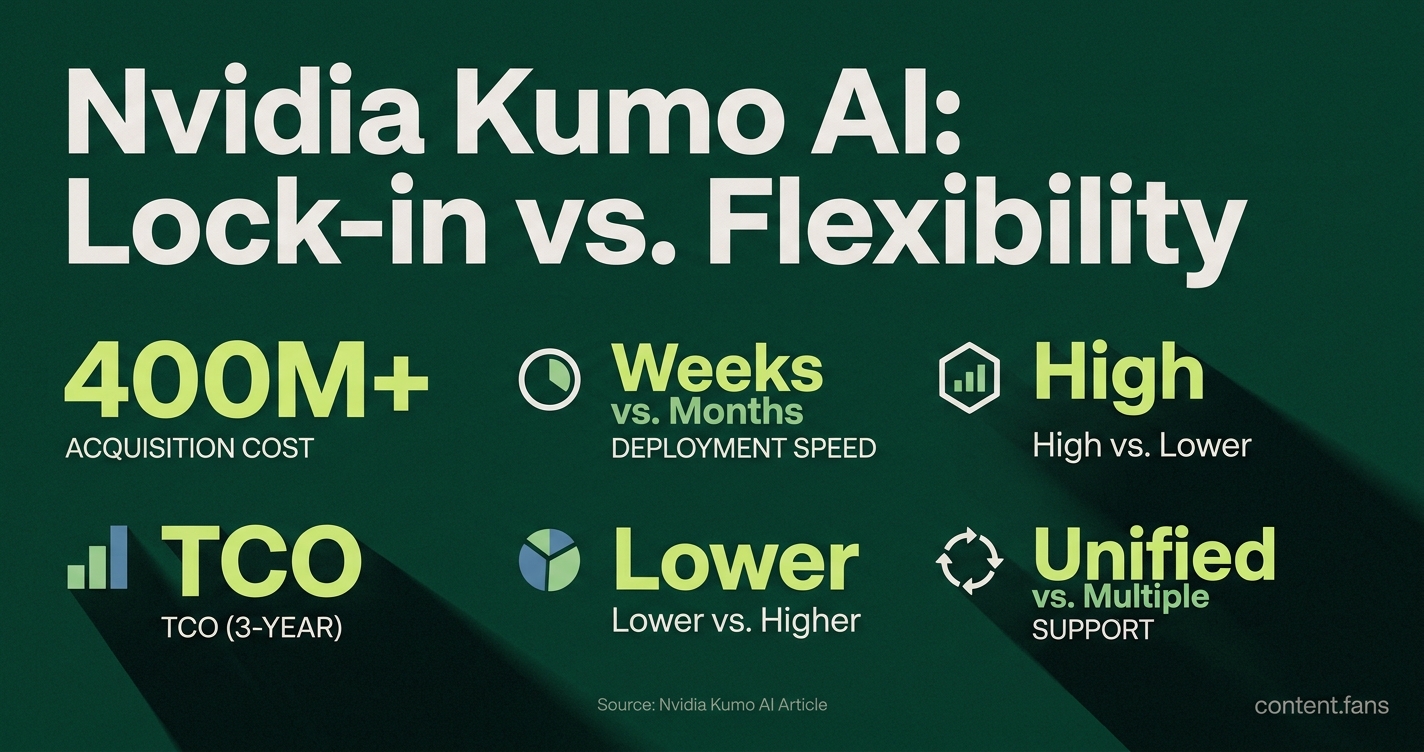
Nvidia's Kumo AI buy, a deal reportedly worth at least 400 million, marks a pivotal moment for enterprise AI strategy. As the GPU leader moves up the software stack, CIOs face a critical choice: embrace a vertically integrated Nvidia ecosystem for faster deployment, or preserve a multi-vendor strategy to mitigate lock-in and maintain negotiation leverage.
How Will the Kumo AI Deal Change AI Procurement?
The acquisition moves Nvidia further up the software stack, creating a more integrated yet proprietary ecosystem. Enterprises should anticipate bundled hardware-software offerings that accelerate deployment but also increase dependency on Nvidia, potentially leading to higher long-term costs and significant vendor lock-in.
The key procurement shifts include:
- Bundled Pricing: Expect Kumo models pre-tuned for CUDA to be sold as a single GPU-plus-software line item, replacing individual component pricing.
- Increased Lock-In Risk: Model layers optimized for Nvidia hardware will significantly raise the effort and cost of migrating to alternative accelerators in the future.
- Faster Time-to-Value: As noted by Lets Data Science, pre-built Kumo connectors for platforms like Snowflake and Databricks could reduce integration timelines.
- Greater Contract Complexity: RFPs must now include stringent clauses covering data portability, egress fees, and software version deprecation policies.
How Should CIOs Decide Between Nvidia-Centric vs. Multi-Vendor Stacks?
This framework helps map the trade-offs between committing to Nvidia's stack versus maintaining a heterogeneous, multi-vendor environment.
| Criterion | Nvidia-centric stack | Heterogeneous approach |
|---|---|---|
| Performance need | Highest for large-scale training | Adequate for inference or R&D |
| Deployment speed | Weeks if workloads align with CUDA | Months due to extra integration |
| Concentration risk | High if capacity outages occur | Lower but spreads talent thin |
| Talent impact | Leverages existing CUDA skill base | Demands ROCm and framework-agnostic skills |
| Three-year TCO | Lower integration cost, higher exit cost | Higher integration cost, easier renegotiation |
What Are the Core Cost vs. Benefit Trade-Offs?
Benefits:
- Faster Deployment: Pilot projects can be accelerated through native CUDA optimizations.
- Unified Support: A single support channel for both hardware and software issues simplifies incident resolution.
Risks:
- Price Escalation: Industry reports suggest many executives fear significant price hikes after initial incentive periods expire.
- Proprietary Formats: The use of proprietary prompt formats can complicate future migrations to other platforms.
What's on the Technical Integration Checklist for Kumo AI?
- Confirm whether Kumo APIs remain open or migrate to Nvidia Enterprise licensing.
- Map data flows to ensure warehouse traffic stays cloud-neutral.
- Benchmark full-cluster throughput, not single GPU metrics.
- Validate that observability hooks are in place for governance and audit trails.
- Document a fallback plan in case Kumo models are re-priced or retired.
Key Questions to Ask Nvidia During Vendor Evaluations
- Can tuned Kumo models export weights or metadata in portable formats such as ONNX?
- What are the exit penalties if the enterprise shifts 30 percent of inference to alternate silicon within three years?
- Does the vendor commit to service-level remedies for cluster-wide outages, not just GPU uptime?
- How will data sovereignty be preserved if models run in multiple clouds?
Tactical Recommendations for Architecture Teams
- Separate training and inference clusters whenever possible.
- Keep logs, prompts, and fine-tuning data in an internal repository to ease re-platforming.
- Review vendor concentration thresholds annually and trigger competitive bids if one provider exceeds them.