
NVIDIA Unveils RTX Spark AI PCs With 1 Petaflop Power
Serge Bulaev
NVIDIA has introduced a new type of AI PC called RTX Spark, which may reach up to 1 petaflop of computing power in devices the size of a typical gaming laptop. These systems combine a Grace CPU with a Blackwell GPU and can support up to 128 GB of unified memory, which might allow users to run much larger AI models on their own device. RTX Spark comes with special security features like session isolation and strict permission controls through the NVIDIA OpenShell software. Release dates are still vague, but NVIDIA says these PCs will be available in the fall, with details about pricing and full performance still to come.

NVIDIA is set to redefine on-device processing with its new RTX Spark AI PCs, a category delivering up to 1 petaflop of peak FP4 throughput in a standard laptop chassis. This performance leap marks a significant advancement over current 40-50 TOPS AI PCs.
Hardware Snapshot
RTX Spark combines a Grace CPU with a Blackwell-class GPU, delivering performance NVIDIA equates to a GeForce RTX 5070 laptop GPU. With up to 128 GB of unified memory, these systems are designed to run large AI models locally, offering a significant upgrade over existing consumer notebooks.
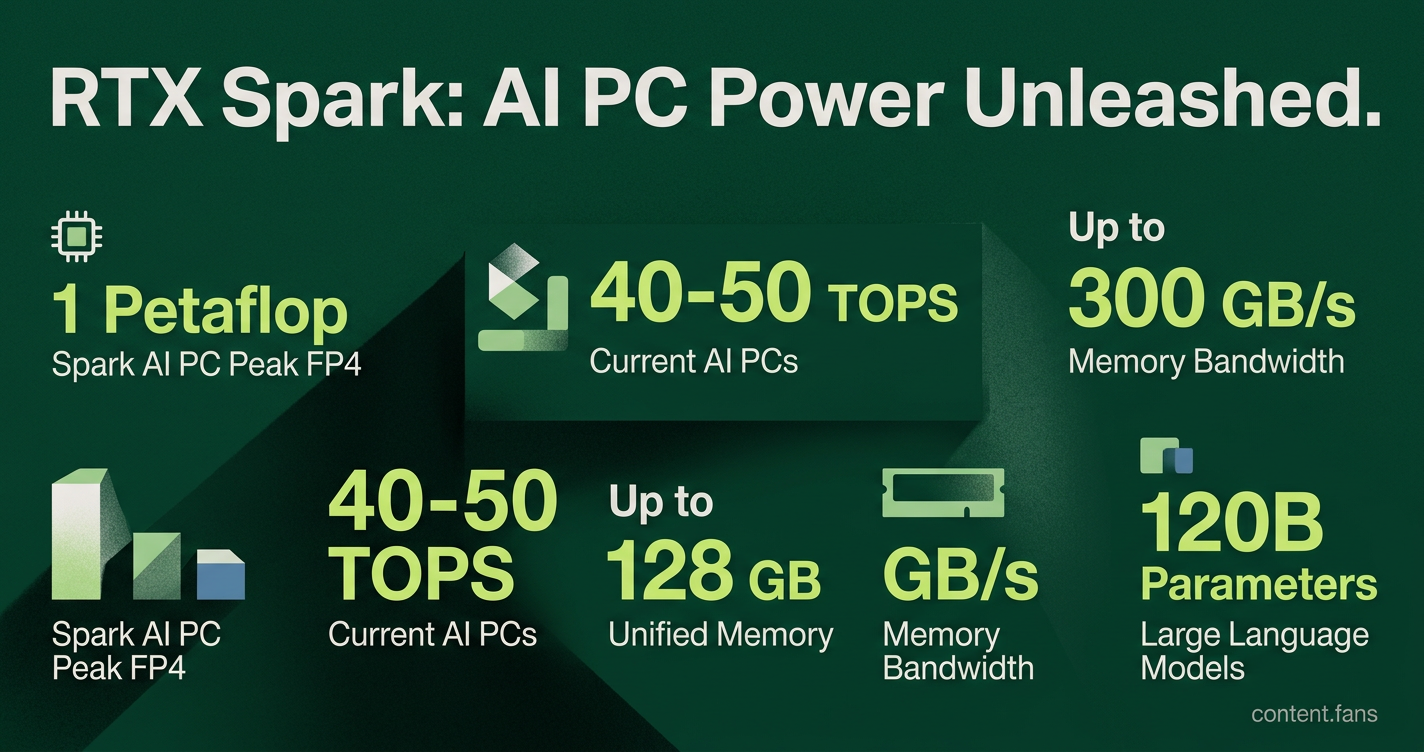
The platform's headline 1,000 TOPS figure and massive memory capacity could enable on-device execution of 120-billion-parameter language models with context windows of up to one million tokens. While its measured memory bandwidth of 300 GB/s for the top configuration trails professional workstations, it is a substantial improvement for consumer laptops. As pricing is not yet public, analysts currently view Spark as a reference design rather than a specific product.
Security Model and Software Stack
To protect user data from local AI models, RTX Spark integrates NVIDIA OpenShell, an open-source runtime designed to isolate each agent session. According to its GitHub documentation, OpenShell provides sandboxed execution, deny-by-default policies for file and network access, and scoped credential injection. The current security stack is Linux-native, leveraging seccomp and Landlock LSM. Since Windows integration details are pending, early systems may operate the runtime within a Linux container until native support is available.
Key security controls include:
- Sandboxed sessions with granular policy controls for files, network, and processes
- A declarative permission model to prevent data exfiltration by default
- Hot-reloadable rules for network traffic and inference routing
- Experimental GPU passthrough for secure, accelerated workloads
Performance Positioning
RTX Spark is positioned as a bridge technology between standard AI PCs and professional workstations. While it delivers a headline 1 petaflop of performance, far exceeding the 40-50 TOPS of current laptops as noted in a Phemex report, its primary advantage is memory capacity, not raw speed. For instance, a high-end RTX PRO 6000 Blackwell workstation GPU provides significantly more memory bandwidth (1.79 TB/s).
Consequently, RTX Spark's large unified memory pool is expected to be most valuable for developers working with long-context language models, advanced image generation, or large multimodal inputs that exceed the VRAM of typical consumer GPUs. However, workloads sensitive to memory bandwidth, such as rendering and scientific computing, will likely still perform better on traditional workstation hardware.
Market Rollout Outlook
According to industry reports, partner devices including 14-16 inch laptops and ultra-efficient desktops are slated for a fall release from major OEMs. With no official MSRP, original equipment manufacturers (OEMs) are expected to offer various configurations tailored to different memory sizes and thermal envelopes. Consequently, industry observers predict a staggered launch, with premium, high-memory models possibly arriving after the initial wave. A definitive assessment of RTX Spark's value will depend on official benchmarks from final retail units.
What exactly is NVIDIA RTX Spark and how does it differ from today's AI PCs?
RTX Spark is a new Windows PC category built for local personal agents and creative AI workflows. Instead of relying on the cloud, it puts up to 1 petaflop of AI performance directly on the device, adds up to 128 GB of unified memory, and bundles Windows security primitives with NVIDIA OpenShell. Current AI PCs hover around 40 - 50 TOPS; RTX Spark is marketed closer to 1,000 TOPS, effectively giving you the power of a GeForce RTX 5070 laptop GPU inside the chassis.
When can I buy an RTX Spark system and who is making it?
According to industry reports, NVIDIA has announced the lineup and says shipments will begin from major OEMs including ASUS, Dell, HP, Lenovo, Microsoft Surface and MSI. Additional manufacturers are expected to follow shortly after. No official retail price has been announced yet, so expect pre-order pages to open closer to the seasonal launch window.
How does RTX Spark handle security for AI agents running on my device?
Each AI agent runs inside NVIDIA OpenShell, an open-source runtime that enforces sandboxed execution, deny-by-default policies, and credential isolation. By combining Linux kernel isolation with programmable policies, it prevents agents from accessing unapproved files, networks or secrets, all while keeping models and prompts entirely on the device.
What model sizes and context windows can RTX Spark actually run?
According to NVIDIA, the platform supports ~120-billion-parameter LLMs with up to one million tokens of context. The 128 GB of unified memory is the enabler: instead of splitting weights between VRAM and system RAM, the entire model can sit in one pool, cutting latency and simplifying software.
How does RTX Spark compare to a high-end workstation GPU?
Think of RTX Spark as memory-first, not bandwidth-first. The 1 petaflop headline is a peak FP4 figure; sustained speed can be lower because unified memory bandwidth tops out around 300 GB/s. A workstation card like the 96 GB RTX PRO 6000 Blackwell offers 1.79 TB/s of bandwidth and will still win in raw sustained throughput. Where Spark excels is on-device experimentation with larger models that do not fit on workstation VRAM, making it ideal for prototyping and local creative AI workflows without cloud costs.